- Home
- Best Foods for Diabetes and What to Avoid
- Low Glycemic Diet for Diabetes Meal Plan and Food List
Low Glycemic Diet: Foods, Meal Plan, Menu, and Diabetes Benefits
A low glycemic diet focuses on choosing carbohydrate foods that tend to raise blood sugar more gradually rather than rapidly. When combined with appropriate portions, balanced meals, and regular physical activity, this eating pattern can help improve blood sugar control and support long-term diabetes management. This guide explains how a low glycemic diet works, which foods to choose, and how to build practical meal plans.

Written by: Dr. Albana Greca, MD, MMedSc, Family Physician and Medical Author.
Medically reviewed by: Dr. Ruden Cakoni, MD, Endocrinologist.
Last reviewed: July 2026.
Quick Answer
A low glycemic diet emphasizes carbohydrate foods that usually raise blood sugar more slowly, such as beans, lentils, minimally processed whole grains, many whole fruits, and unsweetened dairy foods.
It is not a no-carbohydrate diet, and low GI does not mean that a food can be eaten without limits. Portion size, total carbohydrate, fiber, processing, the rest of the meal, medications, and your personal glucose response all matter.
A low glycemic diet can be a practical way to improve the quality of the carbohydrates you eat. It may help reduce sharp after-meal glucose rises for some people with diabetes, but it should be used as one part of a complete eating plan rather than as a rigid list of “good” and “bad” foods.
The safest approach is to combine lower-GI carbohydrate choices with sensible portions, non-starchy vegetables, protein, healthy fats, appropriate medication, and regular glucose review.
What Is a Low Glycemic Diet?
The glycemic index, usually shortened to GI, ranks carbohydrate-containing foods according to how quickly they raise blood glucose compared with a reference food. Pure glucose is commonly assigned a value of 100.
GI does not measure how many grams of carbohydrate a food contains. It describes the relative speed of the glucose response under standardized testing conditions. This corrects a common misunderstanding: the GI is not simply “the quantity of carbs,” and neither white bread nor table sugar should automatically be described as GI 100.
| GI category | GI value | General meaning |
|---|---|---|
| Low GI | 55 or less | Usually produces a slower glucose rise when the food is tested alone. |
| Medium GI | 56–69 | Usually produces a moderate glucose response. |
| High GI | 70 or higher | Usually raises glucose more quickly when eaten alone. |
GI values can differ between brands and varieties. Ripeness, grinding, processing, cooking time, cooling, storage, and laboratory methods may also change the result. Use a reliable glycemic index chart as a guide rather than treating every number as exact.
Glycemic Index Versus Glycemic Load
The glycemic index does not account for how much carbohydrate you actually eat. Glycemic load, or GL, adds portion size to the picture.
Glycemic load = GI × grams of available carbohydrate in the serving ÷ 100
A small serving of a higher-GI food may have a modest glycemic load, while a very large serving of a low-GI food may still raise blood sugar substantially. This is why our glycemic load guide should be considered together with portion size and total carbohydrate.
Can a Low Glycemic Diet Help Diabetes?
Low-GI or low-GL eating patterns may modestly improve HbA1c and some other cardiometabolic markers when compared with higher-GI patterns. However, the research is complex, and results vary between studies and individuals.
Possible benefits may include:
- A gentler rise in blood sugar after some meals
- Improved meal satisfaction when lower-GI choices are also high in fiber and protein
- Better overall carbohydrate quality
- A modest improvement in glucose control for some people
- Support for weight management when the total eating pattern also controls calories and portions
A low glycemic diet does not cure diabetes, guarantee weight loss, prevent every complication, or replace medication. A person can gain weight on low-GI foods if portions and total calories are too large.
Low GI Does Not Automatically Mean Healthy
GI is only one feature of food. A product may have a lower GI because it contains fat, yet still be high in calories, saturated fat, salt, or added sugar. Conversely, a nutritious food may have a medium or higher GI but still fit into a healthy meal when the portion is controlled.
Before choosing a food, also consider:
- Total carbohydrate per serving
- Fiber and protein
- Added sugars
- Saturated fat and sodium
- Degree of processing
- Vitamins, minerals, and overall nutritional value
- Your own blood sugar response
Our glycemic index food chart can help you compare foods, but the nutrition label and serving size remain essential.
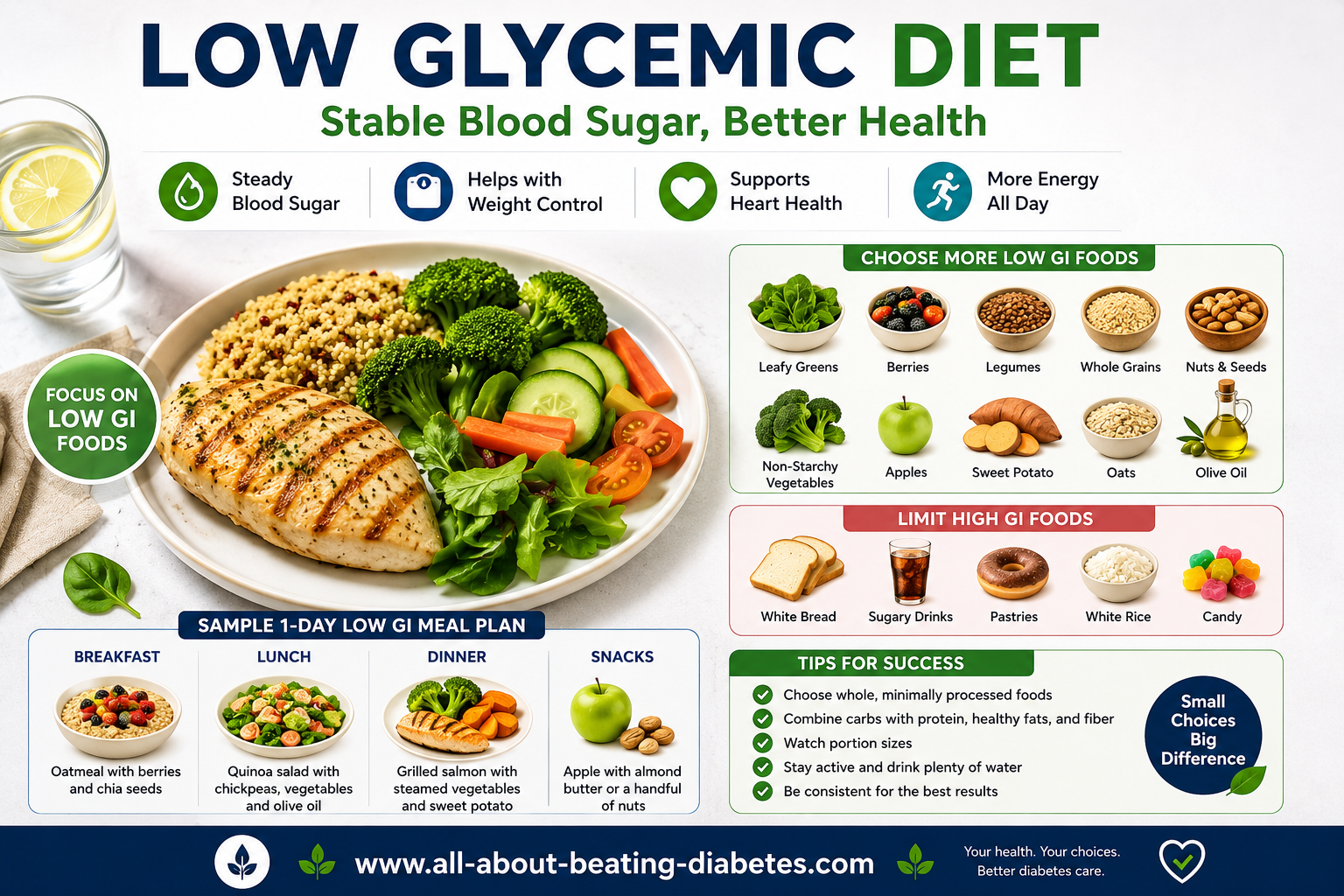
Low Glycemic Foods to Choose More Often
| Food group | Examples | Practical guidance |
|---|---|---|
| Non-starchy vegetables | Leafy greens, broccoli, cauliflower, peppers, cucumber, zucchini | Use generously to build volume, fiber, and nutrients into meals. |
| Legumes | Lentils, chickpeas, kidney beans, black beans | Good sources of fiber and plant protein, but they still contain carbohydrate. |
| Less-processed grains | Barley, steel-cut oats, rolled oats, bulgur, some intact whole grains | Keep portions measured; “whole grain” does not guarantee a low GI. |
| Whole fruit | Berries, apples, pears, oranges, peaches, plums | Choose whole fruit more often than juice and count the carbohydrate portion. |
| Unsweetened dairy | Plain yogurt, Greek yogurt, milk | Check the label because flavored products may contain substantial added sugar. |
| Protein foods | Fish, eggs, poultry, tofu, lean meat | These contain little carbohydrate unless breaded or prepared with sugary sauces. |
| Healthy fats | Olive oil, avocado, nuts, seeds | Helpful in modest portions; they are energy-dense and are not “free foods.” |
For a broader selection, use the low glycemic food list and our guide to lower-GI fruit choices.
Foods to Limit or Combine More Carefully
Foods that often produce a faster rise include refined bread, many sugary breakfast cereals, instant rice, large portions of mashed potatoes, sweet drinks, candy, pastries, and other highly processed starches.
They are not all permanently forbidden. The amount, frequency, and reason for eating them matter. Fast-acting carbohydrate is appropriate when treating hypoglycemia. At ordinary meals, however, higher-GI choices are usually easier to manage when portions are smaller and the meal includes vegetables, protein, or fiber.
Our page on high glycemic index foods explains how to use them more safely without creating unnecessary food fear.
How to Build a Low Glycemic Meal
A simple plate structure is often more practical than calculating the GI of every ingredient:
- Fill about half the plate with non-starchy vegetables.
- Use about one-quarter for lean protein.
- Use about one-quarter for a measured portion of quality carbohydrate.
- Add a small amount of healthy fat when appropriate.
- Choose water or another unsweetened drink.
This structure can be adapted for vegetarian, Mediterranean, South Asian, Middle Eastern, and other cultural eating patterns. It also supports the principles explained in our article about carbohydrates, glycemic index, and blood sugar.
Sample One-Day Low Glycemic Menu
This is a general example, not a prescribed diet or carbohydrate target.
Breakfast: Plain rolled oats with berries, chia seeds, and plain Greek yogurt, or eggs with vegetables and one controlled portion of whole-grain bread.
Lunch: Lentil or chickpea salad with mixed vegetables, olive oil and lemon, plus a small portion of barley, bulgur, or whole-grain bread.
Optional snack: A small apple with a modest portion of nuts, or raw vegetables with hummus.
Dinner: Baked fish, chicken, or tofu with a large serving of non-starchy vegetables and a measured portion of beans, barley, quinoa, or another suitable carbohydrate.
Not everyone needs snacks or the same number of meals. Meal timing should match hunger, medication, insulin, activity, work schedule, and hypoglycemia risk. More ideas are available in our low glycemic recipes and meal ideas.
How Cooking and Food Preparation Change GI
The same food can affect glucose differently depending on preparation:
- Finely ground and highly processed grains are often digested faster.
- Longer cooking may make some starches easier to digest.
- Very ripe fruit may produce a faster response than less-ripe fruit.
- Cooling and reheating some starches may alter their digestibility.
- Protein, fat, and fiber in a mixed meal may slow the glucose rise.
Because people usually eat mixed meals rather than isolated foods, your meter or continuous glucose monitor may provide more useful personal information than a GI number alone.
How to Know Whether the Diet Works for You
When your clinician recommends glucose monitoring, compare similar meals under similar conditions. Record the portion, meal ingredients, medication timing, activity, and glucose before and after eating.
For many nonpregnant adults with diabetes, a common target is below 180 mg/dL one to two hours after the start of a meal, but individual targets vary. Pregnancy, age, kidney disease, insulin use, and hypoglycemia risk may require different goals.
A blood sugar log can help you and your clinician identify which meals produce repeated rises. Our guide to blood sugar levels after eating explains how timing changes the meaning of a result.
Important Safety Note
Changing the amount or timing of carbohydrate can cause low blood sugar if you use insulin, sulfonylureas, or another medicine that can cause hypoglycemia. Do not reduce or skip medication on your own.
Ask for individualized advice if you are pregnant, a child or teenager, underweight, living with kidney disease or gastroparesis, recovering from illness, experiencing frequent low blood sugar, or have a history of an eating disorder.
Doctor’s Note
I advise patients to use GI as a comparison tool, not as the only rule for eating. First look at the whole food, portion, fiber, protein, and total carbohydrate. Then look at your own blood sugar pattern. A balanced meal you can follow consistently is more useful than a perfect GI score that makes eating stressful or restrictive.
Most Asked Questions
Is a low glycemic diet the same as a low-carbohydrate diet?
No. A low glycemic diet focuses mainly on how quickly carbohydrate foods raise glucose. A low-carbohydrate diet limits the total amount of carbohydrate. A food can be low GI and still contain a substantial amount of carbohydrate.
Can I eat fruit on a low glycemic diet?
Yes. Many whole fruits can fit into the plan. Choose a reasonable portion, favor whole fruit over juice, and monitor your personal response. Fruit still contains carbohydrate.
Can I eat low-GI foods without measuring portions?
No. Large portions can produce a high glycemic load and raise blood sugar even when the food has a low GI.
Does a low glycemic diet help with weight loss?
It may help some people feel satisfied and improve food quality, but weight loss depends on the overall calorie balance, portions, activity, sleep, medications, and other health factors.
Is the low glycemic diet useful for type 1 diabetes?
Lower-GI choices may reduce some after-meal glucose peaks, but carbohydrate counting, insulin timing, insulin dose, exercise, and hypoglycemia prevention remain essential. Never replace insulin with diet.
Educational safety note: This article is for general diabetes education only. It does not replace personal medical advice, diagnosis, nutrition therapy, or treatment. Do not start, stop, or change diabetes medicines, insulin, supplements, carbohydrate targets, or weight-loss plans without speaking with your healthcare professional.
Related Questions
- Which Glycemic Index Fruits Can I Eat With Diabetes?
- Does Splenda Have a High Glycemic Index or Affect Insulin?
- Which Foods Are Best for Prediabetes?
- Do People With Type 2 Diabetes Need Strict Food Restrictions?
Related Resources
- Glycemic Index Chart: Low, Medium, and High GI Foods
- Glycemic Index Food Chart for Diabetes
- Low Glycemic Food List
- How to Organize a Low Glycemic Diet Plan
- Low Glycemic Recipes and Meal Ideas
References
- American Diabetes Association Professional Practice Committee. Facilitating Positive Health Behaviors and Well-being to Improve Health Outcomes: Standards of Care in Diabetes—2026.
- American Diabetes Association. Carbs and Diabetes.
- American Diabetes Association. Diabetes Meal Planning and the Diabetes Plate.
- Atkinson FS, Brand-Miller JC, Foster-Powell K, Buyken AE, Goletzke J. International Tables of Glycemic Index and Glycemic Load Values 2021.
- Chiavaroli L, et al. Effect of Low Glycaemic Index or Load Dietary Patterns on Glycaemic Control and Cardiometabolic Risk Factors in Diabetes: Systematic Review and Meta-analysis.