- Home
- Vitamins and Supplements for Diabetes
- Saw Palmetto and Diabetes
Saw Palmetto Berry and Diabetes
Saw Palmetto Berry and Diabetes
Quick Answer
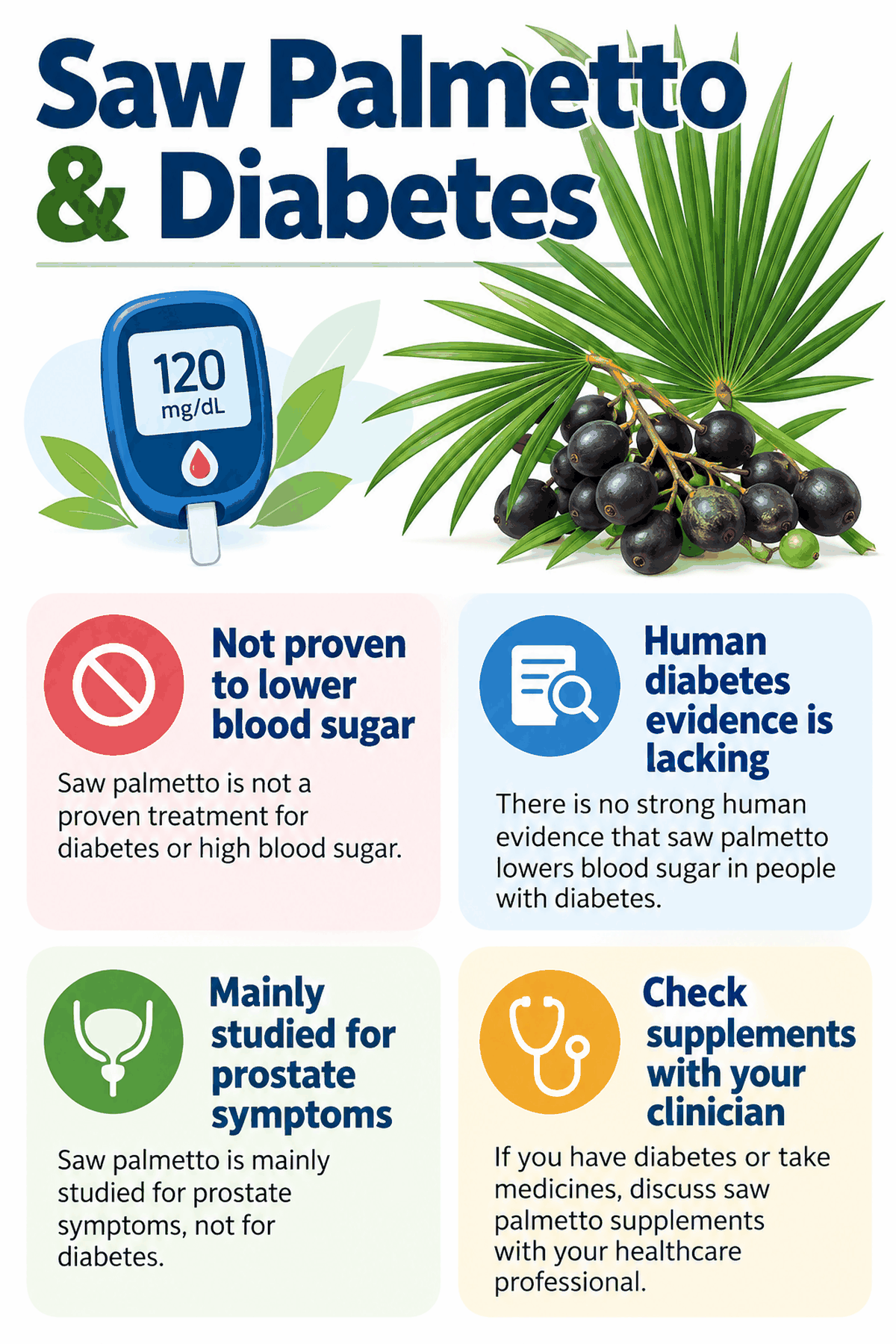
Saw palmetto is not a proven treatment for diabetes and there is no good human evidence that it lowers blood sugar, increases insulin production, or improves insulin sensitivity in people with diabetes. Most clinical research has focused on urinary symptoms related to an enlarged prostate, and high-quality reviews have found little or no benefit when saw palmetto is used alone for typical BPH symptoms.
If you have diabetes and want to take saw palmetto for prostate or urinary symptoms, discuss the exact product with your doctor or pharmacist. Do not replace insulin, metformin, or another prescribed diabetes treatment with a saw palmetto supplement.
Saw palmetto is a plant supplement made from the berries of Serenoa repens, a small palm native to the southeastern United States. It is commonly marketed for prostate health, urinary symptoms, hair loss, and several other conditions.
Because supplement claims can easily overlap with diabetes claims, I want to separate what has actually been studied from what is only theoretical. If you are comparing herbs and supplements, our vitamins and supplements for diabetes guide explains how I evaluate evidence, safety, and interactions before recommending any product.

What Is Saw Palmetto?
Saw palmetto is the common name for Serenoa repens. The berries contain fatty acids and plant sterols, and extracts made from the berries are sold as dietary supplements.
You may also see names such as American dwarf palm or sabal on older products or references. The important point is that different supplements can use different extraction methods and concentrations, so products labeled “saw palmetto” are not necessarily identical.
| Question | What current evidence supports |
|---|---|
| Does saw palmetto lower blood sugar? | No convincing human clinical evidence shows that it is an effective glucose-lowering treatment. |
| Does it increase insulin production? | This has not been established in people with diabetes. |
| Does it improve insulin sensitivity? | There is not enough human evidence to recommend it for this purpose. |
| Is it mainly used for diabetes? | No. Most research and marketing focus on prostate and urinary symptoms. |
Does Saw Palmetto Lower Blood Sugar?
I would not use saw palmetto to lower glucose. There is no established human diabetes evidence showing that it reliably reduces fasting glucose, post-meal glucose, or HbA1c.
Some laboratory or animal research has explored plant compounds from saw palmetto in diabetes models, but animal findings do not prove that the supplement treats diabetes in people. One published study involving diabetic rats reported antioxidant and metabolic effects from phenolic-rich extracts, but that does not establish a clinical diabetes treatment for humans.
If your goal is better glucose control, it is much more useful to monitor your HbA1c and blood sugar pattern, review food portions and activity, and make sure your diabetes medicines are appropriate. Our page on natural blood sugar reducers also explains why “natural” products should be judged by evidence rather than marketing claims.
Why I Would Not Call Saw Palmetto a Diabetes Remedy
Claims that saw palmetto “increases insulin production,” “sensitizes insulin receptors,” or directly improves blood flow enough to lower glucose are not supported by good human clinical evidence.
That distinction matters because people with diabetes can be harmed if an unproven supplement delays effective treatment. If your glucose is above target, use your glucose readings, HbA1c, kidney function, cardiovascular risk, nutrition, and current medicines to guide treatment rather than expecting a herb to replace established therapy.
For a broader evidence-based overview, our herbs for diabetes guide compares commonly promoted herbal products and the quality of evidence behind them.
What About Saw Palmetto for an Enlarged Prostate?
This is where saw palmetto has been studied most extensively. It is widely promoted for urinary symptoms associated with benign prostatic hyperplasia (BPH), such as weak stream, frequency, urgency, or getting up at night to urinate.
However, current reviews do not show a reliable clinically important benefit from ordinary saw palmetto products used alone. The U.S. National Center for Complementary and Integrative Health notes that a 2023 review of 27 studies found little or no benefit for BPH symptoms, and two NIH-funded trials also failed to show improvement compared with placebo.
If prostate symptoms are the reason you are considering saw palmetto, our related medical site has a more detailed BPH treatment guide, including how herbal evidence compares with established treatments for urinary symptoms.
Is Saw Palmetto Safe if You Have Diabetes?
Saw palmetto has generally been well tolerated in clinical studies. Reported adverse effects are usually mild and can include digestive symptoms, dizziness, and headache.
Still, “generally well tolerated” does not mean every supplement is appropriate for every person. If you have diabetes, tell your clinician or pharmacist about the exact product, particularly if you take several prescription medicines or have kidney, liver, prostate, or other medical problems.
NCCIH advises people taking medicines to discuss herbal products with their healthcare professional because supplement-drug interactions are possible. Our diabetes medication guide can help you understand why adding a supplement should be considered alongside your complete medication list.
Is There a Recommended Saw Palmetto Dose for Diabetes?
No evidence-based saw palmetto dose has been established for diabetes. I would therefore avoid presenting saw palmetto as if it had a standard diabetes-treatment dose.
Research on prostate symptoms has used a variety of extracts and doses, but the existence of a studied dose does not mean the product is effective for diabetes—or even effective for BPH. If you choose to use saw palmetto for another reason, follow the product label and discuss it with your healthcare professional instead of increasing the dose in an attempt to lower blood sugar.
What Should You Look for in a Supplement?
Dietary supplements are regulated differently from prescription medicines. In the United States, the FDA does not approve dietary supplements for safety and effectiveness before they are marketed.
That is why I recommend being cautious with products that promise to “reverse diabetes,” “restore insulin production,” or provide a rapid cure. Those claims are much stronger than the evidence.
If you decide to use a supplement, choose a clearly labeled product from a reputable manufacturer, avoid proprietary mixtures that hide ingredient amounts, and show the label to your doctor or pharmacist. Our diabetes vitamins and minerals guide uses the same evidence-first approach when reviewing supplement claims.
When a patient with diabetes asks me about saw palmetto, I first ask why they want to take it. If the goal is lower blood sugar, I explain that the human evidence is not there. If the goal is prostate symptoms, I would rather identify the cause of those symptoms and discuss treatments with established evidence than assume a supplement will solve the problem.
Saw palmetto may be a supplement some people choose to use, but it should not distract from the treatments that actually reduce diabetes complications: appropriate glucose control, blood-pressure and cholesterol management, physical activity, nutrition, smoking avoidance, and prescribed medication when needed.
Most Asked Questions
Can saw palmetto lower HbA1c?
There is no good human evidence showing that saw palmetto reliably lowers HbA1c. It should not be used as an HbA1c-lowering treatment.
Can saw palmetto replace metformin?
No. Saw palmetto has not been shown to provide the glucose-lowering effects or diabetes-outcome evidence of metformin. Do not substitute one for the other without medical guidance.
Can people with type 2 diabetes take saw palmetto?
Some people with type 2 diabetes may use saw palmetto for a separate reason, such as prostate symptoms, but the exact product and medication list should be reviewed with a clinician or pharmacist.
Does saw palmetto increase insulin?
There is no convincing human clinical evidence showing that saw palmetto increases insulin production in people with diabetes.
Is saw palmetto effective for BPH?
High-quality evidence suggests that saw palmetto used alone provides little or no meaningful benefit for typical BPH urinary symptoms. Products also vary in how they are prepared.
References
- National Center for Complementary and Integrative Health. Saw Palmetto: Usefulness and Safety.
- Avins AL, et al. Safety and toxicity of saw palmetto in the CAMUS trial. Journal of Urology. 2013.
- Experimental study of saw palmetto phenolic-rich extracts in a diabetic rat model.
- U.S. Food and Drug Administration. Information for Consumers on Using Dietary Supplements.
Last updated: September 2026