- Home
- Diabetes Information for Patients Types Symptoms Tests and Treatment
- Is an A1C of 5.6 Considered Prediabetes
Prediabetic Check Blood Sugar after Meal regularly?
I have received an e-mail from Anna, who is prediabetic. She is worried about her blood sugar levels and wants to know whether they are concerning. Here is her e-mail:
QUESTION:
I am prediabetic and my A1C test came back 5.6. Do I need to check my glucose after each meal?
Also, my morning fasting numbers are 102, 107, 105, and 111. For a short time, they are sometimes even 98 or 95. Is this normal?
I am not on any medications; I am trying to manage it naturally. I do stress out a lot.
During the day, my numbers are 88, 85, 95, and 77. I am 59 years old, 5'6", and I have lost about 40 pounds.
Is there anything to be worried about? Both of my parents developed diabetes later in life.
Thank you for all the help.
Anna
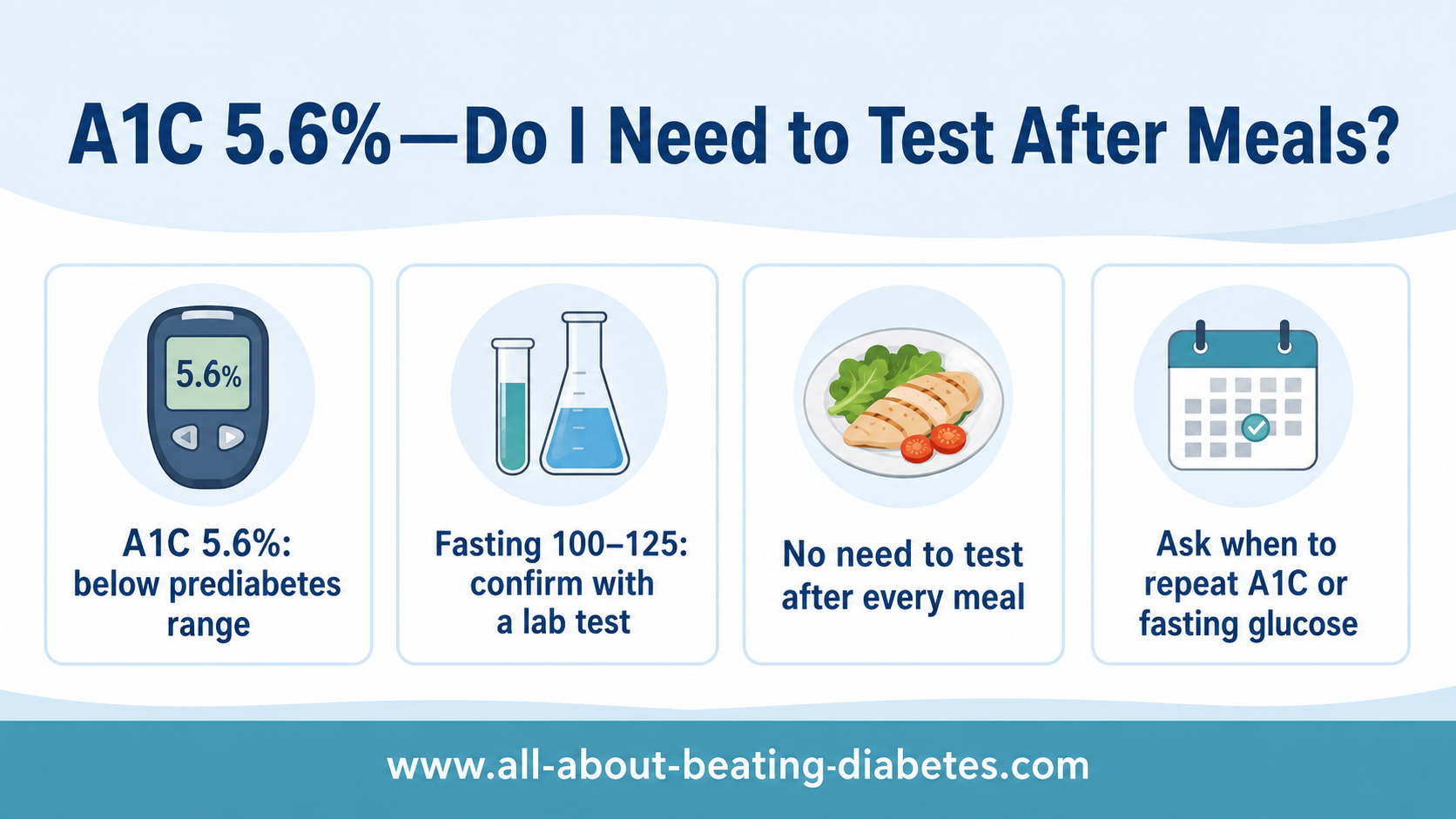
Anna, an HbA1c of 5.6% is below the usual prediabetes range of 5.7%–6.4%. However, fasting glucose readings of 100–125 mg/dL are in the prediabetes range when confirmed by a laboratory fasting plasma glucose test. Your home readings are not an emergency, but I would not call every one of them completely normal. You usually do not need to test after every meal. Ask your clinician whether to confirm your fasting glucose in a laboratory and when to repeat your HbA1c.
Answer by Dr. Albana Greca, MD, MMedSc, Family Physician
Medically reviewed by Dr. Ruden Cakoni, MD, Endocrinologist
Last medically reviewed: July 2026
What do an HbA1c of 5.6% and fasting readings over 100 mean?
Anna, I am encouraged by your weight loss and your HbA1c. An HbA1c of 5.6% reflects an estimated average glucose of about 114 mg/dL and does not, by itself, meet the usual definition of prediabetes. Your daytime readings of 77–95 mg/dL are also not concerning if you feel well.
Your repeated fasting meter readings of 102–111 mg/dL deserve a little more context. Prediabetes may be diagnosed by any one of three laboratory results: HbA1c 5.7%–6.4%, fasting plasma glucose 100–125 mg/dL, or a two-hour glucose of 140–199 mg/dL during a 75-g oral glucose tolerance test. These tests do not always agree. A home glucose meter is useful for observing patterns, but it is not accurate enough to establish a diagnosis on its own.
Do you need to check after every meal?
Probably not. For someone who is not taking insulin or a medicine that can cause low glucose, checking after every meal may add cost and anxiety without changing treatment. Your clinician may instead suggest a short structured experiment: check fasting and about two hours after the start of one selected meal on a few days, record the meal and activity, and then review the pattern. Do not keep testing indefinitely unless the results will guide a decision.
A single after-meal number cannot diagnose prediabetes because an ordinary meal is not standardized. If diagnostic clarification is needed, a laboratory fasting glucose or oral glucose tolerance test is more appropriate.

Why can morning glucose vary?
Morning readings can change because of normal overnight hormone release, the timing and carbohydrate content of the previous meal, sleep, stress, illness, alcohol, physical activity, and normal meter variation. Stress may raise glucose temporarily, but it should not be assumed to explain a persistent pattern without checking other factors.
For the most comparable readings, wash and dry your hands, use unexpired strips, test after at least eight hours without calories, and avoid comparing readings taken under different conditions. If a result seems unexpected, repeat it once with clean, dry hands rather than testing repeatedly.
What I would recommend next
- Share the HbA1c, meter log, family history, weight change, medicines, and supplements with your clinician.
- Ask whether you need a laboratory fasting plasma glucose now. A clinician may repeat the test when results disagree.
- Continue sustainable habits: balanced meals, fiber-rich carbohydrate choices, regular physical activity, adequate sleep, and weight maintenance rather than further weight loss unless recommended.
- Have glucose screening at the interval your clinician advises. People with confirmed prediabetes are generally tested yearly; otherwise the interval depends on age and risk.
Your family history increases your future risk, but it does not make diabetes inevitable. Healthy habits meaningfully reduce risk; they cannot guarantee that diabetes will never develop.
Arrange medical review if fasting readings are repeatedly 126 mg/dL or higher, random readings reach 200 mg/dL or higher, or you develop increased thirst, frequent urination, unexplained weight loss, blurred vision, or unusual fatigue. Seek urgent care for severe symptoms, vomiting, confusion, or difficulty breathing.
Related Questions
- Is fasting blood sugar 111 prediabetes?
- What does fasting blood sugar 130 in the morning mean?
- Why can blood sugar rise from bedtime to morning?
Related Resources
- What Is a Good HbA1c Level?
- Understanding Fasting Blood Sugar
- Blood Sugar Levels by Time of Day
- Reducing Insulin Resistance and Diabetes Risk
References
- American Diabetes Association. Diagnosis and Classification of Diabetes: Standards of Care in Diabetes—2026.
- National Institute of Diabetes and Digestive and Kidney Diseases. The A1C Test & Diabetes.
- Centers for Disease Control and Prevention. Diabetes Testing.
Medical note: This answer provides general education and does not replace an individual diagnosis or treatment plan.