- Home
- blood tests
Blood Tests for Diabetes: What Each Test Means
Blood tests for diabetes measure different aspects of glucose control, so each test answers a slightly different question. Fasting glucose, A1C, random glucose, and the oral glucose tolerance test can help identify normal blood sugar, prediabetes, or diabetes. Here, I explain what each result means and how doctors use these tests together.
Written by: Dr. Albana Greca Sejdini, MD, MMedSc
Medically reviewed by: Dr. Ruden Cakoni, MD, Endocrinologist
Last medically reviewed: July 2026
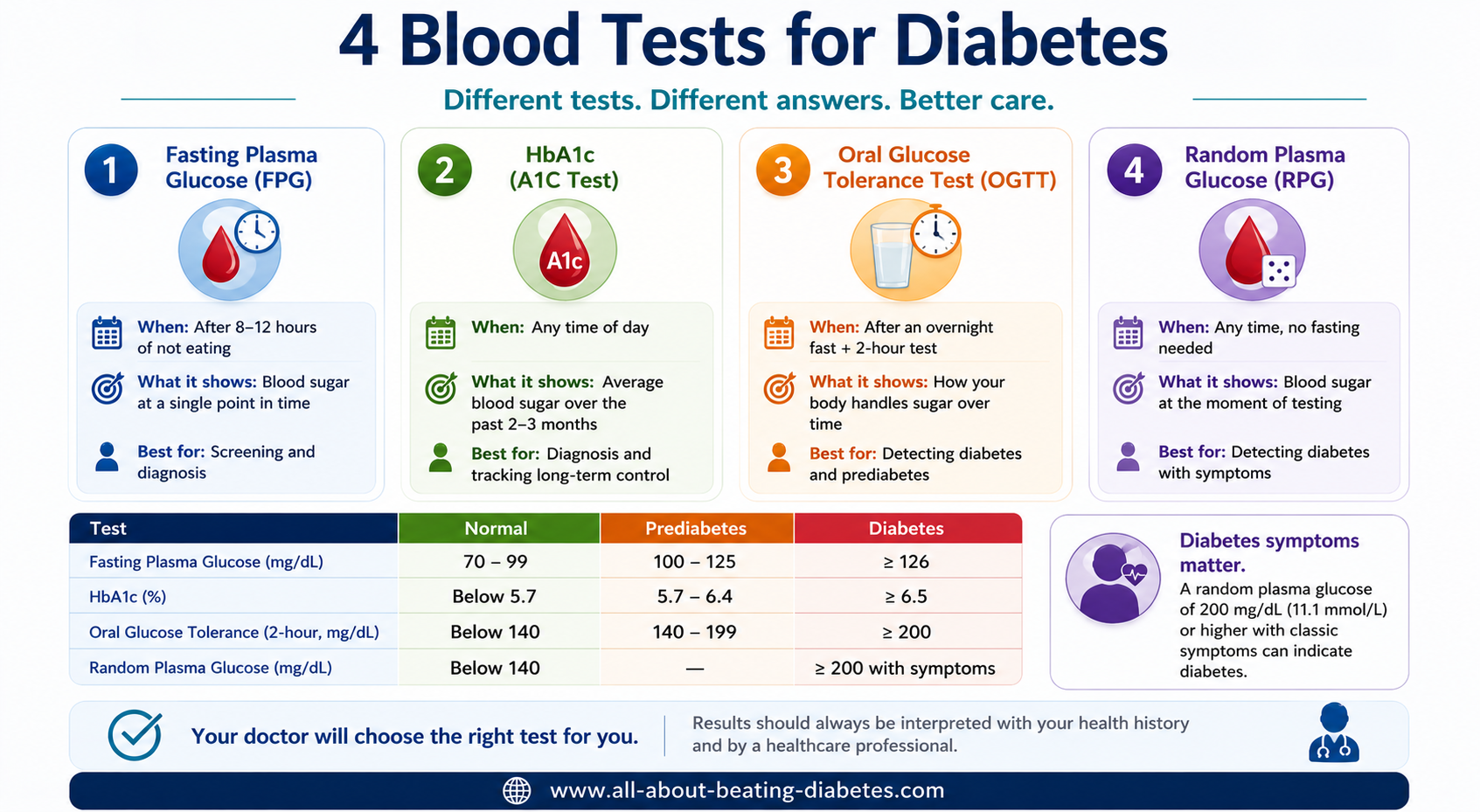
Diabetes blood tests do not all measure the same thing. A fasting plasma glucose test shows your glucose at one moment after fasting. HbA1c estimates longer-term glucose exposure. An oral glucose tolerance test shows how your body handles a standardized glucose drink, while a random plasma glucose test is mainly useful when classic symptoms or a hyperglycemic emergency are present.
- Compare the four diabetes tests
- Fasting plasma glucose
- HbA1c test
- Oral glucose tolerance test
- Random plasma glucose
- Confirming a diabetes diagnosis
- When test results disagree
- Diabetes testing during pregnancy
- Urine glucose and ketone tests
- Home blood sugar testing and CGM
- Which diabetes test should you ask for?
The Four Main Blood Tests for Diabetes
| Test | Normal | Prediabetes | Diabetes |
|---|---|---|---|
| Fasting plasma glucose | 99 mg/dL or below | 100–125 mg/dL | 126 mg/dL or higher |
| HbA1c | Below 5.7% | 5.7%–6.4% | 6.5% or higher |
| Two-hour 75-g OGTT | 139 mg/dL or below | 140–199 mg/dL | 200 mg/dL or higher |
| Random plasma glucose | No standard screening cutoff | Not used to diagnose prediabetes | 200 mg/dL or higher with classic symptoms or crisis |
These thresholds apply to nonpregnant people. The result should come from an appropriate laboratory method. The same tests may identify abnormal glucose, but they do not automatically tell your clinician whether you have type 1 diabetes, type 2 diabetes, medication-induced diabetes, or another form.

1. Fasting Plasma Glucose
The fasting plasma glucose test measures blood glucose after at least eight hours without food or caloric drinks. Water is allowed. It is usually performed in the morning.
This test provides a standardized baseline and is commonly used for screening and diagnosis. A fasting laboratory result of 100–125 mg/dL is in the prediabetes range. A result of 126 mg/dL or higher is in the diabetes range, but confirmation is usually needed when clear symptoms or a hyperglycemic crisis are absent.
Illness, acute stress, dehydration, corticosteroids, inadequate fasting, and some medicines may temporarily affect the result. A home meter reading is not interchangeable with a diagnostic laboratory fasting plasma glucose test.
For a detailed interpretation, see the normal fasting blood sugar levels chart.
2. HbA1c
HbA1c measures the percentage of hemoglobin with glucose attached and reflects average glucose exposure over approximately the previous two to three months, with greater influence from more recent weeks. It does not require fasting.
An HbA1c below 5.7% is considered normal for diagnosis, 5.7%–6.4% is prediabetes, and 6.5% or higher is in the diabetes range. A diagnostic HbA1c should be performed using a standardized laboratory method appropriate for diagnosis.
When HbA1c may be misleading
HbA1c depends on red-blood-cell lifespan and the hemoglobin being measured. The result may be falsely high, falsely low, or difficult to interpret with:
- recent major bleeding or blood transfusion;
- hemolytic anemia or another condition that shortens red-cell survival;
- iron-deficiency anemia or another condition affecting red-cell turnover;
- some hemoglobin variants;
- erythropoietin treatment;
- advanced kidney disease or dialysis;
- pregnancy and the postpartum period;
- a major mismatch between HbA1c and measured glucose.
The direction and degree of error depend on the condition and the assay used. When HbA1c is unreliable, clinicians may rely more heavily on plasma glucose tests and sometimes use alternative markers.
Compare HbA1c with daily blood sugar readings, learn how HbA1c and estimated average glucose are calculated, or use the HbA1c-to-average-glucose calculator.
3. Oral Glucose Tolerance Test
The oral glucose tolerance test, or OGTT, measures how the body handles a standardized glucose challenge. For the common nonpregnancy diagnostic test, you arrive after fasting and drink a solution containing 75 grams of glucose. The two-hour plasma glucose is then interpreted.
- 139 mg/dL or below: normal;
- 140–199 mg/dL: impaired glucose tolerance or prediabetes;
- 200 mg/dL or higher: diabetes range.
The OGTT can identify impaired glucose tolerance that fasting glucose or HbA1c may miss. It may be useful when results are borderline, when tests disagree, or when the clinical picture suggests abnormal glucose regulation despite a less concerning fasting value.
The test takes longer and requires more preparation than fasting glucose or HbA1c. Acute illness, diet changes, inadequate carbohydrate intake before the test, some medicines, smoking, and activity during the test may affect results.
Read the step-by-step oral glucose tolerance test guide.
4. Random Plasma Glucose
A random plasma glucose test can be taken at any time without fasting. It is especially useful when a person has classic symptoms of hyperglycemia or may be experiencing DKA or HHS.
A random laboratory glucose of 200 mg/dL or higher can diagnose diabetes when accompanied by classic symptoms such as excessive thirst, frequent urination, or unexplained weight loss, or when a hyperglycemic crisis is present.
Without classic symptoms or unequivocal hyperglycemia, one elevated random value generally needs confirmation with an appropriate diagnostic test. Random glucose is not used to define prediabetes.
A finger-stick reading from a home meter can identify a possible problem and guide urgent care, but a home reading is not the same as diagnostic random plasma glucose. See random blood glucose results and interpretation.
Does an Abnormal Test Need to Be Repeated?
In the absence of unequivocal hyperglycemia, diagnosis requires confirmatory testing. Confirmation may be obtained by:
- repeating the same abnormal test promptly; or
- using a second diagnostic test, such as confirming an abnormal fasting glucose with HbA1c or an OGTT.
If two different tests are both in the diabetes range, the diagnosis is confirmed. If the tests disagree, the test that is above the diagnostic threshold is generally repeated while possible interference or short-term causes are reviewed.
Confirmation should not be used to delay urgent treatment when a person has unmistakable hyperglycemia, classic symptoms, DKA, or HHS.
What If HbA1c, Fasting Glucose, and Home Readings Disagree?
Different tests measure different aspects of glucose regulation, so disagreement is possible. HbA1c reflects a longer period, fasting glucose is a single baseline measurement, and the OGTT may reveal abnormal glucose handling after a challenge.
Possible reasons for disagreement include:
- normal day-to-day and biological variation;
- an HbA1c interference or altered red-cell lifespan;
- high after-meal glucose with less abnormal fasting glucose;
- recent illness, medicine changes, blood loss, transfusion, or pregnancy;
- home-meter technique, strip storage, or CGM lag and accuracy limitations.
Do not average conflicting tests yourself or assume that the normal result cancels the abnormal one. Your clinician may repeat the abnormal test, order an OGTT, compare meter results with laboratory glucose, or investigate HbA1c interference.
Diabetes Testing During Pregnancy
Gestational diabetes uses pregnancy-specific testing pathways and thresholds. Depending on the healthcare system, screening may begin with a one-hour glucose challenge followed by a longer fasting OGTT, or a one-step 75-g OGTT may be used.
Do not interpret pregnancy glucose results using the nonpregnancy table on this page. People who are pregnant should follow the obstetric or diabetes team’s instructions. After gestational diabetes, postpartum testing is also important because future type 2 diabetes risk is higher.
See our gestational diabetes testing guide for pregnancy-specific information.
Urine Glucose and Ketone Tests
Urine glucose
Glucose may spill into urine when blood glucose rises above the kidney’s reabsorption capacity. However, the threshold varies among people and can be altered by pregnancy, kidney conditions, and SGLT2-inhibitor medicines.
Urine glucose cannot tell you the current blood glucose concentration and cannot diagnose diabetes by itself.
Urine or blood ketones
Ketone testing is a safety test rather than a routine diabetes-diagnosis test. It may be needed during illness, vomiting, fasting, insulin interruption, or persistent hyperglycemia—particularly in type 1 diabetes, insulin-treated diabetes, and people using SGLT2 inhibitors.
Follow your personal sick-day plan for when and how often to test. Blood ketone testing may provide more immediate information than urine ketones, but access and instructions differ.
Learn more in the diabetes urine glucose and ketone test guide.
Can a Home Meter or CGM Diagnose Diabetes?
No. Home finger-stick meters and continuous glucose monitors are designed primarily for monitoring, treatment decisions, and pattern recognition. They may reveal a concerning result that needs laboratory evaluation, but they are not the standard tools used to establish a diabetes diagnosis.
Home monitoring is particularly important for people using insulin or medicines that can cause hypoglycemia. For some people with type 2 diabetes who do not use insulin, structured short-term testing may help show how meals, activity, sleep, illness, and medicines affect glucose.
A useful record includes:
- the time and glucose result;
- whether it was fasting, before a meal, after a meal, or at bedtime;
- food, medicine, insulin, or activity;
- illness, stress, sleep, and symptoms;
- anything unusual, such as a missed dose.
Read how to test blood sugar at home, review test-strip selection and storage, and use the blood sugar log sheet to identify patterns.
Which Diabetes Test Should You Ask For?
| Situation | Common starting test or approach |
|---|---|
| Routine screening | HbA1c or fasting plasma glucose are common, convenient starting tests. |
| Borderline or conflicting results | Repeat the abnormal test or consider a 75-g OGTT. |
| HbA1c may be unreliable | Use plasma glucose criteria, selected according to the clinical situation. |
| Classic symptoms or possible crisis | Prompt plasma glucose and urgent assessment; ketones and other emergency tests may be needed. |
| Pregnancy | Follow a pregnancy-specific glucose challenge or OGTT pathway. |
| Determining diabetes type | Additional clinical assessment, diabetes autoantibodies, C-peptide, or genetic testing may be appropriate. |
Related Questions
- Fasting Glucose 159 but Two-Hour Glucose 109: Am I Diabetic?
- Can Different Blood Sugar Results Confirm or Exclude Diabetes?
- How Should OGTT and Insulin Resistance Results Be Interpreted?
- Why Is HbA1c High When Finger-Prick Readings Look Normal?
Related Resources
- Normal Fasting Blood Sugar Levels
- HbA1c Explained
- Oral Glucose Tolerance Test
- Random Blood Glucose Test
- Home Blood Sugar Testing
- Diabetes Answers and Tools Learning Center
Medical disclaimer: This page provides general education and does not diagnose diabetes or determine its type. Do not change insulin, medicine, food intake, or supplements based only on an online article, home meter, or calculator.
References
- American Diabetes Association: Diagnosis and Classification of Diabetes—Standards of Care in Diabetes 2026
- National Institute of Diabetes and Digestive and Kidney Diseases: Diabetes Tests and Diagnosis
- National Institute of Diabetes and Digestive and Kidney Diseases: The A1C Test and Diabetes
- NGSP: Factors That Interfere With HbA1c Test Results
- American Diabetes Association: Glycemic Goals, Hypoglycemia, and Hyperglycemic Crises—2026
- National Institute of Diabetes and Digestive and Kidney Diseases: Tests and Diagnosis for Gestational Diabetes