- Home
- Vitamins and Supplements for Diabetes
- Apple Juice Diabetes Arsenic
Can you drink apple juice with diabetes?
Written by: Dr. Albana Greca Sejdini, MD, MMedSc • Medically reviewed by: Dr. Ruden Cakoni, MD, Endocrinologist • Last medically reviewed: August 2026
If you choose juice, treat it as a measured carbohydrate rather than a free drink. Approximately 1/3–1/2 cup of fruit juice may provide around 15 grams of carbohydrate, depending on the product.
How Does Apple Juice Affect Blood Sugar?
Apple juice contains carbohydrate primarily from naturally occurring fruit sugars. Removing the pulp and much of the intact fiber makes juice easier and faster to drink than eating the original fruit. A large glass may therefore provide the carbohydrate from several apples without producing the same feeling of fullness.
This is why the words “100% apple juice” and “no added sugar” do not mean sugar-free or carbohydrate-free. They simply mean that extra sugar has not necessarily been added.
If you use insulin or count carbohydrates, check the nutrition label and measure your serving. You can also use our carbohydrate counter for diabetes to include drinks in the total carbohydrate content of your meal.
| Choice | Diabetes consideration |
|---|---|
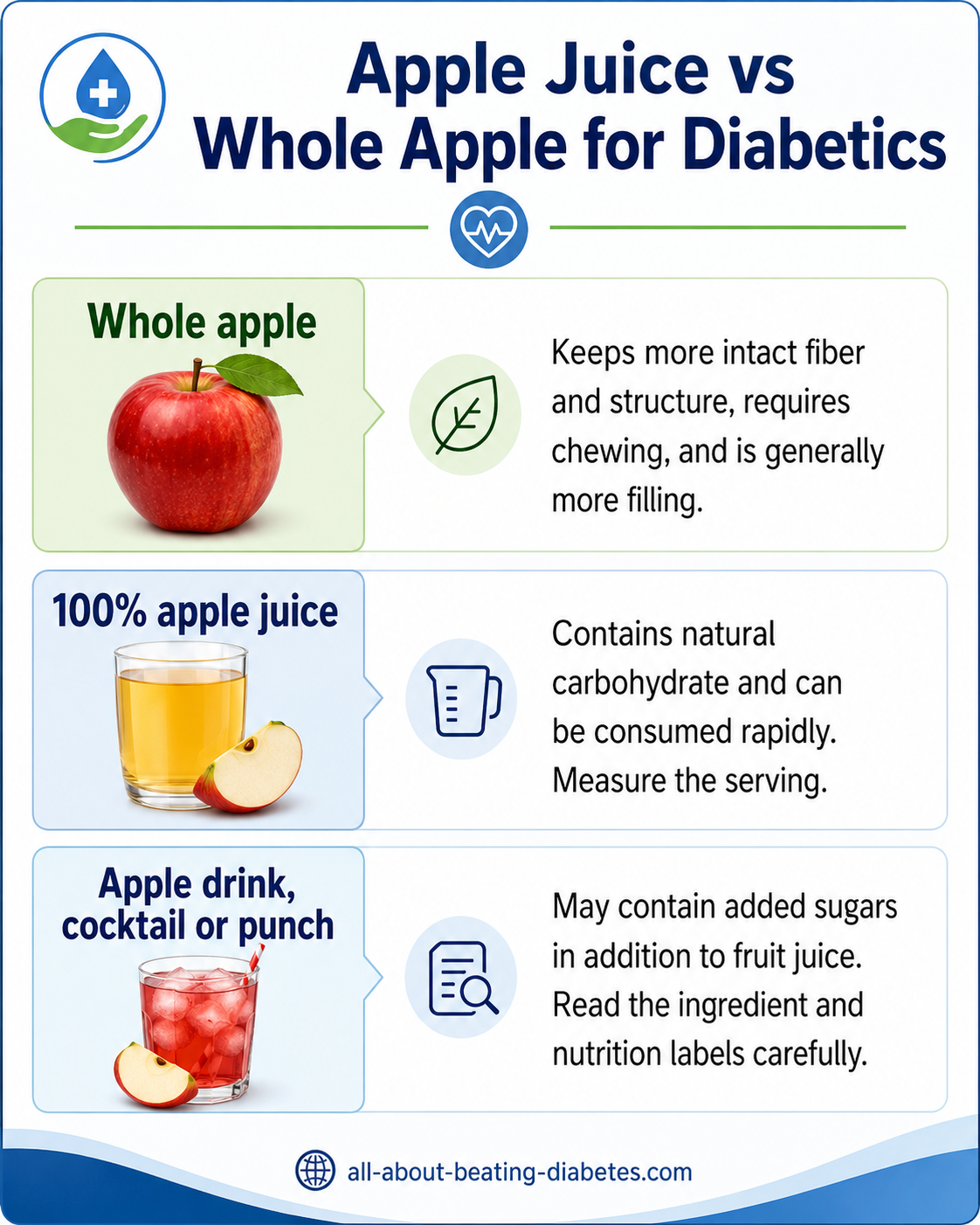
| Whole apple | Keeps more intact fiber and structure, requires chewing, and is generally more filling. |
| 100% apple juice | Contains natural carbohydrate and can be consumed rapidly. Measure the serving. |
| Apple drink, cocktail or punch | May contain added sugars in addition to fruit juice. Read the ingredient and nutrition labels carefully. |

Why I Usually Prefer a Whole Apple
When my patients ask me whether apples are allowed with diabetes, my answer is usually yes. The important questions are the portion, the form of the fruit, the rest of the meal, and the person's glucose response.
A whole apple retains its natural structure and fiber and usually takes longer to eat. Juice is much easier to consume quickly. That does not make apple juice forbidden, but it does make portion control more important.
For more guidance, see my detailed page on choosing fruit with diabetes and the low-glycemic fruit guide.
What About Arsenic in Apple Juice?
Arsenic is an element found naturally in the environment. Human activities can also contribute to environmental arsenic. Plants can absorb arsenic from soil and water, and contaminants may also enter foods during growing or processing.
The form of greatest health concern is inorganic arsenic. Long-term exposure to higher amounts has been associated with cancers and cardiovascular, neurological and other health effects. Research has also reported an association between chronic arsenic exposure and increased risk of type 2 diabetes.
That needs to be interpreted carefully. It does not mean that drinking one glass of apple juice causes diabetes. The concern is reducing unnecessary exposure over time, especially in children and populations who may receive arsenic from several sources.
What Is the FDA's 10 ppb Apple Juice Action Level?
An FDA action level is not exactly the same as a legally permitted amount. It represents a concentration at which the FDA may consider a food adulterated and may consider enforcement action along with other information. The agency also encourages manufacturers to reduce contaminants as much as reasonably achievable.
The number happens to be the same as the U.S. EPA arsenic standard of 10 ppb for regulated drinking-water systems, but the regulatory frameworks for drinking water and apple juice are different.
Is Homemade Apple Juice Lower in Arsenic?
Not necessarily. Making apple juice at home does not guarantee lower arsenic because arsenic exposure can originate from the fruit, soil, water or other environmental sources. Juicing the apple at home cannot reliably tell you how much arsenic is present.
There is also another issue: food safety. Commercial juice is commonly pasteurized or otherwise treated to reduce harmful microorganisms. Fresh, untreated juice may carry bacteria, so extra caution is appropriate for pregnant women, young children, older adults and people with weakened immune systems.
Therefore, I would not tell a patient that homemade juice is automatically safer than commercial juice. For diabetes, my preference for a whole apple is mainly about fiber, portion size, fullness and glucose management—not because homemade juice is proven to be arsenic-free.
How Should Someone With Diabetes Choose Apple Juice?
Choose 100% apple juice without added sugar, then check the serving size and total carbohydrate on the nutrition label. Pour a measured amount instead of drinking directly from a large bottle or filling an oversized glass.
If you notice that apple juice repeatedly produces a large glucose rise, try a smaller portion or choose whole fruit instead. Look at repeated meter or CGM patterns rather than judging a food from one isolated reading.
Water should generally remain your main drink for hydration. Sweet drinks and large servings of juice can add carbohydrate very quickly. You can read more about sweet drinks and diabetes.
Apple Juice Can Be Useful for Low Blood Sugar
There is one situation in which the fast absorption of juice can be useful: hypoglycemia.
For many adults with glucose below 70 mg/dL who are awake and able to swallow, the American Diabetes Association recommends approximately 15 grams of fast-acting carbohydrate followed by another glucose check after 15 minutes. About 1/2 cup (4 oz/120 mL) of juice is one common example.
This is very different from drinking large amounts of juice routinely. If you use insulin or medicines that can cause hypoglycemia, follow the low-glucose treatment plan provided by your healthcare team.
When a patient asks me, “Is apple juice good for diabetes?” I first ask why they want to drink it. If it is for ordinary hydration, water is usually better. If they want fruit, I generally recommend the whole apple. If they are treating low blood sugar, a measured amount of juice can be very useful. The purpose and the portion make a big difference.
Most Asked Questions
Can a person with type 2 diabetes drink apple juice?
Yes, but it should usually be a small measured portion and counted as carbohydrate. Whole fruit is generally a better everyday choice because it is more filling and retains more intact fiber.
Does 100% apple juice contain sugar?
Yes. One hundred percent juice naturally contains fruit sugars and carbohydrate even when no extra sugar has been added.
How much apple juice equals about 15 grams of carbohydrate?
Fruit juices commonly provide about 15 grams of carbohydrate in approximately 1/3–1/2 cup, but brands vary. Check the nutrition label for the exact amount.
Does apple juice contain arsenic?
Small amounts of arsenic can occur in foods and beverages because arsenic exists in the environment. The FDA has established a 10 ppb action level specifically for inorganic arsenic in apple juice.
Does homemade apple juice avoid arsenic?
No guarantee exists. Arsenic can originate from the fruit, soil or water, so making juice at home does not prove that it contains less arsenic.
Can apple juice treat hypoglycemia?
Yes. For many adults who are awake and able to swallow, approximately 1/2 cup or 4 oz of regular fruit juice provides about 15 grams of fast-acting carbohydrate and can be used as part of the 15-15 rule. Follow your personal diabetes treatment plan.
Related Questions
How can I control high blood sugar after meals?
Can drinking more water cure or control diabetes?
Is fasting blood sugar of 122 mg/dL a sign of diabetes?
Related Resources
Choosing Fruits With Diabetes
Low-Glycemic Fruits and Blood Sugar
Carbohydrate Counter for Diabetes
Diabetes, Carbohydrates and Glycemic Index
References
1. U.S. Food and Drug Administration. Guidance for Industry: Action Level for Inorganic Arsenic in Apple Juice. June 2023.
2. U.S. Food and Drug Administration. What You Can Do to Limit Exposure to Arsenic and Lead from Juices.
3. American Diabetes Association. Best Fruit Choices for Diabetes.
4. American Diabetes Association. Hypoglycemia: Symptoms and Treatment.
5. U.S. Environmental Protection Agency. Arsenic and Chemical Contaminant Rules for Drinking Water.
6. Rahimi Kakavandi N, et al. An updated systematic review and dose-response meta-analysis on the relation between exposure to arsenic and risk of type 2 diabetes. Toxicology Letters. 2023.
Medical Disclaimer
This page is for educational purposes only and does not replace professional medical advice, diagnosis or treatment. Always speak with your doctor or qualified healthcare provider before changing your diabetes medication, diet, supplement use or treatment plan.