- Home
- Diabetes Answers and Tools
- Natural Remedies and Diabetes
Natural Cures for Diabetes? What Helps, What Doesn’t, and What Is Safe
Key Medical Takeaways
- No herb, supplement, food or detox has been proven to cure diabetes.
- Healthy eating, physical activity and weight management when appropriate can improve glucose control. Some people with type 2 diabetes achieve remission.
- Remission is not a permanent cure. Regular monitoring and recommended health checks remain important.
- Do not replace insulin or other prescribed treatment with natural remedies.
Quick Answer
There is no proven natural cure for diabetes. However, nutritious meals, regular movement, appropriate weight management and medical treatment can make a meaningful difference. Some people with type 2 diabetes achieve remission, meaning their glucose remains below the diabetes range without glucose-lowering medication for a defined period. Herbs and supplements have uncertain benefits and may cause side effects or interact with medicines.
When patients ask me about natural cures, I understand the wish for a simpler way to feel better. My advice is to begin with changes that have reliable benefits and fit your daily life. You do not need an expensive supplement or an extreme eating plan to make progress.
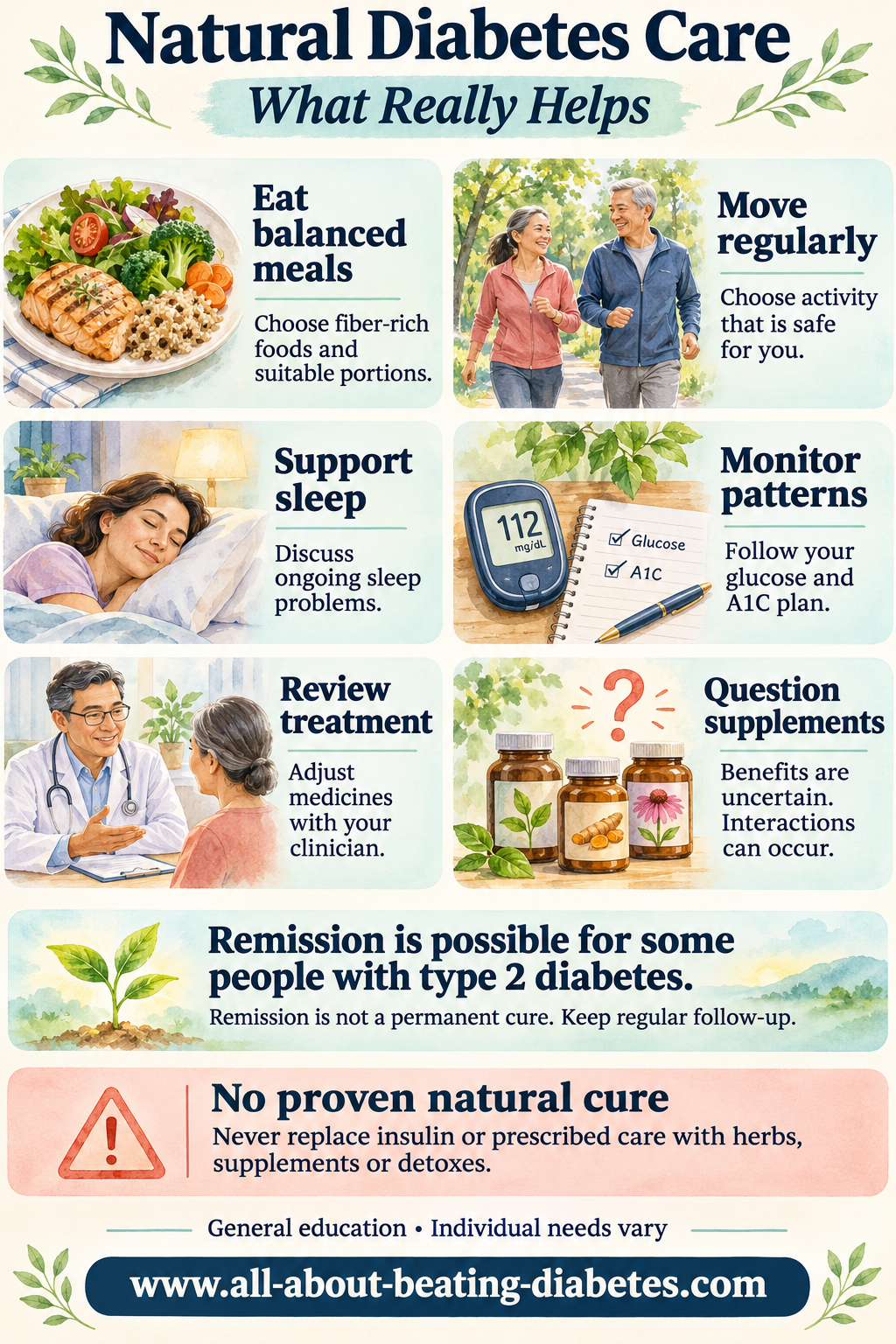
Can Diabetes Be Cured Naturally?
No natural treatment has been proven to cure diabetes. Lifestyle changes are an important part of care, but their role depends on the type of diabetes, your health and the treatment you need.
Type 1 diabetes
Type 1 diabetes usually develops when the immune system damages the pancreatic cells that produce insulin. People with type 1 diabetes need insulin to survive.
Herbs, supplements, special diets and fasting cannot replace insulin. Healthy eating and physical activity still matter, but they support insulin treatment rather than removing the need for it.
Do not stop basal insulin because you are trying a natural remedy or eating less. Insufficient insulin can lead to diabetic ketoacidosis, a life-threatening emergency. Follow your prescribed insulin and sick-day instructions.
Type 2 diabetes
Type 2 diabetes involves insulin resistance and a reduced ability to produce enough insulin over time. Genetics, age, body-fat distribution, medicines and other health factors can contribute. It can develop in people of different body sizes.
Food choices, movement and weight loss when appropriate can improve glucose control. Some people achieve remission, particularly after substantial, sustained weight loss early in the condition. Others continue to need medication despite making helpful changes.
Needing medication does not mean you have failed. Your treatment should reflect your glucose patterns, health needs and risk of complications.
Prediabetes
Prediabetes means glucose is above the normal range but below the diabetes threshold. A structured prevention plan can reduce the risk of developing type 2 diabetes.
Healthier eating, regular activity and weight management when appropriate can help. Follow-up testing remains important even when readings improve.
What Does Type 2 Diabetes Remission Mean?
The international consensus uses A1C below 6.5%, measured at least three months after stopping glucose-lowering medication, as the usual criterion for type 2 diabetes remission.
Medication withdrawal must be planned with your treating clinician. Do not stop treatment simply to see whether you qualify.
Remission is different from a permanent cure. Glucose can rise again, and previous exposure to high glucose may still affect health. Continue A1C testing at least annually, or more often when advised, and keep your recommended eye, kidney, foot and cardiovascular checks.
The two-year DiRECT trial found remission in 36% of participants receiving a structured weight-management intervention, compared with 3% receiving usual care. Participants were selected adults with relatively recent type 2 diabetes who were not using insulin. These results do not predict an individual person’s chance of remission.
As I explain to my patients, remission can be a worthwhile goal, but protecting your health matters whether or not you reach it. Better glucose, blood pressure and cholesterol management are valuable outcomes in their own right.
What Really Helps Blood Sugar?
The most useful approach is a sustainable care plan. Choose changes that suit your medicines, physical abilities, culture and budget, then review the results with your diabetes team.
| Approach | How it can help | Practical safety point |
|---|---|---|
| Individualized eating plan | Supports glucose control, nutrition and heart health. | Match carbohydrate portions to your treatment plan. |
| Weight management when appropriate | Can improve insulin sensitivity and may support remission. | Very low-calorie programs need professional supervision. |
| Walking and other aerobic activity | Helps muscles use glucose and supports cardiovascular health. | Adapt activity to your health and risk of low glucose. |
| Strength and balance activities | Support muscle function, mobility and independence. | Seek guidance when complications limit safe exercise. |
| Sleep and stress support | Can make daily diabetes management easier. | Discuss persistent sleep problems or possible sleep apnea. |
| Monitoring and medication review | Help identify patterns and guide safe treatment changes. | Use your prescribed targets and adjustment instructions. |
Move in ways you can maintain
A short walk after a meal can be a practical starting point if walking is safe for you. Increase activity gradually and interrupt long periods of sitting. Seated exercise or other adapted movement may be more suitable for some people.
Insulin and certain diabetes medicines can cause low glucose during or after activity. Follow your monitoring plan and carry fast-acting glucose when appropriate. Foot ulcers, significant eye disease, chest symptoms or other complications may require an adapted plan.
Manage weight without extreme rules
If weight loss is appropriate, even modest sustained loss can improve glucose control. Larger losses may increase the likelihood of remission for some people, but restrictive diets are not suitable for everyone.
Pregnancy, frailty, eating disorders and unintentional weight loss need a different approach. Ask for individualized nutrition advice rather than following a generic weight-loss plan.
Support sleep and emotional well-being
Poor sleep, stress and the daily demands of diabetes can make self-care harder. Discuss persistent sleep problems, loud snoring, daytime sleepiness or distress with your clinician.
A regular sleep routine, practical support and manageable goals can help you maintain your plan. You do not have to solve every difficulty at once.
Foods That Support Better Glucose Control
No single food cures diabetes. Build meals around non-starchy vegetables, suitable protein, higher-fiber carbohydrate foods and unsaturated fats. Beans, lentils, whole fruit and whole grains can fit into an individualized eating plan.
Portion size matters. Pairing carbohydrate with protein, fat and fiber can change the timing and size of the glucose rise, but it does not cancel the carbohydrate.
If your mealtime insulin plan requires carbohydrate counting, continue using the method taught by your diabetes team. Combining foods does not replace carbohydrate counting or your prescribed dosing instructions.
Choose water or unsweetened drinks more often than sugary drinks. You do not need to ban bread, rice, potatoes or fruit. A realistic plan considers the amount eaten, the complete meal and your glucose response.
Do Herbs and Supplements Help Diabetes?
Some supplements have been studied for glucose control, but study quality, formulations and results vary. A small improvement in one study does not establish a reliable treatment or prove long-term protection against complications.
The National Center for Complementary and Integrative Health reports that evidence for most diabetes supplements is insufficient or inconclusive. Some products can cause serious side effects. They should not replace prescribed care.
Cinnamon
Cinnamon can be enjoyed as a flavoring. Research on supplements has produced inconsistent results, so cinnamon capsules are not an established diabetes treatment. Discuss concentrated products with a pharmacist, particularly if you have liver disease or take regular medicines.
Berberine
Some studies suggest possible glucose effects, but limitations in the research and variation between products make benefits uncertain. Berberine is not a substitute for metformin or other prescribed medicines.
It can interact with medicines and should not be used during pregnancy or breastfeeding. Ask a clinician or pharmacist to check the exact product before considering it.
Bitter melon, fenugreek and Gymnema
Bitter melon , fenugreek and Gymnema sylvestre have been studied, but evidence is not strong enough to recommend them as replacements for standard treatment. Concentrated extracts are different from ordinary food portions. Their effects and safety depend on the preparation and dose.
Discuss supplements before use, especially with insulin or sulfonylureas, because additional glucose-lowering effects may increase the risk of hypoglycemia.
Banaba and “plant insulin” claims
Banaba, also called Lagerstroemia speciosa, contains compounds studied for possible glucose effects. Reliable clinical evidence remains limited.
“Plant insulin” and “botanical insulin” are marketing descriptions. Banaba is not insulin and cannot replace it.
Vitamin C, cayenne and other products
Vitamins have a role when a deficiency or another medical indication exists. Routine vitamin C supplements and cayenne products are not established treatments for diabetes. Obtaining nutrients through a varied eating pattern is a practical starting point.
High-dose supplements may have risks, particularly with kidney or liver disease. Bring the exact product label to your doctor or pharmacist so its ingredients and potential interactions can be checked.
Before buying a supplement
- Be cautious of promises to cure diabetes or replace insulin.
- Check the complete ingredient list and dose.
- Tell your clinician about all medicines and supplements you use.
- Remember that “natural” does not guarantee safety or effectiveness.
- Do not delay medical care while trying a product.
Can Fasting Help, and Can I Reduce Medication?
Some people with type 2 diabetes find a structured eating schedule helpful for weight management. Fasting is not necessary for everyone and can increase the risk of hypoglycemia, dehydration or other problems.
Discuss fasting before starting, particularly if you use insulin, sulfonylureas or an SGLT2 inhibitor. Pregnancy, type 1 diabetes, frailty, kidney disease and eating disorders require particular caution and individualized advice.
Do not stop prescribed treatment because you are trying natural remedies. If glucose improves after food, activity or weight changes, contact your clinician. Medication adjustments should be planned using your readings, symptoms and medical history.
When Natural Remedies Must Not Delay Care
Seek urgent medical advice for glucose repeatedly at or above 300 mg/dL (16.7 mmol/L), particularly if it does not improve with your prescribed plan. Symptoms and ketones can require help at lower glucose levels.
Seek emergency care for:
- Breathing or chest symptoms: chest pain, difficulty breathing or deep, rapid breathing.
- Changes in alertness: confusion, fainting, seizure or difficulty waking.
- Vomiting or severe dehydration: repeated vomiting, inability to keep fluids down or very little urine with significant illness.
- Possible ketoacidosis: high ketones, fruity-smelling breath or other concerning symptoms, especially with vomiting or abdominal pain.
Natural remedies must never delay emergency treatment.
People taking SGLT2 inhibitors can develop ketoacidosis without very high glucose. Do not wait for a particular glucose number when seriously unwell. Follow your emergency plan and seek immediate care.
A Practical Diabetes Care Plan
- Understand your starting point. Review your diabetes type, A1C, medicines and health priorities.
- Choose one achievable food change. Try replacing a sugary drink or adjusting a familiar carbohydrate portion.
- Add suitable movement. Start with an activity you can repeat safely.
- Monitor as advised. Look for patterns rather than judging progress from one reading.
- Review treatment safely. Ask about adjustments if readings improve or lows occur.
- Keep follow-up appointments. Continue recommended screening even during remission.
Frequently Asked Questions
Can diabetes go away without medicine?
Some people with type 2 diabetes achieve remission without glucose-lowering medication, but this requires clinical assessment and ongoing follow-up. Type 1 diabetes requires insulin.
What is the best natural way to lower blood sugar?
There is no single best method for everyone. An individualized eating plan, suitable activity and weight management when appropriate have a stronger role than relying on supplements.
Is a normal A1C while taking medication remission?
It shows that treatment is working. The usual remission definition requires assessment after glucose-lowering medication has been stopped under clinical supervision. Do not stop useful treatment simply to obtain a remission label.
Are supplements safe with metformin or insulin?
Safety depends on the product, dose, other medicines and your kidney and liver health. Ask a pharmacist or clinician to check the exact supplement before using it.
Do I need to stop eating carbohydrates?
No. Carbohydrate foods can fit into an individualized diabetes eating plan. Food quality, portion size and your treatment needs matter. Major carbohydrate reductions may require medication adjustments, particularly with insulin or medicines that can cause low glucose.
A Note From Dr. Albana Greca
I encourage my patients to focus on progress they can maintain. A balanced meal, a safe walk, better sleep or a useful medication review can be more valuable than another bottle of supplements. Your care plan should help you feel informed and supported.
Remission is a possibility for some people, but your health is not measured by that label alone. Protecting your heart, kidneys, eyes, nerves and quality of life remains the goal.
Related Guides
- Insulin Treatment and Safety
- Dangerous Blood Sugar Levels and Warning Signs
- Diabetes Answers and Tools
References
- American Diabetes Association. International Experts Outline Diabetes Remission Diagnosis Criteria. 2021.
- Lean MEJ, Leslie WS, Barnes AC, et al. Durability of a primary care-led weight-management intervention for remission of type 2 diabetes: 2-year results of the DiRECT open-label, cluster-randomised trial. Lancet Diabetes & Endocrinology. 2019;7(5):344–355.
- National Center for Complementary and Integrative Health. Diabetes and Dietary Supplements: What You Need To Know.
Medical disclaimer: This article provides general education and does not replace individual medical advice, diagnosis or treatment. Follow your prescribed medication, glucose-monitoring and emergency plans. Discuss major food changes, fasting and supplements with your diabetes team.
Do you know any natural cures that help to manage diabetes.
What Other Visitors Have Asked
Click below to see Questions from other visitors to this page...
Regarding prediabetics natural supplements 
QUESTION:
By Elaine
My blood-test result was 6.2. I am careful with my diet because my husband takes diabetes medicine. I take blood-pressure …
Where to Find Banaba & Bitter Melon in USA?
.c2{font:18px/1.48 Arial,sans-serif;color:#24323d;max-width:920px;margin:10px auto;text-align:justify}.c2 h2,.c2 h3{color:#14536b;text-align:left;margin:20px …
Does stevia cure diabetes?
QUESTION: I want to know about stevia extract and where to buy it. Does stevia cure diabetes?
Quick Answer
No, stevia does not …

Apple Cider Vinegar Before Meals for Diabetics
Quick Answer
Apple cider vinegar may modestly lower post-meal or fasting glucose in some people, but there is no medically established dose …
Powder of Elephant Apple to Control Diabetes
QUESTION: By Deepak Jindal We have heard that powder made from elephant apple can control diabetes within 21 days. Is this true, and how is it …
Apple Cider Vinegar Before Meals Lowers Blood Sugar
QUESTION: My friend has had type 1 diabetes for 10 years and is doing well. Who should consider a pancreas transplant, can it remove the need …

Type 2 diabetic since July 1991, diagnosed based on a fasting sugar reading of 468 mg/dl
.bd-tight p{margin:0 0 6px!important;}.bd-tight h2{margin:14px 0 5px!important;line-height:1.2;}.bd-tight h3{margin:10px 0 4px!important;line-height:1.25;}.bd-tight …

Okra Health Benefits For Diabetics
.bd-tight p{margin:0 0 6px!important;}.bd-tight h2{margin:14px 0 5px!important;line-height:1.2;}.bd-tight h3{margin:10px 0 4px!important;line-height:1.25;}.bd-tight …

The Budwig mixture can cure diabetes
QUESTION: Can the Budwig mixture of flaxseed oil, cottage cheese or yogurt, cinnamon, and mandarin oranges cure diabetes? Do bitter melon, fenugreek, …
Can herbal medicine reduce insulin needs in diabetes safely 
.c2{font:18px/1.48 Arial,sans-serif;color:#24323d;max-width:920px;margin:10px auto;text-align:justify}.c2 h2,.c2 h3{color:#14536b;text-align:left;margin:20px …
Diabetes Herbal cure Not rated yet
.bd-tight p{margin:0 0 6px!important;}
.bd-tight h2{margin:14px 0 5px!important;line-height:1.2;}
.bd-tight h3{margin:10px 0 4px!important;line-height:1.25;} …
Intermittent fasting diabetic taking Metformin & Glicazaride Not rated yet
Question from Elijah:
I am diabetic and presently taking Metformin and Glicazaride, but also doing lots of intermittent fasting every day of …
Defrozen Okra for Diabetics - Does it Work? Not rated yet
Quick Answer
Frozen okra can be eaten as part of a healthy diabetes-friendly diet, but there is no proven recipe or dose of “okra water” that …
Herbs and vitamins controlling my blood sugar Not rated yet
Quick Answer
Using many supplements to adjust blood sugar from day to day is not a safe or reliable diabetes plan. Most have limited evidence, …
Is Aloe vera gel beneficial to cure Type-II diabetes Not rated yet
Quick Answer
Aloe vera gel is not proven to cure type 2 diabetes , and there is no medically established daily dose for glucose control. Some …

Reduce Blood Sugar by using Apple Cider Vinegar Not rated yet
Question from Tammy Gilden:
I developed type 2 diabetes and take metformin. I have improved my diet, but my waking blood sugar is still often …
Most efficient & maximum controle of Diabetics - YOGA Not rated yet
PERSONAL EXPERIENCE:
By Kumara Swamy, Mysore, Karnataka, India
I have lived with diabetes for 26 years and used tablets according to my …

Mulberry Leaves Combating Type 2 Diabetes? Not rated yet
Question from Pethuru Raj:
Could you please tell me whether mulberry leaves are effective in combating type 2 diabetes?
Quick Answer …

Neem Leaves for Diabetes Control Not rated yet
QUESTION: Are neem leaves good for people with diabetes when fasting blood sugar is around 120–135 mg/dL? Can neem safely lower glucose?
…
Gymnema Sylvestre For Type 1 Diabetics Not rated yet
Quick Answer
Gymnema sylvestre has not been proven to restore pancreatic beta cells, cure type 1 diabetes or reduce insulin needs safely. People …
Garlic & Diabetics Not rated yet
QUESTION: I have read a lot about garlic for diabetes, but little about its adverse effects. Is garlic safe for people with diabetes, and how …
Ginger for diabetics Not rated yet
QUESTION: My cousin has type 2 diabetes and says ginger has lowered her glucose and blood pressure and nearly eliminated her neuropathy. Can …

Galega Officinalis (Goats Rue) for diabetics? Not rated yet
Previous 14 | 19 NEXT >
QUESTION : What can galeka officinalis aka …

Nephelium lappaceum Seeds Controlling Blood Sugar Level? Not rated yet
.bd-tight p{margin:0 0 6px!important;}
.bd-tight h2{margin:14px 0 5px!important;line-height:1.2;}
.bd-tight h3{margin:10px 0 4px!important;line-height:1.25;} …
Vitamin D Shot & Blood Sugar Level? Not rated yet
QUESTION: Can a vitamin D injection affect blood sugar? Can it lower glucose, or could it make diabetes control worse?
Quick Answer …
Why does blood sugar level go up after exercise? Not rated yet
.bd-qa p{margin:0 0 10px; line-height:1.55;}
.bd-qa h2{margin:18px 0 10px; line-height:1.25;}
.bd-qa h3{margin:14px 0 8px; line-height:1.25;}
.bd-qa …

My glucose reading down with hisbiscus tea. Not rated yet
Quick Answer
Hibiscus tea may have modest effects on blood glucose or cholesterol in some studies, but it is not proven to be a reliable treatment …

Flaxceed Oil & Cottage Cheese For Diabetes?! Not rated yet
Quick Answer
Flaxseed oil mixed with cottage cheese—the Budwig mixture—has not been proven to cure diabetes. These foods may fit into a meal …
What can Gymnema Sylvestre do in pre-diabetics? Not rated yet
QUESTION: Hello Dr,
I was told I would be going towards pre-diabetes. I searched the web and found that Gymnema is good, as I do not want …
Method of Cinnamon Use for Control of Blood Sugar? Not rated yet
QUESTION: I have diabetes and would like to cure it naturally with herbs. Can you explain how to use cinnamon powder or capsules to control …

What is the right way to take the apple cider vinegar? Not rated yet
Question:
What is the right way to take apple cider vinegar? How long before meals should it be taken, and should it be mixed with something …
Cinnamon Capsules to Lower Pre-diabetic Blood Sugar? Not rated yet
Question from Kas:
I have prediabetes, well controlled by diet and exercise. When my levels go up a bit, I add 150 mg of cinnamon at night …
Alpha Lipoic Acid For Diabetic Neuropathy? Not rated yet
QUESTION: Can alpha-lipoic acid cure diabetic neuropathy? How well does it work, what dose is used, and what side effects or precautions should …
Shifting from Insulin twice a day to Gymnema Sylvestre and Bitter Melon Not rated yet
VISITOR EXPERIENCE:
By E.C.
Soon after my father died, my glucose rose to almost 800 mg/dL and I was hospitalized. I left hospital on …

Januvia (Sitagliptin) and Onglyza (Saxagliptin) Diabetes Medications Not rated yet
QUESTION:
You mentioned Januvia (sitagliptin) and Onglyza (saxagliptin) in a story about cinnamon and alpha-lipoic acid. Was the person taking …
I stopped taking Glugophage since 3 months and I replaced it with Karela (bitter group) Not rated yet
Question from Sameh
I am a 41-year-old man with a strong family history of diabetes. I was diagnosed nine months ago after a random blood …
SHS - Natural Diabetic Neuropathy Treatment Not rated yet
QUESTION:
I discovered that I may have diabetes after reading about symptoms and because I have leg wounds that are slow to heal. I have been …
Best Natural Ways to Control Type 2 Diabetes Not rated yet
QUESTION: Type 2 diabetes is becoming more common. Doctors often say to stop eating sugar, but what should a person do next? What are the best …
Diabetic colon cleanse Not rated yet
QUESTION: Is a colon cleanse useful for people with diabetes? Do herbs, foods, pills, enemas, or colon irrigation remove toxins or improve glucose? …
Cinnamon and Diabetes - A Story of Success! Not rated yet
Quick Answer
Cinnamon may modestly improve fasting glucose or HbA1c in some people with type 2 diabetes, but it is not a cure and should not …

How to Eat Raw Garlic Safely Not rated yet
QUESTION:
By Romy
I have heard about the possible health benefits of garlic and use jarred minced garlic in cooking. How does someone …
Blessed Black oil seed and diabetes Not rated yet
Quick Answer
Black seed, also called black cumin or Nigella sativa , is not a cure for diabetes. Some clinical studies suggest that it may …