- Home
- normal range
- Ideal Blood Sugar Level
Ideal Blood Sugar Level:
What Is a Healthy Target for People With Diabetes?
Written by Dr. Albana Greca, MD, MMedSc
Medically reviewed by Dr. Ruden Cakoni, MD, Endocrinologist
Last reviewed: June 2026
Many patients want to know the “ideal” blood sugar level, but the safest answer is not one single number for everyone. Blood sugar targets depend on your age, diabetes type, medicines, risk of low blood sugar, pregnancy, and other health conditions.
In this page, I will try to explain common fasting, after-meal, low blood sugar, and A1C targets in a simple patient-friendly way, so you can better understand your readings and discuss them with your doctor.
Quick Answer
Many patients ask me: “Doctor, what is the ideal blood sugar level?”
The most honest answer is this: there is no single perfect blood sugar number that is right for every person.
For many nonpregnant adults with diabetes, common blood sugar targets are:
- Before meals or fasting: 80–130 mg/dL, or 4.4–7.2 mmol/L
- 1–2 hours after meals: less than 180 mg/dL, or less than 10.0 mmol/L
- Low blood sugar alert: below 70 mg/dL, or below 3.9 mmol/L
- A1C goal for many adults: often less than 7%, if safe and appropriate
Important: These are general targets, not personal medical instructions. Your ideal range may be different depending on your age, diabetes type, medicines, pregnancy, risk of low blood sugar, and other health conditions.
These are general targets, not personal medical instructions. Your ideal blood sugar range may be different if you are pregnant, older, a child or teenager, using insulin, have kidney disease, heart disease, frequent low blood sugar, or other medical conditions.
What Does “Ideal Blood Sugar Level” Really Mean?
When we talk about an ideal blood sugar level, we are not looking for one perfect reading all day long.
Blood sugar naturally changes after eating, during exercise, during stress, during illness, and overnight.
A better way to think about your blood sugar is this:
- Is my fasting blood sugar usually in a safe range?
- Is my blood sugar after meals returning toward target?
- Am I having frequent low blood sugar?
- Is my A1C showing good long-term control?
- Do my readings match how I feel?
- Is my treatment plan safe for me?
As your doctor, I would not look at only one number. I would look at the full pattern.
Common Blood Sugar Targets for Many Adults With Diabetes
For many nonpregnant adults with diabetes, the most commonly used targets are illustrated below:
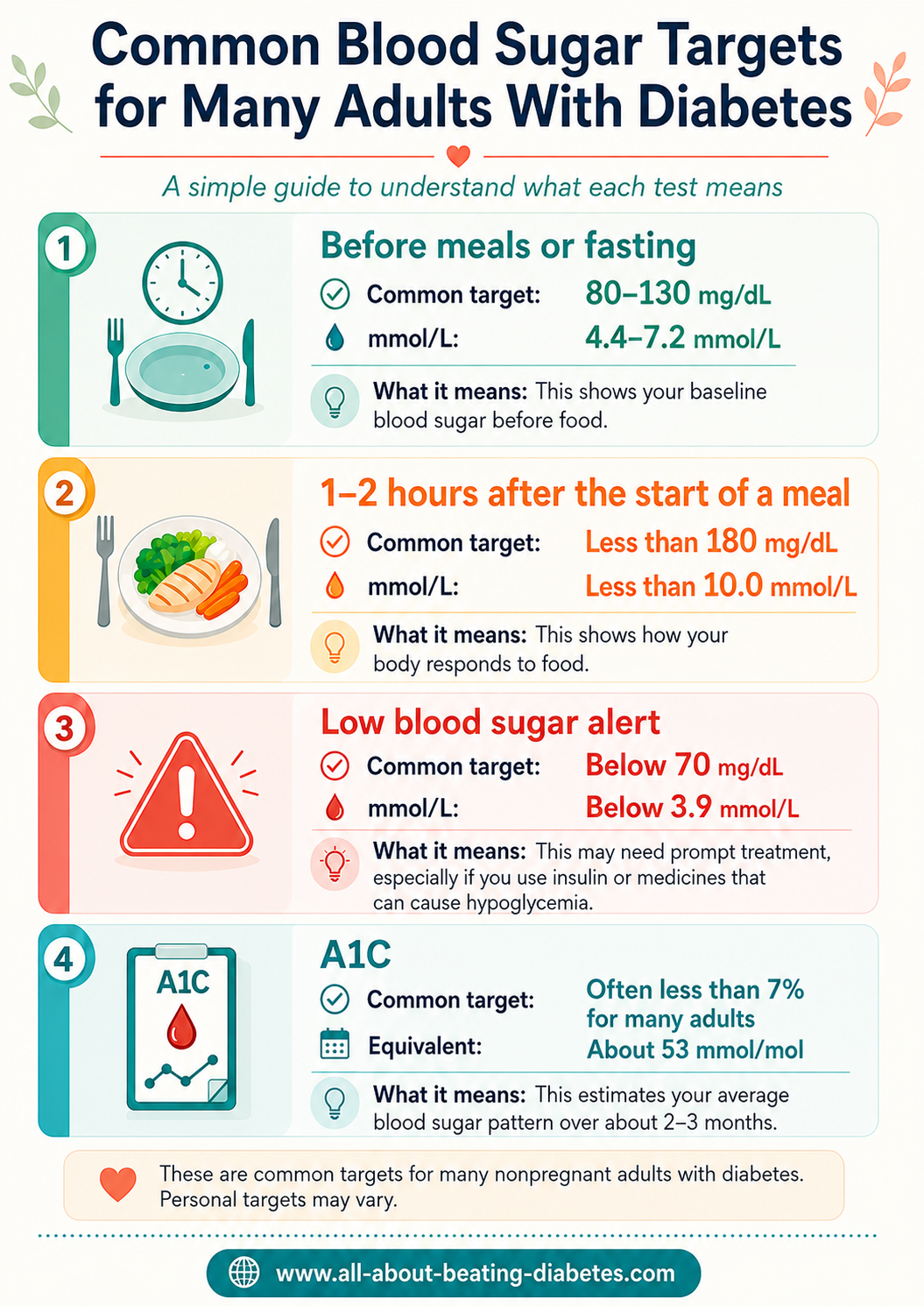
Please remember: these targets are common, but they are not automatically right for everyone. Your doctor may recommend a lower or higher target depending on your age, medicines, pregnancy status, other health problems, and risk of low blood sugar.
Normal, Prediabetes, and Diabetes Fasting Blood Sugar Levels
A fasting blood sugar test helps show how much glucose is in your blood after you have not eaten for at least 8 hours, usually overnight. It is one of the common tests doctors use to screen for prediabetes and diabetes.
In general, fasting blood sugar results are interpreted as follows:
| Fasting blood sugar result | mmol/L | What it may mean |
|---|---|---|
| 99 mg/dL or below | 5.5 mmol/L or below | Usually considered normal |
| 100–125 mg/dL | 5.6–6.9 mmol/L | Prediabetes range |
| 126 mg/dL or above | 7.0 mmol/L or above | Diabetes range, when confirmed by repeat or appropriate testing |
A fasting blood sugar test is usually done after at least 8 hours without food. Water is allowed unless your doctor gives different instructions.
One high fasting reading does not always mean diabetes. Stress, poor sleep, illness, medication timing, late-night eating, or lab differences can affect the result. Diagnosis should be confirmed by your healthcare provider, and based on your continuous monitoring of your blood sugar levels.
What Is an Ideal Fasting Blood Sugar Level?
For people without diabetes, fasting blood sugar is usually expected to be below 100 mg/dL, or below 5.6 mmol/L. This is one of the values doctors use when screening for prediabetes or diabetes.
For many nonpregnant adults who already have diabetes, the common fasting or before-meal target is often 80–130 mg/dL, or 4.4–7.2 mmol/L. This target is different from the “normal” fasting range used for diagnosis.
I explain this carefully to my patients because diabetes care is not about chasing the lowest possible number. The goal is to keep blood sugar in a safe and steady range while also avoiding low blood sugar, especially in people who use insulin or medicines that can cause hypoglycemia.
If your fasting blood sugar is repeatedly above your personal target, do not judge yourself or make medication changes on your own. Instead, discuss the pattern with your doctor. Morning blood sugar can be affected by many factors, and the right solution depends on the cause.
Common reasons for high fasting blood sugar include:
- Dawn phenomenon, when early-morning hormones raise blood sugar
- A late dinner or evening snacks
- Poor sleep or sleep apnea
- Emotional stress
- Illness, infection, pain, or inflammation
- Missed diabetes medication
- Medication timing problems
- Insulin resistance during the night
- Not enough overnight insulin or diabetes medicine
- Alcohol use, especially if it affects sleep or eating patterns
A single high morning reading is useful information, but a repeated pattern is more important. Keeping a blood sugar log can help your doctor understand whether the problem is related to food, sleep, stress, illness, medication timing, or your treatment plan.
What Should Blood Sugar Be After Eating?
After you eat, your body digests food and releases glucose into the bloodstream. Because of this, it is normal for blood sugar to rise after a meal. What matters is how high it rises, how long it stays high, and whether it returns toward your target range.
For many nonpregnant adults with diabetes, a common after-meal target is less than 180 mg/dL, or less than 10.0 mmol/L, about 1–2 hours after the start of a meal. Your doctor may recommend a different target depending on your age, diabetes type, medicines, pregnancy status, risk of low blood sugar, and other health conditions.
As I explain to my patients, after-meal blood sugar is very useful because it shows how your body responds to food, portions, activity, and medication timing. If your readings are often higher than your target after meals, it may be related to one or more of the following:
- * Large portions of carbohydrates
- * Sugary drinks
- * Desserts or sweet snacks
- * Low-fiber meals
- * Eating too quickly
- * Little or no physical activity after meals
- * Insufficient diabetes medication
- * Medication taken too late or at the wrong time
- * Insulin resistance
- * Stress, poor sleep, illness, pain, or infection
This does not mean you should completely avoid carbohydrates. Carbohydrates are part of many healthy foods, including fruits, beans, lentils, yogurt, and whole grains. The goal is to understand which foods, portions, and meal combinations keep your blood sugar steadier.
A practical approach is to keep a short blood sugar log for several days. Write down what you ate, the portion size, your reading before the meal, and your reading 1–2 hours after the meal. This helps you and your doctor see patterns and make safer, more personalized decisions.
Why One Blood Sugar Reading Is Not Enough
One blood sugar reading shows only one moment in time. It can be helpful, but it does not tell the full story of your diabetes control.
Blood sugar naturally changes during the day. It may rise or fall because of food, physical activity, stress, sleep, pain, infection, fever, dehydration, menstrual cycle changes, alcohol, travel, time zone changes, missed medication, too much medication, steroids, or other medicines.
This is why I encourage my patients to look at "patterns", not isolated numbers.
For example, a fasting blood sugar of "145 mg/dL" one morning may happen after poor sleep, a late dinner, stress, or illness. But if your fasting blood sugar is around "145 mg/dL every morning", this is a pattern that should be discussed with your doctor.
In the same way, a blood sugar reading of "210 mg/dL" after a large meal may help you understand how that meal affected your body. But repeated after-meal readings above your personal target may mean your food choices, portion sizes, physical activity, medication timing, or treatment plan need to be reviewed.
Your blood sugar log is not a test you pass or fail. It is medical information. It helps you and your doctor understand what is happening in your body and make safer, more personalized decisions.
If you use a continuous glucose monitor, the same principle applies. Do not focus only on one high or low number. Look at the overall trend, how long your blood sugar stays high or low, and whether the same pattern repeats at certain times of the day.
A1C and Ideal Blood Sugar
A1C is a blood test that estimates your average blood sugar over the last 2–3 months.
For many adults with diabetes, an A1C goal is often less than 7%, if this can be reached safely.
But A1C goals should be individualized.
Some people may need a lower goal. Others may need a higher and safer goal, especially if they are older, have frequent low blood sugar, have multiple medical conditions, or are at higher risk from aggressive treatment.
A1C is helpful, but it does not show everything.
Two people can have the same A1C but very different daily blood sugar patterns. One may have stable readings, while another may have many highs and lows.
This is why home glucose readings or continuous glucose monitoring can be very useful.
What Can Affect Your Ideal Blood Sugar Target?
Your blood sugar target should be safe, realistic, and personalized. Although general targets are useful, they do not apply to every patient in the same way.
As I explain to my patients, your doctor may personalize your blood sugar goals based on:
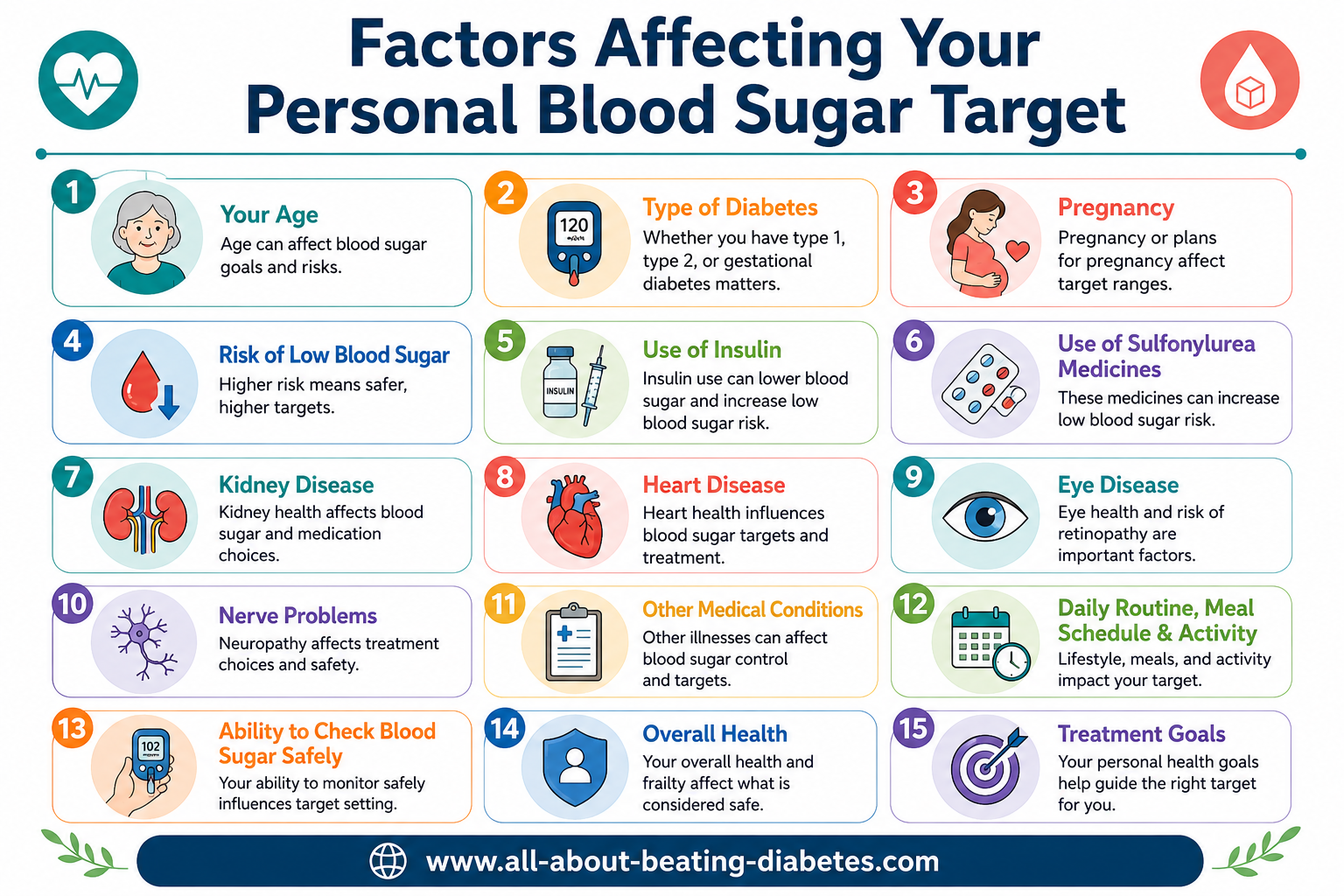
For some patients, a stricter blood sugar goal may be safe and helpful. For others, a slightly higher goal may be safer, especially if there is a high risk of low blood sugar, advanced age, multiple medical conditions, or difficulty recognizing hypoglycemia symptoms.
The goal is not to force every patient into the same number. The goal is to find the safest range for your body.
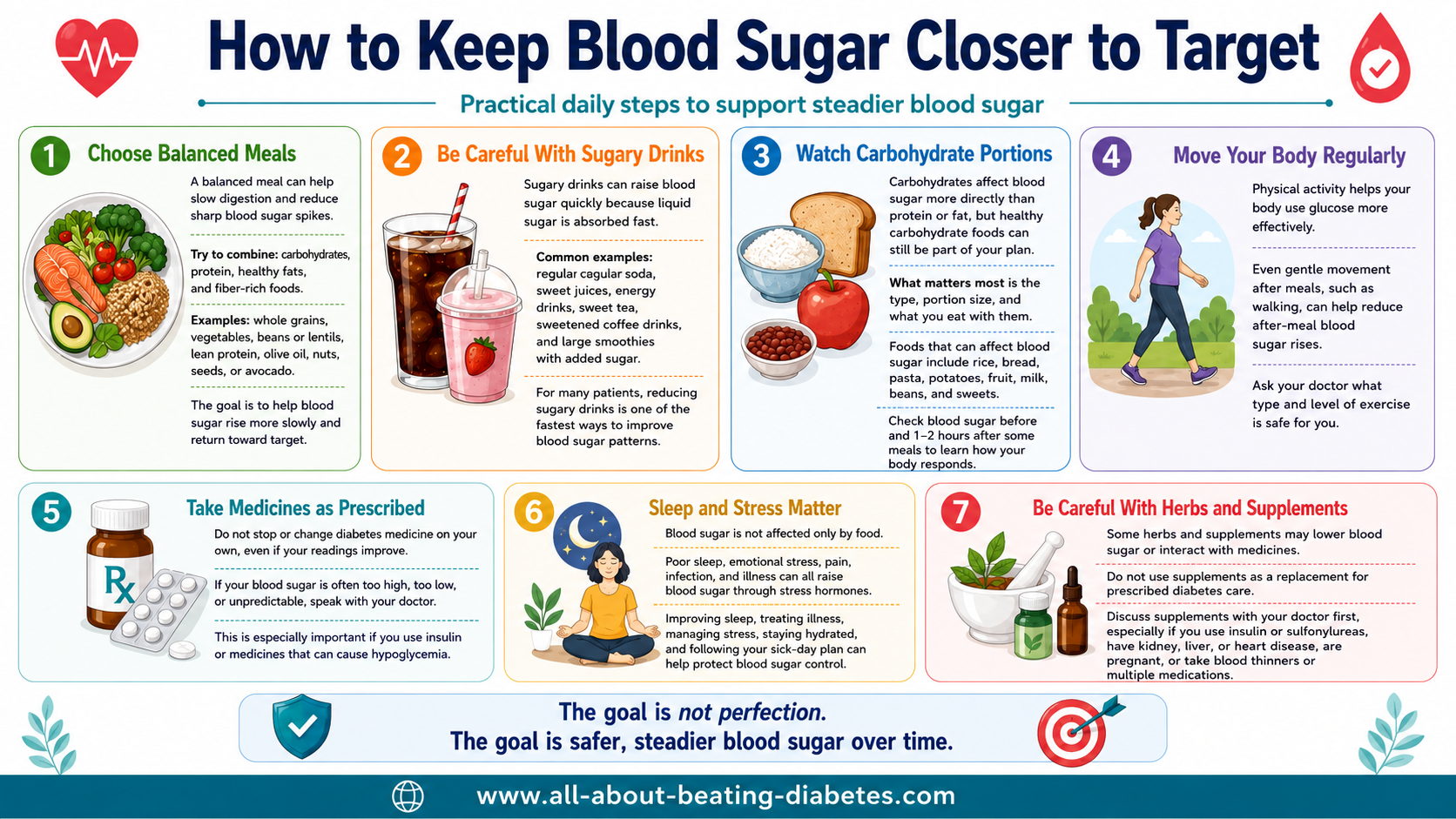
How to Keep Blood Sugar Closer to Target
The goal of diabetes care is not perfection. The goal is safer, steadier blood sugar over time, with fewer sharp highs and fewer dangerous lows.
Small daily habits can make a meaningful difference.


When Should You Call Your Doctor?
Contact your doctor if:
- Your fasting blood sugar is repeatedly above your personal target.
- Your after-meal blood sugar is repeatedly above target.
- Your blood sugar is often below 70 mg/dL.
- You have symptoms of low blood sugar.
- You are sick and your readings are rising.
- You are vomiting or cannot keep fluids down.
- You are losing weight without trying.
- You feel very thirsty and urinate often.
- Your medicines seem too strong or not strong enough.
- You are unsure how to adjust food, exercise, or medication safely.
Seek urgent medical help if you have very high blood sugar with vomiting, dehydration, confusion, difficulty breathing, severe weakness, fruity-smelling breath, or signs of diabetic ketoacidosis.
Final Note
My advice to you is simple: do not chase perfect numbers. Learn your pattern.
- A safe blood sugar plan should protect you from both high blood sugar and low blood sugar.
- High readings over time can damage the eyes, kidneys, nerves, heart, and blood vessels.
- Low readings can become dangerous quickly, especially if you use insulin or certain diabetes tablets.
- Your ideal blood sugar range should be personal, realistic, and safe.
- Work with your doctor. Keep a blood sugar log. Learn how food, movement, sleep, stress, and medication affect your numbers.
- Small daily improvements can make a very big difference over time.
Frequently Asked Questions
What is the ideal blood sugar level for diabetics?
What is the ideal blood sugar level for diabetics?
For many nonpregnant adults with diabetes, common targets for ideal sugar levels are 80–130 mg/dL before meals and less than 180 mg/dL 1–2 hours after meals. Your personal target may be different, so ask your doctor what range is safest for you.
Is 100 mg/dL a good blood sugar level?
Is 100 mg/dL a good blood sugar level?
A fasting blood sugar below 100 mg/dL is usually considered normal for people without diabetes. For many adults with diabetes, fasting or before-meal targets are often 80–130 mg/dL. The meaning depends on whether the reading was fasting, after a meal, or taken at another time.
Is 130 mg/dL high in the morning?
Is 130 mg/dL high in the morning?
For many adults with diabetes, 130 mg/dL is near the upper end of a common fasting target. If your fasting readings are 130 or are often above your personal goal, speak with your doctor. The cause may be food, sleep, stress, illness, or medication timing.
What should blood sugar be 2 hours after eating?
What should blood sugar be 2 hours after eating?
For many adults with diabetes, a common target for blood sugar 2 hours after eating is less than 180 mg/dL about 1–2 hours after the start of a meal. Your doctor may recommend a different goal depending on your health situation.
Is below 70 mg/dL dangerous?
Is below 70 mg/dL dangerous?
A blood sugar below 70 mg/dL is considered low for many people with diabetes and should be treated promptly according to your care plan. Severe symptoms such as confusion, fainting, seizure, or inability to swallow safely require emergency help.
Should men and women have different blood sugar targets?
Should men and women have different blood sugar targets?
Usually, blood sugar targets are not based only on gender. They are individualized based on age, pregnancy, medicines, risk of low blood sugar, diabetes type, other health conditions, and personal treatment goals.
Can I have normal fasting blood sugar but still have diabetes?
Can I have normal fasting blood sugar but still have diabetes?
Yes, it is possible. Some people may have normal fasting blood sugar but high after-meal blood sugar or an elevated A1C. Your doctor may use fasting glucose, A1C, oral glucose tolerance testing, symptoms, and risk factors to understand the full picture.
Common reasons include the dawn phenomenon, late dinner, evening snacks, poor sleep, stress, illness, inflammation, missed medication, or medication timing. If this happens repeatedly, discuss it with your doctor.
Is one high blood sugar reading dangerous?
Is one high blood sugar reading dangerous?
One high reading is not always an emergency, but it should not be ignored. Look at the full pattern. If readings are repeatedly high, or if high blood sugar comes with vomiting, dehydration, confusion, difficulty breathing, or severe weakness, seek medical help.
References
- American Diabetes Association. Standards of Care in Diabetes, 2026.
- American Diabetes Association. Checking Your Blood Sugar.
- National Institute of Diabetes and Digestive and Kidney Diseases. The A1C Test & Diabetes.
- Centers for Disease Control and Prevention. Manage Blood Sugar.
- Mayo Clinic. Diabetes Diagnosis and Treatment.
|
Convert mg/dl to mmol/l
Blood glucose level:
|