- Home
- Diabetes Information for Patients Types Symptoms Tests and Treatment
- How to Test for Insulin Resistance and Interpret HOMA-IR
Insulin Resistance Test: What Your Results Really Mean
Written by: Dr. Albana Greca Sejdini, MD, MMedSc
Medically reviewed by: Dr. Ruden Cakoni, MD, Endocrinologist
Last medically reviewed: July 2026
Insulin resistance means that muscle, liver, and fat cells do not respond to insulin as effectively as expected. The pancreas may compensate by producing more insulin for years, so fasting glucose and HbA1c can remain normal during early insulin resistance.
Is There a Definitive Insulin Resistance Test?
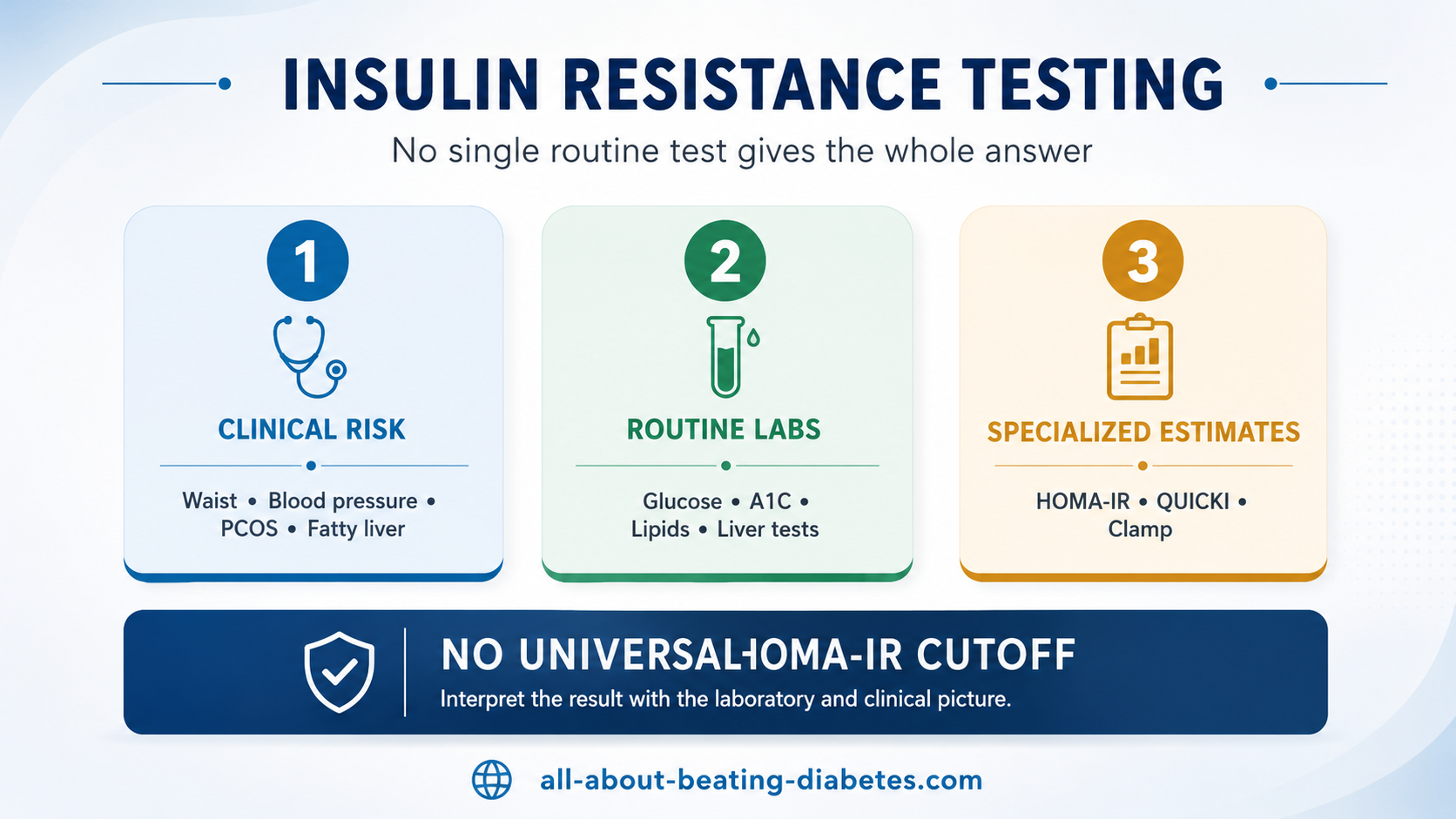
There are methods that directly measure insulin sensitivity, but no single inexpensive, standardized test is routinely used to diagnose insulin resistance in the same way that fasting glucose or HbA1c is used to diagnose diabetes.
The reason is not simply cost. Insulin resistance is a continuous biological characteristic rather than a yes-or-no condition, and different tissues can respond differently. For example, the liver may be insulin resistant while muscle insulin sensitivity differs. Results also vary with age, puberty, pregnancy, body composition, illness, medicines, ethnicity, laboratory insulin assays, and the method used.
In ordinary clinical care, the practical questions are often:
- Does the person have prediabetes or diabetes?
- Are triglycerides, HDL cholesterol, blood pressure, waist size, or liver fat abnormal?
- Is there polycystic ovary syndrome, acanthosis nigricans, sleep apnea, or another associated condition?
- Which risk factors can be treated now?
- Would measuring fasting insulin change management?

Educational HOMA-IR and QUICKI Calculator
Enter fasting laboratory glucose and fasting insulin drawn at the same time. This calculator estimates HOMA-IR and QUICKI. It does not diagnose insulin resistance and should not be used with one random glucose reading.
Important limitations: HOMA-IR and QUICKI are surrogate estimates. There is no universally accepted HOMA-IR cutoff. Results depend on the insulin assay and population. They may be misleading during acute illness, pregnancy, severe hyperglycemia, after prolonged fasting, with major changes in insulin secretion, and in people using injected insulin. HOMA-IR is not appropriate for deciding medication or insulin doses.
Hyperinsulinemic-Euglycemic Clamp: The Reference Method
The hyperinsulinemic-euglycemic clamp is widely regarded as the reference, or “gold-standard,” method for measuring insulin sensitivity.
During the procedure:
- Insulin is infused intravenously at a controlled rate.
- Glucose is checked frequently.
- Glucose is infused at a variable rate to keep the blood glucose near a normal, stable level.
- The amount of glucose needed to maintain that level is used to estimate how strongly insulin is promoting glucose uptake.
A person who is more insulin sensitive generally requires more infused glucose to maintain euglycemia during the standardized insulin infusion. A person who is more insulin resistant generally requires less.
The clamp is time-consuming, labor-intensive, costly, and technically demanding. It is mainly used in metabolic research and specialized clinical investigations rather than routine screening.
The old description that it “consists in measuring the blood insulin level” was incomplete. The procedure requires controlled insulin and glucose infusions with repeated glucose monitoring and protocol-specific calculations.
What Does a Fasting Insulin Test Show?
A fasting insulin test measures insulin concentration after an overnight fast. When glucose is still normal, a higher insulin level may suggest that the pancreas is compensating for reduced insulin sensitivity.
However, fasting insulin alone cannot diagnose insulin resistance because:
- insulin assays are not fully standardized among laboratories;
- reference intervals vary;
- insulin secretion changes with age, puberty, pregnancy, body composition, ethnicity, medicines, and pancreatic function;
- a person with advanced beta-cell dysfunction may have insulin resistance but a normal or low insulin level;
- acute stress, illness, fasting duration, and recent activity can affect results;
- injected insulin may interfere with interpretation depending on the assay.
Be cautious with online claims that one narrow fasting-insulin range is “optimal” for everyone. A value must be interpreted with the laboratory method, simultaneous glucose, health history, and reason for testing.
HOMA-IR and QUICKI
HOMA-IR
The Homeostatic Model Assessment of Insulin Resistance estimates insulin resistance from fasting glucose and fasting insulin.
HOMA-IR = fasting insulin × fasting glucose (mg/dL) ÷ 405
or fasting insulin × fasting glucose (mmol/L) ÷ 22.5
A higher HOMA-IR generally suggests lower insulin sensitivity within the population and method being studied. It mainly reflects fasting, or basal, glucose-insulin physiology and is influenced strongly by hepatic insulin resistance.
There is no universal cutoff because proposed thresholds differ by:
- population and ancestry;
- age, sex, puberty, and pregnancy;
- body size and metabolic health;
- insulin assay;
- study definition and reference method;
- whether the goal is research classification or clinical risk assessment.
HOMA2 is an updated computer model that accounts for some nonlinear aspects of glucose-insulin physiology. HOMA2 results are not interchangeable with the simple HOMA-IR formula.
QUICKI
The Quantitative Insulin Sensitivity Check Index also uses fasting glucose and insulin:
Lower QUICKI values generally indicate lower insulin sensitivity. Like HOMA-IR, QUICKI is a surrogate estimate and does not have one universal diagnostic threshold.
Fasting Glucose, HbA1c, and Prediabetes Testing
Fasting glucose and HbA1c do not directly measure insulin resistance. They identify whether the pancreas can still compensate sufficiently to keep glucose below prediabetes or diabetes thresholds.
| Test | Prediabetes | Diabetes |
|---|---|---|
| Fasting plasma glucose | 100–125 mg/dL | 126 mg/dL or higher |
| HbA1c | 5.7%–6.4% | 6.5% or higher |
| Two-hour 75-g OGTT glucose | 140–199 mg/dL | 200 mg/dL or higher |
A person may have insulin resistance with normal glucose tests because the pancreas is producing additional insulin. Conversely, abnormal glucose can occur for reasons other than ordinary type 2 insulin resistance, including type 1 diabetes, pancreatic disease, pregnancy, medication effects, or endocrine disease.
Without unequivocal hyperglycemia, a diabetes-range result generally requires confirmation. Read the blood tests for diabetes guide.
Oral Glucose Tolerance Test and Insulin Measurements
A standard 75-g oral glucose tolerance test measures plasma glucose before and two hours after a glucose drink. It is used to diagnose prediabetes and diabetes—not to directly diagnose insulin resistance.
Some specialists or researchers measure insulin at fasting and at several points during an OGTT. These values can help study insulin secretion and insulin sensitivity, but routine interpretation is difficult because:
- there are no universally standardized insulin thresholds at each time point;
- different laboratories use different assays;
- timing protocols vary;
- high insulin may represent compensation, while low insulin may represent beta-cell failure;
- the same glucose result can reflect different combinations of insulin resistance and insulin secretion.
An “insulin curve” should not be interpreted from one online chart. The complete pattern must be considered with glucose, symptoms, medicines, pregnancy status, and clinical context.
Other Tests and Markers Associated With Insulin Resistance
Triglycerides and HDL cholesterol
High triglycerides and low HDL cholesterol commonly occur with insulin resistance. They identify cardiometabolic risk but do not prove insulin resistance by themselves.
Waist circumference and waist-to-height ratio
Increased abdominal or visceral fat is associated with insulin resistance. Body measurements are screening tools, not direct metabolic measurements.
Blood pressure
High blood pressure often clusters with insulin resistance, abnormal lipids, and elevated glucose. Treating blood pressure is important regardless of whether a formal insulin-resistance estimate is calculated.
Liver tests and metabolic liver disease
Fatty liver disease is strongly associated with insulin resistance. Normal ALT and AST do not exclude liver fat or fibrosis, and abnormal liver tests have many causes.
Triglyceride-glucose index
The TyG index is calculated from fasting triglycerides and glucose and is used increasingly in research as a surrogate marker. It is not a universally accepted diagnostic test for individual clinical care.
C-peptide
C-peptide estimates endogenous insulin secretion. It is useful in selected cases to help classify diabetes or assess beta-cell function, especially in people treated with insulin. It is not a direct test of insulin resistance.
Does Insulin Resistance Cause Symptoms?
Insulin resistance itself usually causes no specific symptoms. Many people feel well while the pancreas compensates with higher insulin production.
Possible clinical clues include:
- acanthosis nigricans—dark, thickened, velvety skin, often on the neck or armpits;
- skin tags;
- increased waist circumference;
- polycystic ovary syndrome, irregular ovulation, or fertility concerns;
- high triglycerides, low HDL cholesterol, or high blood pressure;
- fatty liver disease;
- prediabetes;
- sleep apnea.
Fatigue, hunger, cravings, brain fog, or sleepiness after meals are nonspecific and cannot diagnose insulin resistance.
Thirst, frequent urination, weight loss, or blurry vision may indicate that glucose has already risen into the diabetes range rather than proving early insulin resistance.
Learn more in What Is Insulin Resistance?
How to Prepare for Fasting Glucose and Insulin Tests
Follow the laboratory and clinician’s instructions. Common preparation includes:
- fasting for approximately 8–12 hours, with water usually allowed;
- avoiding an unusually heavy meal or alcohol the evening before;
- avoiding strenuous exercise immediately before testing unless instructed otherwise;
- telling the clinician about acute illness, pregnancy, steroids, supplements, and all medicines;
- not stopping medicine unless specifically instructed;
- having glucose and insulin drawn at the same time when HOMA-IR is planned.
A prolonged fast is not better and may change glucose and insulin physiology. Acute infection, sleep loss, pain, stress, and recent major diet changes can also affect results.
How Should Insulin Resistance Results Be Interpreted?
The clinician should interpret the complete picture rather than one score:
- Confirm the question. Are you screening for prediabetes, investigating PCOS, studying unexplained hypoglycemia, classifying diabetes, or assessing research insulin sensitivity?
- Check the laboratory method and reference interval.
- Review simultaneous glucose. The same insulin value means different things at glucose 80, 110, or 180 mg/dL.
- Consider insulin secretion. Advanced beta-cell dysfunction can lower insulin even when insulin resistance remains present.
- Review medicines and illness.
- Look at cardiometabolic risk. Waist, blood pressure, triglycerides, HDL, liver health, sleep apnea, and smoking may matter more clinically than a borderline HOMA score.
- Repeat only when it will change management.
What Happens After an Insulin Resistance Evaluation?
Management is generally based on risk and associated conditions rather than achieving one “perfect” fasting-insulin or HOMA-IR number.
Possible next steps include:
- testing for prediabetes or diabetes;
- reviewing blood pressure and cholesterol;
- assessing metabolic liver disease;
- screening for sleep apnea or PCOS when appropriate;
- increasing aerobic and resistance activity safely;
- reducing prolonged sedentary time;
- improving food quality and carbohydrate portions;
- supporting sustainable weight management when appropriate;
- stopping smoking;
- using metformin for selected people with high-risk prediabetes;
- treating diabetes, obesity, hypertension, or abnormal lipids when present.
Insulin resistance may improve substantially, but no laboratory estimate can guarantee that type 2 diabetes or cardiovascular disease will never develop. Follow-up should focus on glucose, blood pressure, lipids, weight or waist trends, liver health, and the treatment goals relevant to you.
See insulin resistance treatment strategies and the prediabetes guide.
Most Asked Questions
What is a normal HOMA-IR?
There is no universal normal range. Cutoffs vary by age, population, insulin assay, pregnancy status, and study method. Use the laboratory and clinician’s interpretation rather than one internet number.
Can I have insulin resistance with normal glucose?
Yes. The pancreas may compensate by making more insulin. Normal glucose does not prove normal insulin sensitivity.
Can I have insulin resistance with normal insulin?
Yes. Insulin secretion may be declining, the assay range may be broad, or resistance may not be captured accurately by a fasting measurement.
Does a high fasting insulin mean diabetes?
No. Diabetes is diagnosed with glucose or HbA1c criteria. High fasting insulin may suggest compensation, but it does not diagnose diabetes.
Can a glucose meter test insulin resistance?
No. A meter measures glucose, not insulin sensitivity. Repeated patterns can identify abnormal glucose but cannot calculate a definitive insulin-resistance diagnosis.
Is the OGTT an insulin resistance test?
A standard OGTT diagnoses impaired glucose tolerance or diabetes. It may indirectly reveal difficulty handling glucose, but it is not a direct measurement of insulin sensitivity.
Should everyone with obesity have fasting insulin measured?
Not necessarily. Testing is useful only when it will add information or change care beyond routine metabolic-risk evaluation.
Related Questions
- How Should GTT and Insulin Resistance Results Be Interpreted?
- Fasting Glucose 159 but Two-Hour Glucose 109: Am I Diabetic?
- Why Is HbA1c High When Finger-Prick Readings Look Normal?
Related Resources
- What Is Insulin Resistance?
- Insulin Resistance Treatment
- Prediabetes Symptoms, Testing, and Prevention
- Blood Tests for Diabetes
- Type 2 Diabetes Risk Screener
- BMI and Waist-to-Height Calculator
Medical disclaimer: This calculator and article provide general education. They do not diagnose insulin resistance, prediabetes, diabetes, PCOS, fatty liver disease, or another condition. Do not start, stop, or change medicine based on fasting insulin, HOMA-IR, QUICKI, or an online calculation.
References
- National Institute of Diabetes and Digestive and Kidney Diseases: Insulin Resistance and Prediabetes
- American Diabetes Association: Diagnosis and Classification of Diabetes—Standards of Care in Diabetes 2026
- American Diabetes Association: Prevention or Delay of Diabetes—2026
- Kim: Hyperinsulinemic-Euglycemic Clamp to Assess Insulin Sensitivity
- Gastaldelli and colleagues: Measuring and Estimating Insulin Resistance in Clinical and Research Settings
- Rudvik and Månsson: Evaluation of Surrogate Measures of Insulin Sensitivity
- Schrank and colleagues: Fasting Insulin and HOMA-IR Reference Intervals