- Home
- Diabetes Complications
- Why Do My Feet Turn Purple Or Blue With Diabetes
Purple or Blue Feet With Diabetes: Causes and Urgent Signs
If you have diabetes and a foot becomes painful, purple, blue, very dark, or unusually pale, I do not want you to assume that it is “only neuropathy.” A color change can be a warning that blood is not entering or leaving the foot normally, but infection, injury, pressure, bruising, and other conditions can look similar.
The pattern matters: Did the change begin suddenly? Is one foot affected or both? Is the foot cold or warm? Is there swelling, a wound, numbness, fever, or severe pain? These details help determine how urgently you need care.
Painful purple or blue feet in a person with diabetes may be caused by reduced arterial blood flow, venous congestion, a blood clot, infection, a wound, pressure or injury, Charcot foot, or swelling related to the heart, kidneys, medicines, or veins. Diabetic neuropathy can cause burning, tingling, electric-shock pain, and numbness, but neuropathy alone does not adequately explain new blue-purple skin. A new color change needs prompt clinical assessment.
When Purple or Blue Feet Are an Emergency
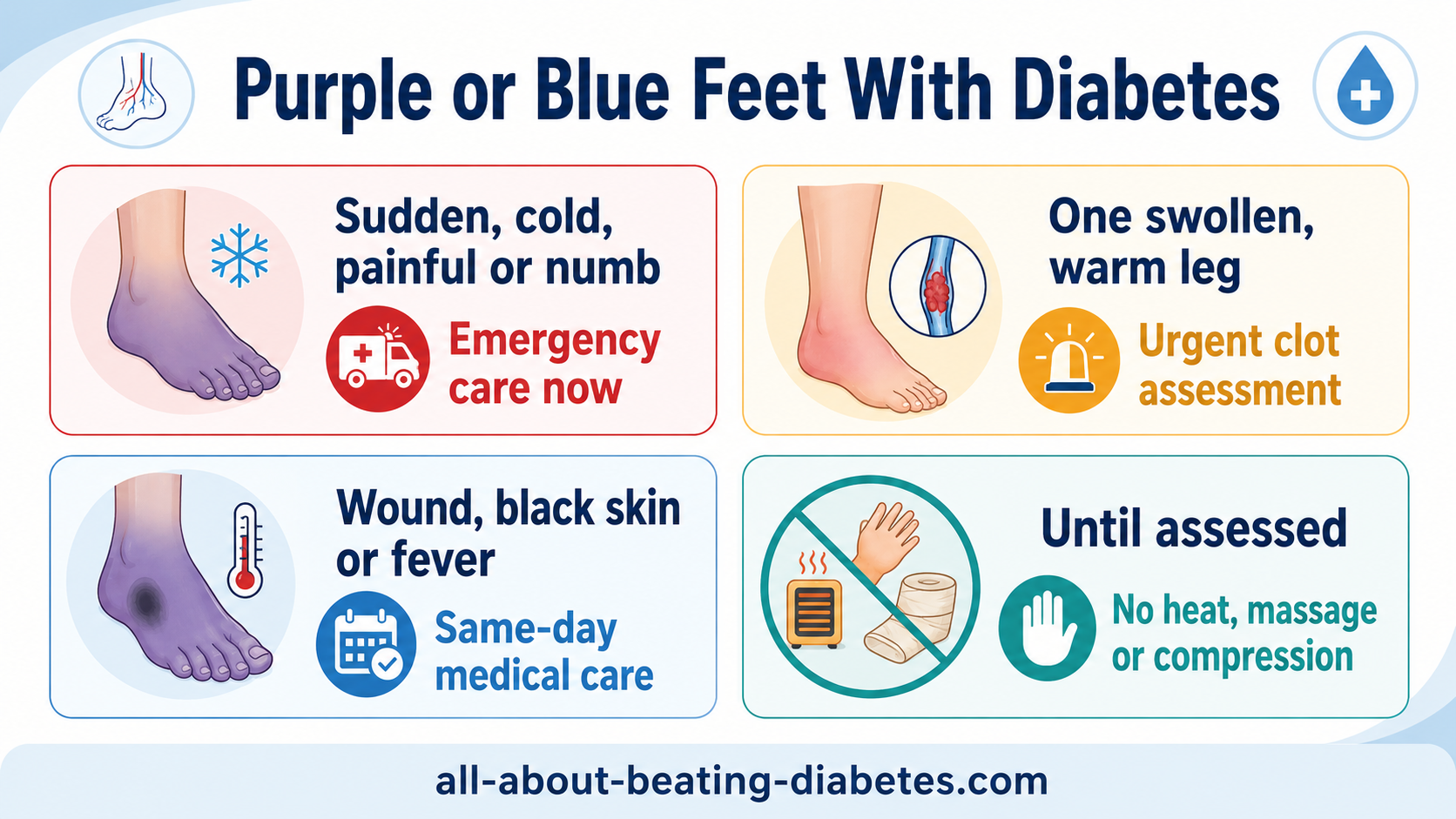
Call emergency services now if a foot or leg suddenly becomes blue, pale, or very cold and is painful, numb, weak, or difficult to move. These can be signs of acute limb ischemia—an abrupt loss of arterial blood flow in which time matters.
Also call emergency services for new one-sided leg swelling with chest pain, sudden shortness of breath, coughing blood, fainting, or a very fast heartbeat, because a blood clot may have traveled to the lungs.
The Patient Story Behind This Question
One of my patients had lived with type 2 diabetes for more than 10 years. He used metformin and bedtime insulin and had overweight with abdominal fat. He developed pain around both ankles, ankle swelling, and feet that sometimes looked purple or unusually dark. He reported that several Doppler ultrasound examinations had been described as normal.
This history is useful for teaching, but it does not provide one diagnosis. In a real consultation, I would first confirm exactly which Doppler test was performed, when it was done, which blood vessels were examined, and whether the color change was present at the time. I would then compare both feet and assess arteries, veins, nerves, skin, joints, wounds, medicines, heart and kidney health.
What Can Cause Painful Purple or Blue Feet in Diabetes?
| Possible cause | Clues that may occur | How urgently to act |
|---|---|---|
| Acute loss of arterial blood flow | Sudden severe pain; pale, blue, or mottled color; a cold foot; numbness, weakness, absent pulse, or difficulty moving the toes | Emergency. Call emergency services immediately. |
| Peripheral artery disease (PAD) | Calf or foot discomfort with walking, pain at rest, cold skin, weak pulses, slow-healing wounds, or a foot that becomes red-purple when lowered and paler when raised; PAD can also be painless | Prompt assessment; urgent care for rest pain, a wound, rapidly changing color, or black tissue. |
| Deep-vein thrombosis (DVT) | New swelling mainly in one leg, calf or thigh pain, warmth, tenderness, redness or blue-purple discoloration, and more visible veins | Urgent same-day assessment. Chest pain or breathlessness is an emergency. |
| Chronic venous insufficiency | Ankle swelling and heaviness that often worsen after standing, varicose veins, itching, aching, and gradual brown, red, or purple skin change | Arrange assessment. New one-sided swelling still needs a clot excluded. |
| Infection, ulcer, or gangrene | A break in the skin, drainage, odor, spreading redness, warmth, swelling, tenderness, fever, or blue-black tissue; pain may be mild when neuropathy is present | Same-day urgent care; emergency care if rapidly spreading or the person is seriously unwell. |
| Active Charcot foot | A foot that is much warmer, redder, and more swollen than the other, sometimes after minor injury and sometimes with surprisingly little pain | Stop weight-bearing and seek same-day specialist assessment. |
| Pressure, injury, or bruising | A localized purple area after a bump, tight shoe, friction, pressure under a callus, or bleeding under the skin; the injury may not have been felt | Prompt assessment if the skin is broken, pain is increasing, color spreads, or circulation is uncertain. |
| Cold-related vessel spasm | Toes may become pale or blue with cold and improve after gentle rewarming; episodes may affect both sides | A clinician should confirm the cause. Do not attribute a new painful blue foot to cold alone. |
| Generalized fluid retention or medicine effect | Both ankles or legs swell; possible breathlessness, rapid weight gain, reduced kidney function, or use of medicines such as pioglitazone, amlodipine, steroids, or NSAIDs | Arrange a prompt medical and medication review; urgent care for breathlessness or rapidly worsening swelling. |
| Joint inflammation, gout, or arthritis | Pain, warmth, and swelling centered around a joint, often the ankle or big toe; color may be red-purple because of local inflammation | Needs targeted examination. Do not assume arthritis before circulation and infection are assessed. |
You can read more about the different patterns in my guides to diabetes-related leg pain, diabetes foot symptoms, and diabetic foot ulcers.

Does Diabetic Neuropathy Make Feet Turn Purple?
Diabetic peripheral neuropathy commonly causes tingling, burning, electric-shock pain, sensitivity, numbness, poor balance, or loss of protective sensation. It can allow a blister, tight shoe, burn, bruise, or pressure injury to develop without being noticed. Autonomic nerve damage can also alter sweating and skin health.
However, neuropathy should not be used as the sole explanation for purple or blue skin. The color may come from an unnoticed injury, an ulcer, reduced arterial flow, venous pooling, infection, or another condition occurring alongside neuropathy. This is why I inspect the skin and circulation as carefully as I test sensation.
A 10-g monofilament helps identify loss of protective sensation. Vibration, pinprick, temperature, reflexes, strength, and balance may also be checked. Nerve-conduction studies or electromyography are not required for every typical case; they are more useful when the pattern is unusual, asymmetric, rapidly progressive, motor-predominant, or otherwise uncertain. See my full guide to diabetic peripheral neuropathy.
Can Feet Be Purple Even When a Doppler Test Is Normal?
Yes. “Doppler” is not one single test. A venous Doppler may look for a blood clot or faulty veins, while an arterial Doppler evaluates arterial flow. A study of larger leg vessels may not answer every question about pressure or perfusion at the toes. A result also describes the situation when the test was performed; it cannot rule out a later change.
In diabetes, ankle arteries can become stiff and difficult to compress. This can produce a falsely high or apparently reassuring ankle-brachial index (ABI). When symptoms or examination findings still suggest poor blood flow, clinicians may combine:
- foot pulses, skin temperature, capillary refill, and Doppler waveforms
- ankle pressure and ABI
- toe pressure and toe-brachial index (TBI)
- pulse-volume recordings or segmental pressures
- transcutaneous oxygen or skin-perfusion measurements
- arterial duplex ultrasound, CT angiography, MR angiography, or catheter angiography when indicated
How a Doctor Assesses a Painful Discolored Foot
I begin by asking when the change started, whether it is constant or position-dependent, whether one or both feet are affected, and whether there is pain with walking, rest pain, swelling, a wound, fever, trauma, immobility, surgery, smoking, or a previous ulcer. I also review glucose patterns, kidney and heart health, and all prescription and nonprescription products.
Foot and circulation examination
I compare color, temperature, swelling, pulses, capillary refill, wounds, callus, pressure areas, veins, foot shape, footwear, movement, and the difference between the two feet.
Nerve and joint examination
I assess protective sensation, vibration, reflexes, strength, balance, joint tenderness, warmth, range of motion, and whether active Charcot foot, gout, arthritis, or injury is possible.
Tests should follow the clinical pattern. They may include glucose or A1C, complete blood count, kidney and liver function, urine albumin, inflammatory markers when infection or inflammation is suspected, vascular testing, venous ultrasound for suspected DVT, or X-ray and MRI for a wound, fracture, bone infection, or Charcot foot.
There is no standard panel of ESR, CRP, antistreptolysin, rheumatoid factor, and fibrinogen that can determine the cause of every painful swollen purple foot. Rheumatoid factor can be positive without rheumatoid arthritis and negative when inflammatory arthritis is present. Antistreptolysin testing is useful only in selected clinical situations. The history and examination should determine which tests are appropriate.
What Should You Do Until the Foot Is Assessed?
- Choose the right level of care. Use emergency services for sudden coldness, severe pain, numbness, weakness, a pale-blue foot, or chest and breathing symptoms. Seek same-day care for a new wound, black tissue, fever, one-sided swelling, or a hot red swollen foot.
- Reduce pressure. Do not force yourself to walk through pain or continue weight-bearing on a hot swollen foot, a wound, or a possible circulation emergency.
- Inspect without injuring the skin. Look at the sole and between the toes. Note wounds, blisters, drainage, odor, bruising, callus, temperature, and whether the other foot looks different.
- Protect the foot. Use clean, loose, protective footwear if walking is safe. Do not walk barefoot, cut calluses, puncture blisters, or apply strong chemicals.
- Bring useful information. Take your medicine list, recent glucose readings, prior Doppler reports, and a photograph showing how the color changes over time or with position.
- Continue prescribed diabetes treatment. Do not stop insulin or change doses solely because of the foot color unless your treating clinician gives you specific instructions.
Can you take ibuprofen, ketoprofen, or naproxen?
Do not use an anti-inflammatory medicine as a substitute for diagnosis. NSAIDs can worsen fluid retention, blood pressure, kidney function, heart failure, stomach bleeding, and interactions with blood thinners or other medicines. They may also reduce pain while a serious foot problem continues. Ask a clinician or pharmacist whether any pain medicine is safe for your kidney, heart, stomach, and medication history.
How Is a Purple or Blue Diabetic Foot Treated?
Treatment depends completely on the cause. Acute arterial blockage needs emergency vascular treatment. Chronic PAD may require cardiovascular risk treatment, structured exercise for selected patients, medicines, and sometimes revascularization. A DVT usually requires anticoagulation when confirmed. Infection may need antibiotics, drainage, wound care, and urgent circulation assessment. Active Charcot foot requires immediate offloading and specialist follow-up.
Venous disease may be managed with movement, elevation, skin care, and correctly selected compression—but only after dangerous arterial disease and an acute clot have been considered. Neuropathic pain treatment may include glucose management, foot protection, and a clinician-selected neuropathic pain medicine. Joint disease requires its own diagnosis and targeted treatment.
Improving glucose, blood pressure, cholesterol, smoking status, weight, and activity can protect circulation and nerves over time. However, lowering one high glucose reading will not immediately reverse a blue foot, dissolve a clot, treat an infection, or restore a blocked artery. My daily diabetic foot-care guide can help you prevent injuries after the urgent cause has been addressed.
Doctor’s Note
When a patient with diabetes shows me a painful purple or blue foot, I first decide whether the foot is threatened. I compare temperature, pulses, capillary refill, sensation, swelling, wounds, and movement in both feet. A burning or electric-shock feeling may suggest neuropathy, but it does not allow me to ignore a new color change. I also ask which Doppler study was normal, because a venous study, an arterial study, ABI, and toe-pressure testing answer different questions. The safest approach is to identify the vascular, infectious, neurologic, or joint cause before recommending compression, exercise, heat, herbs, or pain medicine.
Frequently Asked Questions About Purple or Blue Feet With Diabetes
Why do diabetic feet turn purple or blue?
Possible causes include reduced arterial blood flow, venous pooling, DVT, bruising or pressure injury, infection, an ulcer, cold-related vessel spasm, and swelling from heart, kidney, medicine, or vein problems. The color alone cannot identify the cause.
Is a purple or blue foot always an emergency?
Not always, but a sudden cold, pale-blue, severely painful, numb, weak, or immobile foot is an emergency. A wound, black tissue, fever, a hot swollen foot, or new one-sided leg swelling requires urgent same-day assessment.
Can diabetic neuropathy change foot color?
Neuropathy can reduce sensation and allow an unnoticed injury, pressure area, burn, or ulcer to develop. It may alter sweating and skin health, but neuropathy alone should not be assumed to be the cause of new purple-blue skin. Circulation, infection, and injury still need assessment.
Can peripheral artery disease cause purple feet?
Yes. PAD can cause coldness, weak pulses, walking pain, rest pain, slow-healing wounds, pallor, or red-purple color changes, particularly with position. PAD may also be present without typical pain when neuropathy reduces sensation.
Why are my Doppler results normal when my feet change color?
The test may have examined veins rather than arteries, focused on larger vessels, been performed before the new change, or not included toe pressure and waveforms. In diabetes, stiff ankle arteries can also make ABI results falsely high. Your clinician should match the exact test with your current examination.
Should I elevate a purple foot?
Elevation can temporarily reduce venous or dependent swelling, but severe arterial pain may worsen when the foot is raised. Because the direction of change can help identify the cause, do not rely on elevation as treatment for a new painful discolored foot. Seek assessment.
Can I wear compression socks for purple swollen feet?
Do not start compression until a clinician has assessed arterial circulation and considered a clot, infection, wound, and Charcot foot. Correctly fitted compression can help selected venous conditions, but it may be unsafe with severe arterial insufficiency.
Will better blood sugar control return my feet to normal color?
Keeping glucose in your individualized target range supports nerve, vessel, immune, and wound health over time. It does not immediately correct an arterial blockage, DVT, infection, venous disease, bruise, or Charcot foot. The specific cause must be treated.
Related Questions From Readers
Related Resources
References
- American Diabetes Association. Retinopathy, Neuropathy, and Foot Care: Standards of Care in Diabetes—2026.
- National Institute of Diabetes and Digestive and Kidney Diseases. Diabetes & Foot Problems.
- 2024 ACC/AHA Multisociety Guideline for the Management of Lower Extremity Peripheral Artery Disease.
- IWGDF, ESVS, and SVS. Intersocietal Guideline on Peripheral Artery Disease in People With Diabetes and a Foot Ulcer.
- Society for Vascular Surgery. Deep Vein Thrombosis.
- Society for Vascular Surgery. Chronic Venous Insufficiency.