- Home
- Best Foods for Diabetes and What to Avoid
- 800 Calorie Diabetes Plan for Type 2 Diabetes Remission
800-Calorie Diabetes Diet Plan: Benefits, Risks, and Medical Supervision
Written by: Dr. Albana Greca Sejdini, MD, MMedSc
Medically reviewed by: Dr. Ruden Cakoni, MD, Endocrinologist
Last medically reviewed: July 2026
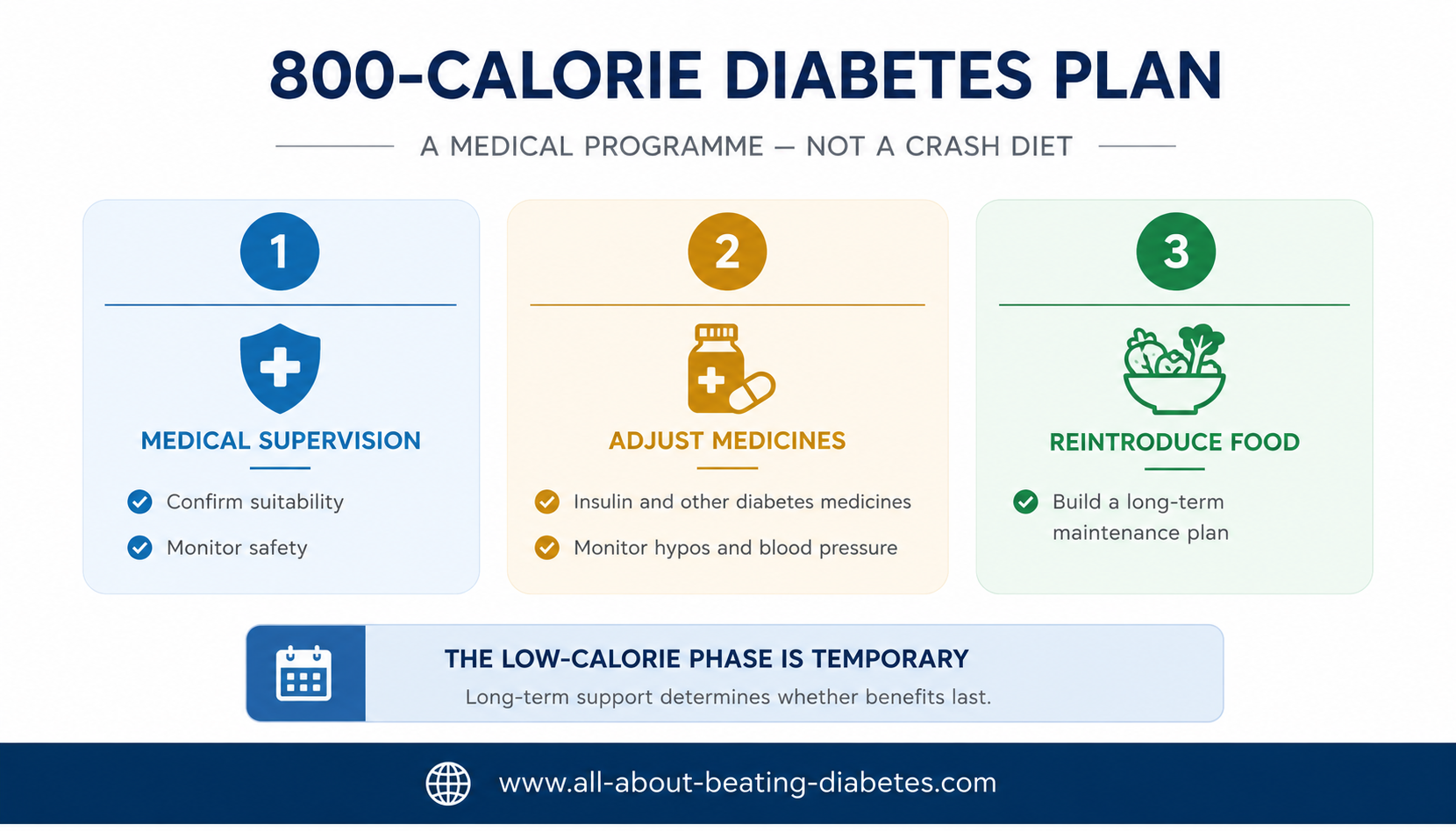
An 800-calorie diabetes programme is a short-term, highly restrictive weight-management intervention used for selected adults with type 2 diabetes and overweight or obesity. The best-studied programmes use nutritionally complete total diet replacement products, close clinical monitoring, medication adjustment, structured food reintroduction, and long-term weight-maintenance support.
- What an 800-calorie programme is
- Evidence for weight loss and remission
- Who may benefit
- Who should not start independently
- Type 1 diabetes
- Medication adjustment
- The four programme phases
- Nutritional completeness
- Side effects and risks
- Monitoring checklist
- What remission means
- Preventing weight regain
- Safer alternatives
What Is an 800-Calorie Diabetes Diet?
An 800-calorie plan provides approximately 800 kilocalories per day—far below the energy needs of most adults. Terminology varies among professional organisations:
- ADA 2026 describes very-low-calorie interventions as usually providing approximately 800–1,000 kcal per day.
- NICE classifies 800–1,200 kcal per day as a low-energy diet and under 800 kcal per day as a very-low-energy diet.
Whatever term is used, 800 calories is a medically significant restriction. It is not simply a smaller version of an ordinary healthy meal plan.
The strongest evidence comes from structured programmes that use nutritionally complete total diet replacement—often formulated soups, shakes, or bars—for a defined initial period. These products are designed to provide specified protein, essential fatty acids, vitamins, minerals, and trace elements while calories remain very low.
The original page’s mixture of four protein supplements, measured meat, fruit exchanges, diet cola, coffee cream, and a general multivitamin is not equivalent to a validated remission programme. A homemade combination may fail to provide adequate protein, essential fats, electrolytes, vitamins, minerals, fiber, or medication safety.

What Does the Evidence Show?
DiRECT clinical trial
The Diabetes Remission Clinical Trial, or DiRECT, studied a structured primary-care weight-management programme in adults with type 2 diabetes. It used total diet replacement followed by gradual food reintroduction and long-term weight-maintenance support.
At one year, almost half of participants in the intervention group met the study definition of remission. Remission was closely related to the amount of weight lost: among participants who lost at least 15 kg, remission was achieved by a large majority.
The important lesson is not that “800 calories cures diabetes.” The results came from:
- carefully selected participants;
- structured total diet replacement;
- early medication review;
- regular follow-up;
- food reintroduction;
- weight-maintenance support;
- continued medical monitoring.
NHS Type 2 Diabetes Path to Remission Programme
NHS England now offers eligible adults a programme using nutritionally complete total diet replacement providing approximately 800–900 calories daily for 12 weeks, followed by food reintroduction and support for a total of 12 months.
Early real-world results showed that among participants who completed the programme and had the required HbA1c measurements, approximately one-third achieved remission at one year, with substantial average weight loss.
Not everyone completes the programme, loses the same amount of weight, or achieves remission. Weight regain and return of diabetes-range glucose can occur.
Who May Be Considered for a Supervised Programme?
A low-energy total diet replacement programme may be considered for selected adults who:
- have type 2 diabetes and overweight or obesity;
- need substantial weight loss to improve health;
- have relatively recent type 2 diabetes and retain enough beta-cell function to make remission more likely;
- can attend regular medical and dietary follow-up;
- can monitor glucose as instructed;
- understand that the initial phase is temporary;
- are willing to complete food reintroduction and long-term maintenance.
NHS England’s specific programme has formal eligibility rules, including type 2 diabetes diagnosed within the previous six years and BMI thresholds. Other services may use different criteria.
ADA 2026 notes that very-low-calorie interventions may be appropriate for some people with diabetes and obesity. It does not recommend that every person with type 2 diabetes consume 800 calories.
Who Should Not Start an 800-Calorie Diet Independently?
Specialist assessment is especially important for people with:
- type 1 diabetes or suspected insulin deficiency;
- pregnancy, plans for pregnancy, or breastfeeding;
- childhood or adolescence;
- an active or previous eating disorder, significant food restriction, or disordered eating;
- frailty, underweight, malnutrition, sarcopenia, or unexplained weight loss;
- advanced kidney or liver disease;
- heart failure, significant arrhythmia, unstable cardiovascular disease, or fluid restriction;
- recurrent severe hypoglycemia or impaired hypoglycemia awareness;
- gastroparesis, malabsorption, inflammatory bowel disease, or major gastrointestinal surgery;
- gallstones, recurrent pancreatitis, or substantial gallbladder risk;
- acute infection, recent surgery, cancer treatment, or another catabolic illness;
- complex insulin regimens or multiple medicines requiring rapid adjustment;
- a medical or psychiatric condition that makes adherence or monitoring unsafe.
This list is not exhaustive. Suitability depends on the complete health assessment, not only BMI or the desire for rapid weight loss.
Why This Is Not a Routine Type 1 Diabetes Diet
Type 1 diabetes is caused by autoimmune insulin deficiency. An 800-calorie diet does not restore pancreatic beta cells and cannot replace insulin.
Severe carbohydrate and calorie restriction in type 1 diabetes may increase the risk of:
- hypoglycemia if insulin is not adjusted safely;
- ketone production and DKA if insulin is reduced excessively or omitted;
- loss of muscle and lean tissue;
- nutrient inadequacy;
- eating-disorder behaviors or diabetes-related disordered eating.
Read the type 1 diabetes information guide.
Why Diabetes Medicines Must Be Reviewed First
Glucose can fall rapidly after calorie and carbohydrate intake is reduced. Medicines that were appropriate with the previous diet may become excessive.
Insulin, sulfonylureas, and meglitinides
These medicines can cause hypoglycemia. Dose reduction, temporary discontinuation, or more frequent glucose monitoring may be required before or at the start of the programme. The exact adjustment must come from the prescribing clinician.
SGLT2 inhibitors
SGLT2 inhibitors can increase the risk of ketoacidosis, sometimes with glucose that is not extremely high. Severe calorie restriction, very-low-carbohydrate intake, dehydration, illness, surgery, or reduced insulin can add to this risk. The clinician should decide whether and when the medicine must be paused.
Blood-pressure medicines and diuretics
Rapid weight loss and lower food intake can reduce blood pressure or change fluid and electrolyte balance. Dizziness, fainting, dehydration, and kidney problems may occur if medicines are not reviewed.
GLP-1 medicines and tirzepatide
These treatments reduce appetite and can cause nausea, vomiting, constipation, or dehydration. Combining them with an 800-calorie programme requires an individualized nutrition and medication plan rather than simply adding both interventions.
Other medicines
Warfarin, lithium, seizure medicines, thyroid replacement, transplant medicines, and other treatments may require special monitoring when diet, hydration, body weight, or vitamin K intake changes.
Review all prescriptions, over-the-counter medicines, vitamins, minerals, and supplements before starting.
The Four Phases of a Proper Programme
1. Medical and nutritional assessment
Before starting, the team may review:
- diabetes type and duration;
- HbA1c and glucose patterns;
- insulin and medicine doses;
- blood pressure and hydration;
- kidney, liver, and cardiovascular health;
- weight history and previous diets;
- eating-disorder risk and mental health;
- pregnancy status;
- ability to monitor and attend follow-up;
- a plan for hypoglycemia, illness, and ketones.
2. Total diet replacement
A validated programme usually replaces ordinary meals with specified nutritionally complete products for approximately 8–12 weeks. The exact calorie level, product, fluid plan, fiber, and allowed nonstarchy vegetables depend on the service protocol.
This is different from choosing four random protein bars or shakes. Products vary greatly in protein, carbohydrate, fat, potassium, sodium, fiber, vitamins, and minerals.
3. Structured food reintroduction
Ordinary food is reintroduced gradually over several weeks. This phase teaches:
- balanced portions;
- meal structure;
- protein and fiber intake;
- carbohydrate quality and amount;
- how glucose responds as food returns;
- which medicines need further adjustment.
Returning immediately to the previous eating pattern increases the likelihood of glucose deterioration and weight regain.
4. Long-term maintenance
The long-term phase may include regular weighing, activity goals, relapse planning, meal-replacement “rescue” periods within the programme, behavioral support, obesity medication, or bariatric/metabolic surgery when appropriate.
Why Nutritional Completeness Matters
At 800 calories, there is little room for nutritional error. A supervised plan must protect:
- protein and lean mass;
- essential fatty acids;
- vitamins and minerals;
- electrolytes and fluid balance;
- fiber and bowel function;
- individual kidney, liver, and heart requirements.
A generic multivitamin does not automatically correct an inadequate homemade diet. It may not provide enough protein, sodium, potassium, magnesium, calcium, essential fat, or fiber, and excessive supplementation can also be harmful.
The old fixed macronutrient target of 40% carbohydrate, 40% protein, and 20% fat is not a universal requirement. Validated programmes use their own formulations and are adjusted to clinical needs.
Possible Side Effects and Risks
Short-term effects may include:
- hunger, headache, irritability, or difficulty concentrating;
- fatigue, weakness, dizziness, or feeling cold;
- constipation or diarrhea;
- bad breath or altered taste;
- sleep changes;
- temporary hair shedding;
- loss of lean tissue if protein and resistance activity are inadequate;
- hypoglycemia;
- low blood pressure or dehydration;
- electrolyte disturbance;
- gout symptoms or changes in uric acid;
- menstrual changes;
- gallstones during rapid weight loss.
NICE advises that low-energy and very-low-energy diets should be nutritionally complete, last no more than 12 weeks, and include ongoing clinical support. It also advises discussing constipation, fatigue, hair loss, weight cycling, weight regain, and other adverse events.
Gallstones
Rapid weight loss increases gallstone risk. Seek medical advice for persistent upper-right abdominal pain, particularly after eating, or pain with fever, vomiting, jaundice, or dark urine.
Loss of muscle
Rapid weight loss includes both fat and lean tissue. Adequate protein, appropriate resistance activity, and monitoring are especially important for older adults or anyone at risk of sarcopenia.
What Should Be Monitored?
A monitoring plan may include:
| What to monitor | Why it matters |
|---|---|
| Glucose or CGM pattern | Detects hypoglycemia and rapid improvement requiring medicine changes. |
| Ketones when indicated | Important with type 1 diabetes, SGLT2 inhibitors, illness, vomiting, or possible DKA. |
| Weight and waist trend | Tracks response without assuming every daily fluctuation is fat loss. |
| Blood pressure and symptoms | Identifies hypotension, dehydration, or need to change medication. |
| Kidney function and electrolytes | Needed in selected patients, especially with kidney disease, diuretics, or dehydration risk. |
| Medication list | Needs repeated review as glucose and blood pressure improve. |
| Bowel function, gallbladder symptoms, and nutrition | Detects common and potentially important adverse effects. |
| Mood and eating behavior | Restrictive diets can worsen distress or disordered eating. |
Use the blood sugar log sheet to record glucose, food phase, medicine changes, symptoms, and ketones.
Does an 800-Calorie Diet Reverse Type 2 Diabetes?
The preferred term is remission, not cure or permanent reversal.
An international consensus defines type 2 diabetes remission as HbA1c below 6.5% for at least three months without usual glucose-lowering medication. Alternative glucose criteria may be needed when HbA1c is unreliable.
Remission means glucose has improved below the diabetes range without diabetes medicine at that time. It does not mean:
- the person can no longer develop diabetes-range glucose;
- weight regain will have no effect;
- screening for eye, kidney, nerve, cardiovascular, or foot complications can stop;
- blood pressure and cholesterol no longer matter;
- every person with type 2 diabetes can achieve remission.
Remission is more likely with substantial sustained weight loss, shorter diabetes duration, and greater remaining beta-cell function. Some people improve greatly without meeting the formal remission definition, and that improvement still has value.
Why Weight Regain Is Common
The body adapts to weight loss through changes in appetite, energy expenditure, and hunger-regulating hormones. The food environment, stress, sleep, medicines, pain, work, finances, and social circumstances also affect maintenance.
Weight regain is not proof that the patient “failed.” NICE specifically advises clinicians to explain that regain is likely for many people and to plan long-term support.
Maintenance strategies may include:
- regular follow-up and self-weighing at an agreed frequency;
- repeat dietitian review;
- a sustainable meal structure;
- adequate protein and resistance activity;
- aerobic activity and less sedentary time;
- sleep and mental-health support;
- obesity pharmacotherapy;
- metabolic or bariatric surgery for appropriate candidates;
- early action when weight or glucose begins to rise.
Continuing support is part of the treatment—not an optional extra after the “real diet” ends.
Alternatives to an 800-Calorie Programme
A person does not need to follow an 800-calorie diet to improve diabetes or lose weight. Alternatives include:
- a moderate individualized calorie deficit;
- the diabetes plate method;
- carbohydrate-aware Mediterranean-style, lower-carbohydrate, or other evidence-based eating patterns;
- structured behavioral weight-management programmes;
- anti-obesity medication;
- GLP-1 receptor agonists or tirzepatide when clinically appropriate;
- metabolic or bariatric surgery for eligible patients;
- combined nutrition, activity, sleep, and psychological support.
ADA 2026 notes that losing approximately 5%–7% of starting weight improves glucose and other cardiovascular risk factors, while larger sustained losses often produce greater metabolic benefits. The best approach is the one that is medically appropriate, nutritionally adequate, and maintainable.
Build a sustainable plan with the diabetes plate method and meal-planning guide and review treatment choices in Diabetes Medications: Benefits and Side Effects.
Most Asked Questions
Can I create an 800-calorie diet from ordinary food?
Not safely without specialist planning. At this calorie level, it is difficult to meet protein, essential-fat, vitamin, mineral, electrolyte, and fiber needs. The strongest evidence uses nutritionally complete total diet replacement.
How long can I stay on 800 calories?
NICE recommends that low-energy and very-low-energy phases last no more than 12 weeks and include clinical support, supervision, and food-reintroduction advice. A clinician may stop the phase earlier if safety concerns arise.
How much weight will I lose?
Results vary. Some supervised programmes produce losses above 10 kg, but no individual amount is guaranteed. Fluid loss, starting weight, adherence, medicines, age, and biology affect the result.
Will my glucose improve before much weight is lost?
It may. Glucose and liver insulin sensitivity can improve rapidly after energy intake falls, which is why medication review must occur at the beginning rather than after several weeks.
Can I continue insulin?
Some people with type 2 diabetes may need insulin reduced or temporarily discontinued under supervision; others still need it. People with type 1 diabetes must continue basal insulin. Never decide this independently.
Can I drink diet soda, coffee, or tea?
Programme rules differ. Water should be the main drink. Caffeine, sweeteners, milk, kidney or heart restrictions, and product instructions must be considered. A list allowing unlimited diet drinks is not a universal medical standard.
Are watermelon and pineapple forbidden?
No fruit needs to be banned solely because of its GI. During total diet replacement, ordinary fruit may be temporarily excluded because all meals are replaced—not because one fruit is uniquely dangerous. During food reintroduction, portion and total carbohydrate matter.
Does remission mean I can stop follow-up?
No. HbA1c, weight, blood pressure, cholesterol, kidney health, eyes, feet, and cardiovascular risk still require follow-up.
Related Questions
- Can Bariatric Surgery Put Type 2 Diabetes Into Remission?
- How Many Carbohydrates Are Appropriate for Diabetes?
- High and Low Blood Sugar With High Blood Pressure
Related Resources
- Diabetic Meal Plan and Plate Method
- Type 2 Diabetes Information
- Diabetes Medications: Benefits and Side Effects
- BMI and Waist-to-Height Calculator
- Is My Blood Sugar Too High or Too Low?
- Dangerous Blood Sugar Levels
Medical disclaimer: This article does not prescribe an 800-calorie diet, meal-replacement product, medication adjustment, or insulin dose. A low-energy or very-low-energy diabetes programme requires individualized medical and nutritional assessment, active monitoring, and a planned transition back to ordinary food.
References
- American Diabetes Association: Obesity and Weight Management—Standards of Care in Diabetes 2026
- NICE: Overweight and Obesity Management—Low-Energy and Very-Low-Energy Diets
- NHS England: Type 2 Diabetes Path to Remission Programme
- Lean and colleagues: DiRECT One-Year Results
- Lean and colleagues: DiRECT Two-Year Results
- Lean and colleagues: DiRECT Five-Year Extension
- International Consensus: Definition and Interpretation of Type 2 Diabetes Remission
- National Institute of Diabetes and Digestive and Kidney Diseases: Dieting and Gallstones