- Home
- Best Foods for Diabetes and What to Avoid
- Healthy Low-carbohydrate Snacks for Diabetics
Healthy Snacks for Diabetics: Easy Ideas, Portions and Recipes
A snack can be helpful when you are truly hungry, have a long gap between meals, plan to exercise, or need one because of insulin or another diabetes medicine. But having diabetes does not automatically mean you must eat every two or three hours.
The best snacks for diabetics are usually modest portions that combine protein with vegetables, whole fruit or another fiber-rich carbohydrate. Examples include plain Greek yogurt with berries, an apple with nut butter, vegetables with hummus, or one of the three party recipes below. Count the total carbohydrate, not only the sugar, and choose lower-sodium products when possible. A routine snack is not the same as treatment for low blood sugar.
On This Page
- Do people with diabetes need snacks?
- A simple snack formula
- 20 easy snack ideas
- How to read snack labels
- A safer party-snack plan
- Confetti tuna celery boats
- Angelic deviled eggs
- Turkey-broccoli roll-ups
- Exercise, bedtime and low blood sugar
- Match snacks to treatment
- Common snack mistakes
- Frequently asked questions

Do People With Diabetes Need Snacks?
No—not everyone does. I prefer to describe these as snacks for people with diabetes, although many readers search for “snacks for diabetics.” The person matters more than the diagnosis, and the right eating schedule is individual.
A snack may serve a useful purpose when:
- You are physically hungry and the next meal is several hours away.
- Your insulin or medication plan requires a certain amount of carbohydrate at a certain time.
- You are preparing for or recovering from activity, based on your glucose and treatment plan.
- You are pregnant, growing, underweight, recovering from illness or have higher nutritional needs.
- Your healthcare professional recommends a bedtime snack to reduce a documented pattern of overnight lows.
A snack may be unnecessary when it is driven by boredom, habit, stress, advertising or food simply being within reach. Frequent grazing can add calories and carbohydrates without giving glucose time to settle between eating occasions. If you are hungry soon after every meal, the first step may be to improve the meal itself with more vegetables, protein, fiber or an appropriate portion—not automatically to add another snack.
There is no universal carbohydrate amount for a snack. Some people use a planned range such as 10–20 grams, while others need more, less or no carbohydrate depending on insulin, activity, body size, pregnancy, kidney health and their overall meal plan. A registered dietitian nutritionist or diabetes educator can help you set a personal target.
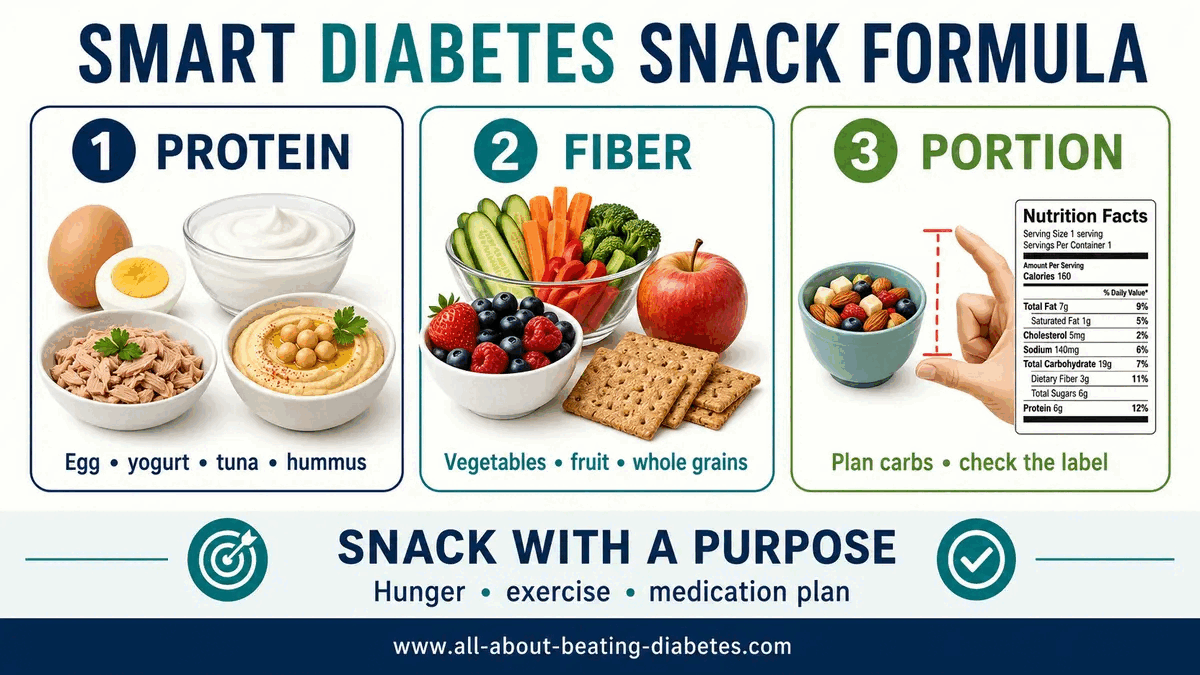
My Simple Formula for a Satisfying Diabetes Snack
1. Add protein
Try eggs, plain yogurt, cottage cheese, tuna, tofu, hummus, edamame, nuts or seeds. Protein can improve fullness, but it is not carbohydrate-free in every food.
2. Add fiber or produce
Choose non-starchy vegetables, whole fruit, legumes or a controlled portion of a whole-grain food. Fiber-rich foods are usually more filling than juice or refined snacks.
3. Plan the portion
Check the serving size and total carbohydrate. Portion nuts, crackers, popcorn and dips into a bowl instead of eating directly from a large package.
This formula does not mean protein and fat cancel carbohydrate. They may slow digestion and change the shape or timing of the glucose rise, but the carbohydrate still counts. If you use mealtime insulin, follow the carbohydrate-counting method and dosing instructions given by your diabetes team.
For more help with meal structure, see my diabetic meal plan, best diabetes diet guide and guide to carbohydrates and the glycemic index.
20 Easy Snacks for Diabetics
These are flexible ideas rather than prescriptions. Brands, ripeness and portions change the carbohydrate, sodium and calorie content, so use the food label or a reliable carbohydrate counter when exact numbers matter.
| Snack idea | Why it may work | Portion point |
|---|---|---|
| Plain Greek yogurt with berries | Protein plus whole-fruit fiber | Choose unsweetened yogurt; measure granola if adding it. |
| Half a small apple with nut butter | Whole-fruit carbohydrate with fat and some protein | Use about 1 tablespoon nut butter if that fits your plan. |
| Cucumber, pepper or carrot sticks with hummus | Vegetables plus legume-based protein and fiber | Hummus contains carbohydrate and calories; spoon out a portion. |
| One hard-cooked egg with tomato or cucumber | Protein with non-starchy vegetables | Add a small fruit or whole-grain cracker only if you need carbohydrate. |
| Low-sodium cottage cheese with tomato | Protein-rich and simple | Compare sodium among brands. |
| Edamame | Plant protein, fiber and carbohydrate in one food | Choose unsalted or lightly salted. |
| A small pear with walnuts | Whole fruit with unsaturated fat | Fruit and nuts both need a planned portion. |
| Tuna in celery boats | Lean protein with a crisp non-starchy vegetable | Use low-sodium tuna when available. |
| Roasted chickpeas | Plant protein and fiber | Chickpeas contain carbohydrate; measure before eating. |
| Cheese with whole-grain crackers | Protein paired with a counted carbohydrate | Count the crackers and compare saturated fat and sodium. |
| Avocado on one small whole-grain crispbread | Fiber and unsaturated fat | Check the crispbread’s total carbohydrate. |
| Unsweetened chia pudding | Fiber and healthy fats | Milk, fruit and sweetener choices change the carbohydrate. |
| Air-popped popcorn with a few nuts | Whole-grain volume with fat and protein | Measure the popped popcorn and avoid heavy butter or salt. |
| Turkey, cucumber and tomato skewers | Protein and vegetables in a party-friendly form | Choose lower-sodium turkey and keep skewers chilled. |
| Plain kefir or yogurt drink | Convenient protein and calcium | Read total and added sugars; avoid sweetened versions when possible. |
| Small orange with pistachios | Whole fruit plus nuts | Choose unsalted pistachios and portion them first. |
| Tofu cubes with cucumber and sesame | Plant protein with non-starchy vegetables | Use a lower-sodium dressing or lemon and herbs. |
| Olives, tomato and a little feta | Low-carbohydrate Mediterranean flavors | Olives and feta can be high in sodium. |
| One or two deviled egg halves | Protein-rich party bite | Keep refrigerated and use the yogurt-based recipe below. |
| Leftover bean salad in a small cup | Plant protein and fiber | Beans contain carbohydrate; include them in the snack count. |
If you have chronic kidney disease, gastroparesis, celiac disease, food allergies, swallowing difficulties or another condition affecting nutrition, several choices above may need modification. For example, potassium, phosphorus, protein, fiber texture or gluten may matter. Ask your healthcare team for a plan that fits both diabetes and the other condition.
How to Read a Packaged-Snack Label
Front-of-package words such as “keto,” “sugar-free,” “natural” or “high protein” do not tell you how the complete snack fits your plan. Turn the package over and read the Nutrition Facts label.
- Start with serving size. The label may describe one serving even when the package contains two or more.
- Check total carbohydrate. This includes starch, sugars and fiber. Do not count only the “sugars” line.
- Look at dietary fiber. The American Diabetes Association emphasizes minimally processed, nutrient-dense, higher-fiber carbohydrate sources.
- Check added sugars. “No added sugar” does not mean the food contains no carbohydrate or no calories.
- Compare sodium. Smoked meats, cheese, crackers, dips and dressings can add a surprising amount.
- Review saturated fat and calories. Low carbohydrate does not automatically mean heart-healthy or suitable for weight goals.
If you need an exact estimate for a mixed snack, use the carbohydrate counter calculator. Compare your usual portion—not an unrealistic package serving—with your personal glucose response.
How to Enjoy Party Snacks Without Mindless Grazing
Parties do not need to mean giving up enjoyable food, and they do not have to become an “overdose” of fat, calories or carbohydrate. A little planning can make the choice feel normal instead of restrictive.
- Do not arrive extremely hungry. Eat your usual meals unless your treatment plan says otherwise.
- Look at all the choices before filling a plate.
- Choose two or three items you genuinely want instead of repeatedly picking at everything.
- Place food on a plate so the portion is visible.
- Include vegetables and a protein food when available.
- Choose water or an unsweetened drink most often.
- If you use insulin, estimate carbohydrate using the method taught by your care team; do not guess an extra correction dose.
- Keep cold foods cold. Perishable party foods should not remain at room temperature for more than two hours, or more than one hour in temperatures above 90°F/32°C.
The following three recipes retain the flavors and easy party style of the original page. I have adjusted them to reduce unnecessary added sugar and make sodium, portions and food safety clearer.
Confetti Tuna Celery Boats
Makes: about 10–12 small boats
Ingredients
- 1 can (about 3–5 ounces) chunk-light tuna in water, drained; choose low-sodium when available
- ½ cup finely shredded red or green cabbage
- ¼ cup finely shredded carrot
- ¼ cup finely shredded yellow squash or zucchini
- 2 tablespoons plain Greek yogurt
- 1 tablespoon reduced-fat cream cheese, softened
- ½ teaspoon dried basil or 1 teaspoon chopped fresh herbs
- Black pepper and lemon juice to taste
- 10–12 celery pieces, about 4 inches long
Directions
- Mix the drained tuna, cabbage, carrot and squash in a bowl.
- Stir in the yogurt, cream cheese, basil, black pepper and a little lemon juice.
- Spoon the mixture into the celery pieces just before serving.
- Keep chilled until ready to eat.
Optional swaps: Replace tuna with mashed chickpeas for a plant-based version, remembering that chickpeas add carbohydrate. If you are pregnant or serving young children, follow current local seafood advice for tuna type and frequency.
Angelic Yogurt Deviled Eggs
Makes: 12 egg halves
Ingredients
- 6 large eggs
- ¼ cup low-fat cottage cheese
- 2 tablespoons plain Greek yogurt
- 2 teaspoons Dijon mustard
- 2 tablespoons chopped fresh chives or dill
- 1 tablespoon diced, well-drained pimiento or roasted red pepper
- Black pepper to taste
Directions
- Place the eggs in a saucepan, cover with water and cook until hard-cooked using your usual safe method.
- Cool promptly, peel, cut lengthwise and remove the yolks.
- Blend the yolks with cottage cheese, Greek yogurt and mustard until smooth.
- Stir in the herbs, pimiento and black pepper.
- Spoon the filling into the egg-white halves. Cover and chill for at least one hour.
Food safety: Refrigerate hard-cooked eggs within two hours. USDA guidance says hard-cooked eggs should be used within one week. At a party, return the plate to refrigeration or place it over ice rather than leaving it out for the whole event.
Turkey-Broccoli Roll-Ups
Makes: about 20 roll-ups
Ingredients
- About 2 pounds broccoli spears, trimmed into slim bite-size pieces
- ⅓ cup plain Greek yogurt or low-fat sour cream
- 1 tablespoon reduced-fat mayonnaise
- 1 teaspoon finely grated orange zest and 1 teaspoon orange or lemon juice
- 1 tablespoon Dijon mustard
- 1 teaspoon dried basil or 1 tablespoon chopped fresh basil
- 1 pound thinly sliced lower-sodium turkey breast
- Black pepper to taste
Directions
- Steam or microwave the broccoli with a small amount of water until crisp-tender.
- Transfer it carefully to cold water to stop the cooking, then drain and dry well.
- Mix the yogurt, mayonnaise, zest, juice, mustard, basil and black pepper.
- Cut or fold the turkey into strips. Spread a small amount of sauce over each strip.
- Place one broccoli piece at the short end, roll tightly and place seam-side down.
- Cover and refrigerate until serving.
The original recipe used two tablespoons of frozen orange juice concentrate. Orange zest and a small amount of juice provide flavor with less concentrated sugar. If you dislike citrus, use lemon, vinegar or chopped herbs instead.
Snacks for Exercise, Bedtime and Low Blood Sugar
Before or during exercise
Exercise may lower, raise or have little immediate effect on glucose depending on intensity, duration, starting glucose, insulin on board and the person. A snack is not automatically necessary before every walk. If you use insulin or a medicine that can cause hypoglycemia, your care team may advise checking glucose, carrying fast-acting carbohydrate and adjusting food or medicine for certain activities.
Do not use a high-protein, high-fat snack as the only emergency carbohydrate. Keep glucose tablets, glucose gel or another measured fast-acting source available when you are at risk of lows.
At bedtime
A bedtime snack is not required for every person with diabetes. It may be useful when your medication plan or glucose pattern shows a risk of overnight hypoglycemia. However, a large evening snack—especially one high in refined carbohydrate—can contribute to high fasting glucose.
If you repeatedly wake with low or high readings, collect bedtime, overnight and morning results and discuss them with your clinician. The safest solution may involve the timing or dose of insulin rather than adding food every night. Read more about high morning blood sugar and bedtime snacks.
When blood sugar is below 70 mg/dL (3.9 mmol/L)
If you are awake and able to swallow safely, take about 15 grams of fast-acting carbohydrate, wait 15 minutes and recheck. Repeat if glucose remains below 70 mg/dL. Examples include glucose tablets according to the label, glucose gel, 4 ounces (about 120 mL) of juice or regular soda, or 1 tablespoon of sugar or honey.
Chocolate, nuts, cheese, eggs, tuna and peanut butter are not ideal first treatments because fat or protein can slow glucose absorption. Once the low is corrected, you may need a balanced snack or meal if the next meal is not soon.
If the person is unconscious, seizing, severely confused or unable to swallow, do not give food or drink by mouth. Use glucagon if prescribed and call emergency services.
Use my detailed guide to low blood sugar from 45–69 mg/dL and review recurrent lows with your healthcare team.
Match Snacks to Your Diabetes Treatment
Your snack needs are influenced by treatment—not only by diabetes type.
- Insulin: carbohydrate timing, insulin on board, exercise and your insulin-to-carbohydrate ratio matter. Do not add or remove a routine snack without considering the insulin plan.
- Sulfonylureas and meglitinides: these can cause hypoglycemia. Ask what to do if a meal is delayed or missed.
- Metformin, GLP-1 medicines, DPP-4 inhibitors and SGLT2 inhibitors: these usually have a lower hypoglycemia risk when used without insulin or a secretagogue, but combinations change the risk.
- GLP-1 medicines: smaller portions may feel better because nausea, fullness or slowed stomach emptying can occur. Persistent vomiting, severe abdominal pain or inability to drink needs medical advice.
- Pregnancy: meal and snack timing may be more structured, and carbohydrate needs should not be reduced aggressively without obstetric and nutrition guidance.
- Children and adolescents: snacks must support growth, school, activity and insulin dosing. Do not apply an adult weight-loss plan to a child.
If you keep needing food to prevent lows, do not simply accept the extra calories as unavoidable. Repeated lows may mean your insulin or medication needs review. Never reduce a prescribed dose on your own, but bring the glucose pattern to your clinician promptly.
Common Diabetes Snack Mistakes
- Assuming “sugar-free” means carbohydrate-free. Sugar-free cookies and candy may still contain starch, sugar alcohols, saturated fat and calories.
- Eating nuts directly from the bag. Nuts are nutritious, but large portions can add substantial calories.
- Drinking the snack. Juice, sweetened coffee, smoothies and sweet yogurt drinks can provide carbohydrate quickly and may be less filling than whole foods.
- Ignoring sodium. Deli turkey, tuna, cheese, olives, dips and crackers can create a high-sodium plate even when carbohydrate is low.
- Counting net carbs without understanding the label. “Net carb” claims are not a substitute for following the method your diabetes team recommends.
- Using protein or fat to treat a low. Fast-acting carbohydrate should come first when glucose is low and you can swallow safely.
- Snacking because a glucose reading is high. Food does not correct hyperglycemia. Follow your prescribed correction and sick-day plan, hydrate as advised and seek help for dangerous readings or ketones.
- Trying to make every snack nearly carbohydrate-free. Whole fruit, beans and whole grains can fit many diabetes plans; the type and portion of carbohydrate matter.
I do not tell every patient with diabetes to snack. I first ask what job the snack is meant to do. Is it responding to hunger, matching insulin, supporting exercise, preventing a documented low or simply filling a habit? Once the purpose is clear, we can choose a portion that helps rather than complicates glucose control.
At a party, I would rather see you enjoy two or three chosen foods on a plate than stand beside the table feeling deprived and grazing without noticing. Diabetes care should be planned, safe and realistic—not joyless.
Frequently Asked Questions
What is the best snack for a person with type 2 diabetes?
There is no single best choice. A modest portion combining protein with vegetables, whole fruit or another fiber-rich food works well for many people. Examples include plain Greek yogurt with berries, vegetables with hummus, or half an apple with nut butter. The best option fits your glucose pattern, medicine, hunger, kidney health and weight goals.
Do people with diabetes need to eat snacks between meals?
No. Snacks are optional unless they serve a specific nutritional or treatment purpose. If your meals are balanced and you are not hungry or at risk of low blood sugar, you may not need one. People using insulin or medicines that can cause lows should follow their individual plan.
How many carbohydrates should a diabetic snack contain?
There is no universal number. Some plans use approximately 10–20 grams of carbohydrate, but children, pregnancy, exercise, insulin dosing and individual energy needs can require a different amount. Ask your diabetes clinician or dietitian for a target and use total carbohydrate on the label.
What snack will not raise blood sugar?
No food can promise a completely flat glucose response. Non-starchy vegetables and protein foods often contain little carbohydrate, but portion, preparation, stress, medication and current glucose all matter. Check your own pattern when your clinician recommends monitoring.
Is fruit a bad snack for diabetes?
No. Whole fruit provides carbohydrate along with fiber, vitamins and minerals. Choose an appropriate portion and consider pairing it with yogurt, nuts or another protein food. Juice is less filling and raises glucose faster, so it is generally better reserved for treating lows or used in a carefully planned portion.
Are cheese and nuts free foods?
No. They may contain relatively little carbohydrate, but they provide calories, fat and sometimes significant sodium. Large portions can interfere with weight or heart-health goals. Kidney disease may also change which nuts, seeds or dairy products are suitable.
Should I eat a snack before bed?
Only if it serves a purpose in your personal plan. A bedtime snack may help some people at risk of overnight hypoglycemia, but it can raise fasting glucose in others. Review bedtime, overnight and morning readings with your clinician instead of adding or removing the snack by guesswork.
Can I use these snacks to treat low blood sugar?
Not as the first treatment. When glucose is below 70 mg/dL and you are awake and able to swallow, use fast-acting carbohydrate and the 15-15 rule. Fat- or protein-rich snacks may work too slowly. After the low is corrected, a balanced snack may be appropriate if the next meal is not soon.
Related Questions
Related Resources
References
- American Diabetes Association Professional Practice Committee. Facilitating Positive Health Behaviors and Well-being to Improve Health Outcomes: Standards of Care in Diabetes—2026.
- Centers for Disease Control and Prevention. Treatment of Low Blood Sugar (Hypoglycemia).
- National Institute of Diabetes and Digestive and Kidney Diseases. Managing Diabetes.
- U.S. Food and Drug Administration. Serving Size on the Nutrition Facts Label.
- U.S. Food and Drug Administration. Added Sugars on the Nutrition Facts Label.
- U.S. Department of Agriculture Food Safety and Inspection Service. Shell Eggs from Farm to Table.
- U.S. Department of Agriculture Food Safety and Inspection Service. Danger Zone (40°F–140°F).
Medical disclaimer: This information is for general education and does not replace individual medical care. Snack needs depend on your diabetes type, medication, insulin, glucose pattern, pregnancy status, kidney health and nutritional needs. Do not change insulin, medication or a prescribed meal plan without your healthcare professional. Seek urgent help for severe hypoglycemia, inability to swallow, seizure, unconsciousness, persistent vomiting, ketones with illness, or other emergency symptoms.