- Home
- Natural Remedies for Diabetes
- Bay Leaves and Diabetes Benefits and Safety
Bay Leaves and Diabetes: Safety, Benefits, and Evidence
Quick Answer
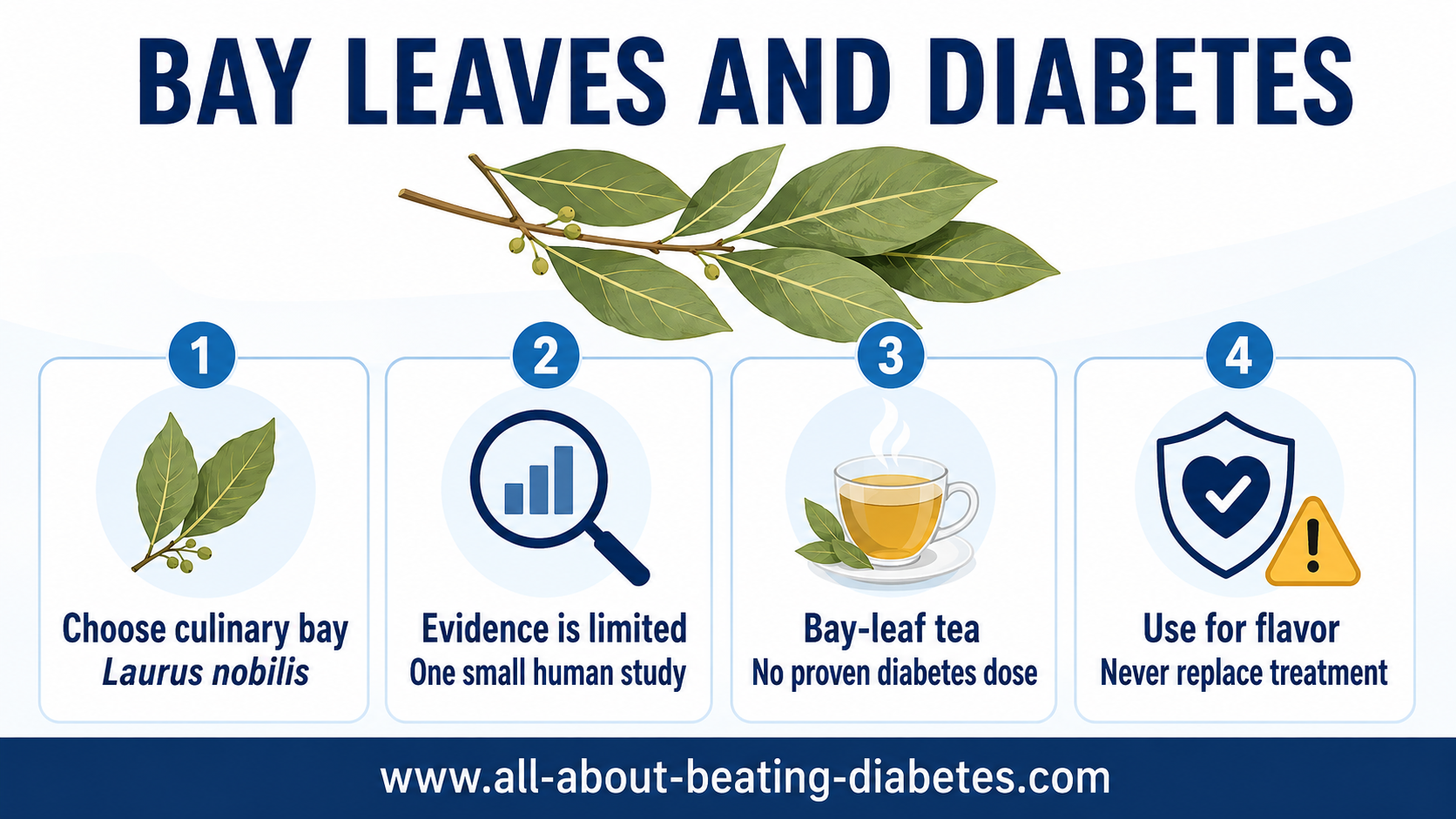
Bay leaves have not been proven to treat diabetes. One small 30-day study reported lower glucose after participants took capsules containing 1–3 grams of ground Laurus nobilis leaf. Only 40 people took part, with 10 in each group, and the study tested capsules—not bay-leaf tea. This is not enough evidence to recommend bay leaves for glucose control.
Culinary bay can add flavor to food without sugar or salt, but there is no established diabetes dose, tea recipe, or best time to take it. Use only packaged culinary bay, remove whole leaves before eating, and never replace diabetes treatment with an herb. Ask your clinician or pharmacist before using concentrated products, especially if you take insulin or medicine that can cause low blood glucose.
Bay laurel is familiar to me as a Mediterranean herb, and I enjoy its fragrance in cooking. Tradition can make a plant feel reassuring, but tradition and aroma are not proof of a medical effect. I have revised this guide to separate the pleasure of using culinary bay from the much stronger claim that it lowers blood glucose.
What Is Bay Leaf?
The culinary herb usually called true bay, sweet bay, Grecian laurel, or bay laurel is Laurus nobilis, an evergreen native to the Mediterranean region. Its leaves are used to flavor soups, stews, sauces, beans, and meat dishes.
Several unrelated plants are also called “bay” or “laurel.” Indian bay leaf, Indonesian bay leaf, and California bay are botanically different from Laurus nobilis. Their flavor and chemical composition differ, so research on one species cannot simply be applied to another.
| Name | What it is | Practical guidance |
|---|---|---|
| True or sweet bay Laurus nobilis | The Mediterranean culinary bay used in the small diabetes study. | Reasonable as a food flavoring. Buy a product clearly labeled for culinary use. |
| Other culinary “bay” leaves | Different plant species used in some regional cuisines. | Use only products sold and labeled as food. Do not assume Laurus nobilis research applies to them. |
| Cherry laurel Prunus laurocerasus | An ornamental plant whose leaves, stems, and seeds contain cyanogenic glycosides. | Do not eat or brew it. It is not culinary bay. |
| Unknown garden or foraged “laurel” | Identification can be difficult, and common names are unreliable. | Do not use it in food or tea. Choose packaged culinary bay instead. |
Plant identification matters
Do not make tea from an ornamental hedge, a garden plant, or a leaf identified only by an app or photograph. If someone has swallowed an unknown or ornamental laurel leaf, contact your local poison service or emergency department for advice. Keep a sample or photograph of the plant if this can be done safely.
What Is in Bay Leaves?
Bay leaves contain aromatic plant compounds, including 1,8-cineole and other volatile oils. Analyses also list vitamins and minerals in the dried plant. These facts are sometimes used to imply that bay leaf is a powerful diabetes remedy, but a list of compounds is not clinical evidence.
The quantity used to flavor a meal is small, and the whole leaf is normally removed before serving. Culinary bay should therefore not be presented as a meaningful source of vitamins or minerals, and the presence of a plant chemical does not show that tea or food portions improve HbA1c or prevent diabetes complications.
Can Bay Leaves Lower Blood Sugar?
The main human study often cited online was published in 2009. It enrolled 40 adults with type 2 diabetes. Participants received capsules containing 1, 2, or 3 grams of ground bay leaf daily, or placebo, for 30 days, followed by a 10-day washout. The researchers reported reductions in fasting serum glucose and improvements in some cholesterol measures in the bay-leaf groups.
Those results are interesting, but they should be interpreted cautiously:
- There were only 10 people in each group.
- The treatment lasted only 30 days.
- The study tested measured capsules of ground leaf—not bay-leaf tea or ordinary culinary use.
- It does not establish a long-term effect on HbA1c, diabetes complications, medication needs, or safety.
- A single small trial needs confirmation in larger, rigorous, independently conducted studies.
The American Diabetes Association’s 2026 Standards of Care state that micronutrients, herbs, and spices are not recommended for glycemic benefits because the evidence is insufficient. That guidance does not mean you must avoid bay in cooking. It means bay should not be prescribed or promoted as a glucose-lowering treatment.
| Claim | What the evidence actually shows | Bottom line |
|---|---|---|
| “Bay lowers blood glucose.” | One very small, short study of ground-leaf capsules reported an effect. | Promising but highly uncertain; not enough for treatment advice. |
| “Bay-leaf tea treats diabetes.” | The commonly cited study did not test tea. Brewing changes what and how much is consumed. | No proven diabetes benefit or dose. |
| “Adding cinnamon makes it work better.” | There is no reliable clinical evidence that this combination improves outcomes. | Do not present the combination as therapy. |
| “Natural means safe with medication.” | Concentrated products can have uncertain strength, quality, and interactions. | Review supplements with a clinician or pharmacist. |
| “Bay can replace medicine.” | No evidence supports replacing prescribed diabetes care. | Stopping or reducing treatment without medical advice can be dangerous. |

What About Bay-Leaf Tea?
There is no clinically established recipe, number of leaves, dose, frequency, or best time for bay-leaf tea in diabetes. The old recommendation to boil 10 leaves, add cinnamon, and drink the tea once or twice daily before meals was not supported by the cited capsule study, so I no longer recommend it as a glucose-lowering method.
If you enjoy an unsweetened tea made from a packaged culinary bay product, think of it as a flavored beverage—not treatment. Do not use it to correct high glucose, skip medicine, or delay medical care. Remove or thoroughly strain out all leaf pieces before drinking.
Does cinnamon enhance the effect?
There is no good evidence that combining cinnamon with bay leaf creates an added glucose-lowering benefit. Combining several supplements also makes side effects and glucose changes harder to interpret. If you like cinnamon and bay as culinary flavors, that is different from taking them in concentrated medicinal amounts. Read my separate evidence review of cinnamon and diabetes.
How to Use Bay Leaves Safely
Reasonable culinary use
- Buy bay labeled as a food product, ideally identified as Laurus nobilis.
- Use it to flavor soups, stews, beans, sauces, and other balanced meals.
- Remove whole leaves before serving or strain liquids carefully.
- Use herbs to add flavor without relying on excess salt or sugar.
Uses to avoid
- Do not chew or swallow whole rigid leaves; they do not soften fully and can injure the mouth or digestive tract.
- Do not eat or brew unknown, ornamental, or foraged laurels.
- Do not swallow bay essential oil.
- Do not use concentrated extracts or supplements as a substitute for diabetes care.
Whole bay leaves are usually removed because they remain stiff and can be a choking or injury hazard. This physical risk is separate from whether the culinary plant itself is toxic. Crumbled leaves should be enclosed in a spice bag or strained out unless the food product is specifically intended to be eaten in finely ground form.
Who Should Ask a Clinician or Pharmacist First?
Culinary amounts used for flavor are different from capsules, extracts, essential oils, or repeated medicinal-strength drinks. Get professional advice before using a concentrated bay product if you:
- Take insulin, a sulfonylurea, or another medicine that can cause hypoglycemia
- Have frequent or unexplained low-glucose episodes
- Are pregnant, trying to conceive, or breastfeeding
- Have liver or kidney disease
- Take several medicines or supplements
- Are preparing for surgery or a procedure requiring anesthesia
- Are considering giving the product to a child
Product strength, purity, and labeling can vary. “Natural” does not guarantee that a supplement is effective, free of contamination, or compatible with medicine. Bring the bottle or a photograph of its full label to your appointment.
Low blood glucose needs proven treatment
If glucose is below your personal target or below 70 mg/dL (3.9 mmol/L), follow your prescribed hypoglycemia plan rather than using bay tea. A person who is unconscious, having a seizure, or unable to swallow should not be given food or drink by mouth. Use glucagon if available and call emergency services.
A Better Way to Judge Natural-Remedy Claims
- Confirm the exact plant. Common names may refer to several species.
- Check the preparation. Food, tea, powder, capsule, extract, and essential oil are not equivalent.
- Look at the human evidence. Cell and animal studies cannot prove that a remedy helps people.
- Check study size and duration. A small, short study may suggest a question without settling it.
- Ask about meaningful outcomes. A brief glucose change is not the same as improved HbA1c, fewer complications, or long-term safety.
- Review interactions. Supplements can add to medicine effects or create new risks.
You can apply this checklist to other products in my guide to herbs and diabetes and my overview of natural diabetes remedy claims.
Doctor’s Note
I understand why a Mediterranean herb such as bay leaf feels appealing and familiar. I am comfortable using true bay to give food a beautiful fragrance, but I do not describe it to my readers as diabetes treatment. The fairest conclusion is that one small capsule study raised an interesting possibility, while evidence for bay-leaf tea, long-term benefit, and safe dosing remains inadequate. Keep the herb in its proper place: flavor on the plate, never a replacement for your diabetes plan.
Frequently Asked Questions
Do bay leaves lower blood sugar?
We do not know with confidence. One small 30-day study of ground-leaf capsules reported lower fasting serum glucose, but it had only 40 participants and does not establish long-term benefit or prove that tea works.
How many bay leaves should I use for diabetes?
There is no evidence-based number of leaves or medically established diabetes dose. The commonly cited human study used measured capsules, not a leaf-count tea recipe.
Can I drink bay-leaf tea every day?
Daily medicinal use has not been adequately studied, so routine dosing cannot be recommended. If you use packaged culinary bay occasionally as an unsweetened flavor, do not treat the drink as medicine and strain out every leaf piece.
Can I combine bay leaves and cinnamon?
You may use them as flavors in food, but there is no reliable evidence that combining them treats diabetes or enhances glucose lowering. Discuss concentrated products with a clinician or pharmacist.
Can I eat the whole bay leaf?
Whole leaves stay stiff even after cooking and can cause choking or injury. Remove them before serving. Do not eat any leaf unless you know it is a culinary species and the food product is intended to be consumed in that form.
Is bay leaf safe during pregnancy or breastfeeding?
Culinary seasoning and medicinal-strength products are different. Safety data for concentrated bay preparations during pregnancy and breastfeeding are inadequate, so avoid medicinal use unless your maternity clinician specifically approves it.
Related Questions
Related Resources
- Herbs and Diabetes: What to Know
- Natural Cures for Diabetes: Claims and Cautions
- Cinnamon and Diabetes
- Fenugreek for Diabetes
- Blood Tests for Diabetes
References
- Khan A, Zaman G, Anderson RA. Bay Leaves Improve Glucose and Lipid Profile of People With Type 2 Diabetes. Journal of Clinical Biochemistry and Nutrition. 2009;44(1):52–56.
- American Diabetes Association. Facilitating Positive Health Behaviors and Well-being to Improve Health Outcomes: Standards of Care in Diabetes—2026. Diabetes Care. 2026;49(Suppl 1).
- North Carolina State Extension: Laurus nobilis (True Laurel).
- North Carolina State Extension: Prunus laurocerasus (Cherry Laurel)—Toxicity and Identification.
- Batool S, Khera RA, Hanif MA, Ayub MA. Bay Leaf. In: Medicinal Plants of South Asia. 2020:63–74. doi:10.1016/B978-0-08-102659-5.00005-7.