- Home
- Diabetes Information for Patients Types Symptoms Tests and Treatment
- How Glycemic Index and Glycemic Load Affect Blood Sugar
Glycemic Index of Foods: How GI and Glycemic Load Affect Blood Sugar
Written by: Dr. Albana Greca Sejdini, MD, MMedSc
Medically reviewed by: Dr. Ruden Cakoni, MD, Endocrinologist
Last medically reviewed: July 2026
The glycemic index, often shortened to GI, compares how equal amounts of available carbohydrate from different foods affect blood glucose under standardized testing conditions. It can help explain why lentils, intact barley, firm pasta, white bread, instant rice, and breakfast cereals may produce different average glucose responses even when their carbohydrate amounts are similar.
What Does the Glycemic Index Measure?
GI ranks foods that contain enough digestible carbohydrate to be tested. It compares the blood-glucose response after a test food with the response after a reference food—usually glucose, assigned a value of 100.
GI mainly reflects carbohydrate quality under the test conditions. It is influenced by:
- how quickly starch or sugar becomes available for absorption;
- the food’s physical structure and particle size;
- starch type and gelatinization;
- fiber and resistant starch;
- ripeness, variety, and processing;
- acidity, fat, and protein in the tested food;
- individual variation among study participants.
GI does not directly tell you:
- how many carbohydrate grams are in your portion;
- how high your own glucose will rise;
- whether a food is nutritionally balanced;
- whether it contains added sugar, saturated fat, or excess sodium;
- how insulin or medicine should be adjusted;
- whether the food will prevent diabetes complications.

How Is a Food’s Glycemic Index Tested?
Under the standardized method, participants consume a portion of the test food containing a fixed amount of available—or digestible—carbohydrate, commonly 50 grams. Their blood glucose is measured repeatedly, and the area under the glucose-response curve is compared with their response to the reference food on separate occasions.
The resulting GI is an average:
This method creates several practical limitations:
- The tested portion may be much larger or smaller than a normal serving.
- Many foods require a large quantity to supply 50 grams of available carbohydrate.
- Foods are usually tested by themselves rather than as part of a full meal.
- The reported number is a group average, not a personal prediction.
- Different varieties or preparation methods may receive different results.
- A value copied from another product, country, or recipe may not apply to the food in your kitchen.
Foods with little available carbohydrate—such as meat, fish, eggs, oils, and many cheeses—do not have a meaningful GI. Calling them “zero GI” does not automatically make them healthy or suitable in unlimited portions.
Low, Medium, and High Glycemic Index Categories
| GI category | Glucose-reference value | How to interpret it |
|---|---|---|
| Low GI | 55 or below | Produces a lower average glucose response than medium- or high-GI foods containing the same available carbohydrate under test conditions. |
| Medium GI | 56–69 | Produces an intermediate average response; portion and preparation remain important. |
| High GI | 70 or above | Produces a higher average response to the fixed carbohydrate amount; it is not automatically forbidden. |
Some older lists use different cutoffs or mix a bread-reference scale with the glucose-reference scale. Use values from a validated glucose-based source and do not combine scales.
Glycemic Index vs. Glycemic Load vs. Total Carbohydrate
| Measure | What it describes | Best practical use |
|---|---|---|
| Glycemic index | Relative response to a fixed amount of available carbohydrate. | Compare carbohydrate quality among similar foods. |
| Glycemic load | GI adjusted for the available carbohydrate in the portion eaten. | Compare the likely effect of different serving sizes. |
| Total carbohydrate | Sugar, starch, and fiber listed for the labeled serving. | Meal planning and carbohydrate counting; always check the actual portion. |
| Personal glucose response | Your meter or CGM pattern after the meal. | Evaluate the complete real-world response, including medicine, activity, sleep, and timing. |
The common glycemic-load formula is:
GL per serving is often described as low at 10 or below, medium at 11–19, and high at 20 or above. These categories are educational conventions rather than a medication or insulin-dosing system.
Example: a food with GI 70 that provides 10 grams of available carbohydrate has an estimated GL of 7. The same food in a portion containing 30 grams of available carbohydrate has an estimated GL of 21.
Use the Glycemic Load Chart and Calculator for a fuller explanation.
Practical Glycemic Index Food Guide
The categories below describe common patterns, not guaranteed values for every brand, variety, or recipe.
| Food pattern | Examples | Practical diabetes note |
|---|---|---|
| Often lower GI | Lentils, chickpeas, many beans, intact barley, steel-cut or traditional oats, firm pasta, apples, pears, berries, plain milk, and unsweetened yogurt | Still count carbohydrate and use a suitable portion. Sweetened yogurt, large grain bowls, and large fruit portions can raise glucose substantially. |
| Frequently variable | Bread, rice, potatoes, sweet potatoes, quinoa, couscous, bananas, grapes, and mixed-grain products | Variety, milling, ripeness, cooking, cooling, and serving size can move the result across categories. |
| Often higher GI | Glucose drinks, many puffed or flaked cereals, rice cakes, some white breads, instant mashed potato, and many sticky or instant rice products | A smaller portion may fit; compare the post-meal pattern and complete nutritional quality. |
| No meaningful GI | Meat, fish, eggs, oils, and many cheeses | They may still affect calories, saturated fat, cardiovascular risk, digestion, and delayed glucose in mixed meals. |
For tested food values, use the Glycemic Index Chart. Treat each number as a reference for the tested food—not a permanent value for every version of that food.
Why Does the Same Food Have Different GI Values?
Variety and starch structure
Different rice, potato, oat, bread, and fruit varieties contain different proportions of rapidly digestible starch, slowly digestible starch, resistant starch, sugars, and fiber.
Particle size and processing
Finely milled flour, puffing, flaking, instant preparation, and extensive grinding often make starch easier to digest. “Whole grain” on a package does not guarantee an intact low-GI structure. A finely milled whole-grain bread may have a relatively high GI.
Cooking
Longer cooking can soften structure and gelatinize starch, often increasing availability. Firm pasta usually produces a different response from overcooked pasta. Potato and rice responses vary with method, variety, and texture.
Cooling and reheating
Cooling some cooked starches can increase resistant starch. The effect is variable and does not remove carbohydrate. Food must also be cooled, stored, and reheated safely to prevent foodborne illness.
Ripeness
As some fruits ripen, starch is converted into sugars and texture softens. A very ripe banana may produce a different response from a greener banana, but portion remains essential.
Acidity
Acidic ingredients and natural fermentation may slow stomach emptying or starch digestion in some meals. Lemon or vinegar does not neutralize carbohydrate and should not be consumed in excessive medicinal amounts.
Brand and recipe
A bread, cereal, granola, yogurt, or snack can differ in flour, sugar, fiber, fat, processing, and serving size. One published value should not be assigned to every brand.
Why Mixed Meals Behave Differently
Most people do not eat one carbohydrate food alone. Protein, fat, fiber, vegetables, sauces, and beverages change digestion and the timing of glucose.
Adding vegetables and an appropriate protein may reduce or delay the early peak compared with eating a large refined-carbohydrate portion alone. However:
- the carbohydrate grams still count;
- high fat may delay glucose rather than eliminate it;
- a late rise may occur several hours after pizza, fried food, creamy pasta, or another high-fat meal;
- adding butter or cheese solely to lower the early GI can increase saturated fat and calories;
- protein may also influence later glucose, particularly in type 1 diabetes.
A smaller balanced meal is usually more useful than attempting to “cancel” a large high-GI portion with fat.
Example: rice meal
A large bowl of rapidly digested rice may produce a sharp rise. A more manageable meal may use a smaller rice portion with nonstarchy vegetables, beans or lean protein, and unsaturated fat.
Example: breakfast cereal
A large bowl of puffed cereal with sweetened milk may act quickly. Traditional oats with berries, seeds, and plain yogurt often provide more fiber and protein, but the oat and fruit portions still count.
Example: fruit snack
Whole fruit is often more filling than juice. Pairing a measured fruit portion with plain yogurt or nuts may slow the early response, but it adds calories and does not erase fruit carbohydrate.
How to Use GI in Daily Diabetes Care
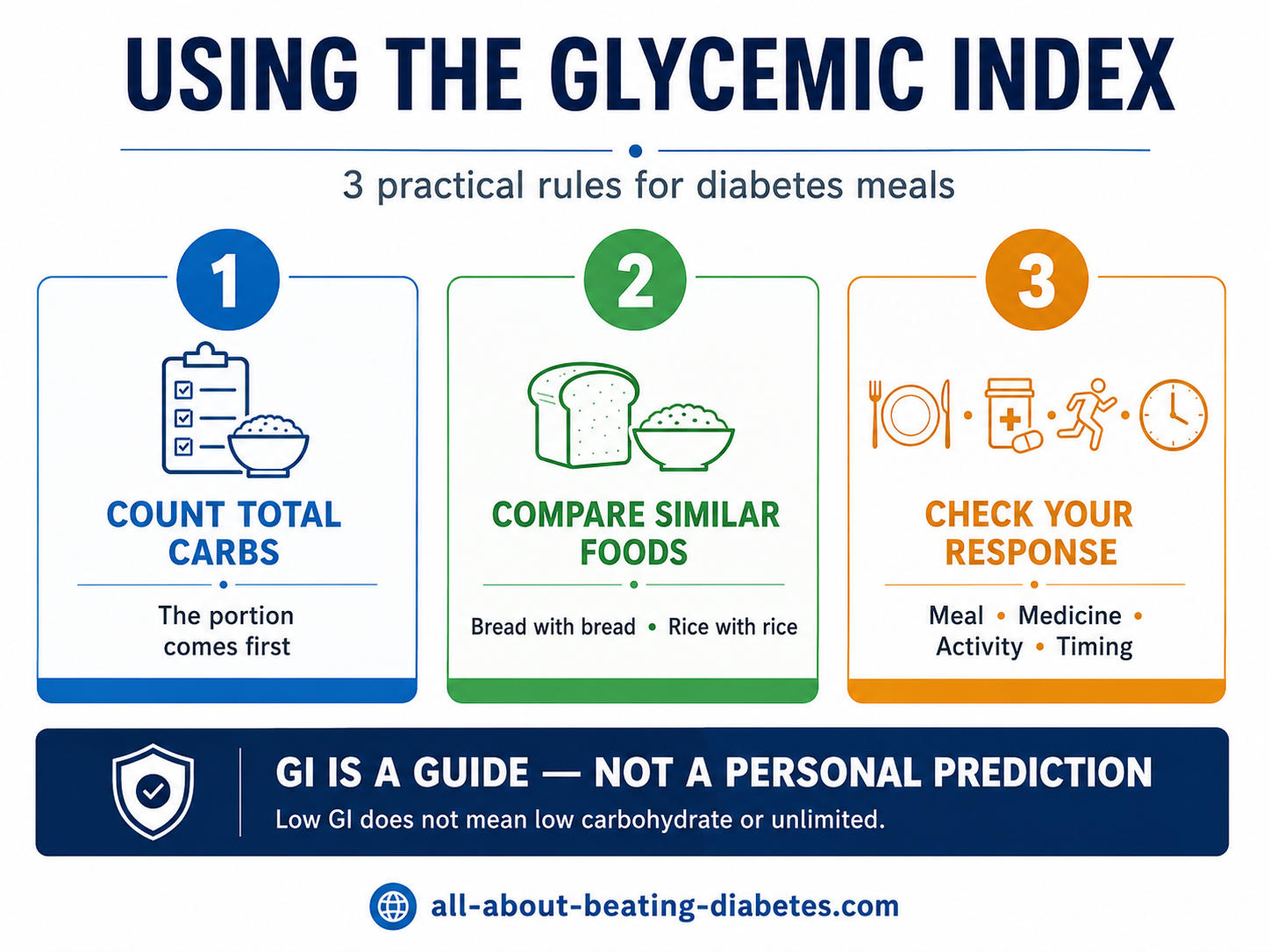
- Start with total carbohydrate. Check the label, recipe, portion, or carbohydrate-counting resource.
- Compare similar foods. Use GI to compare breads with breads, rice with rice, cereals with cereals, or fruit forms with fruit forms.
- Choose less processed options more often. Favor beans, intact grains, vegetables, and whole fruit.
- Control the portion. Low GI does not mean unlimited.
- Build the full plate. Include nonstarchy vegetables and an appropriate protein source.
- Consider cardiovascular and kidney health. Check saturated fat, sodium, potassium, and protein needs—not only GI.
- Watch the timing. High-fat meals may require longer monitoring than one or two hours.
- Review repeated personal data. Change one variable at a time when possible.
For a complete eating strategy, read Diabetes, Carbohydrates, and Glycemic Index and the Diabetes Plate Method.
Can You Find GI on a Food Label?
GI is not required on standard Nutrition Facts labels. In the United States, GI and “net carbohydrate” marketing terms are not defined in the same way as mandatory nutrient declarations.
Check these first:
- Serving size and servings per container
- Total carbohydrate
- Dietary fiber
- Added sugars
- Ingredients and degree of processing
- Saturated fat and sodium
A product labeled “low GI” may still be a poor choice when it contains excessive calories, saturated fat, sodium, or added sugar. A product with no GI claim may be an excellent minimally processed food.
Do not subtract all fiber or sugar alcohol automatically to create a “net carb” value for insulin dosing unless your diabetes team has provided a method for the specific product.
GI, Insulin Dosing, and Diabetes Medicines
GI should not replace carbohydrate counting or the prescribed insulin-to-carbohydrate ratio.
For people using mealtime insulin, dose decisions may consider:
- total carbohydrate grams;
- current glucose and CGM trend;
- active insulin;
- planned activity;
- meal fat and protein;
- gastroparesis or altered digestion;
- previous response to the same meal;
- the individualized correction and timing plan.
A high-GI food may require different timing from a slow, high-fat mixed meal, but changing pre-bolus timing or split dosing can cause hypoglycemia if done incorrectly. Use a clinician-approved plan.
People taking sulfonylureas, meglitinides, or fixed insulin doses should not reduce carbohydrate abruptly without reviewing low-glucose risk.
How to Check Your Personal Glucose Response
GI values describe averages. A structured home comparison can show how your real meal behaves.
- Measure the carbohydrate portion.
- Record the brand, variety, cooking method, and ripeness.
- Record the rest of the meal.
- Check glucose before eating when included in your plan.
- Check at the recommended time—often one to two hours after the first bite.
- For a high-fat meal, review later readings when advised.
- Record insulin, medicine, activity, sleep, illness, and stress.
- Repeat the meal before making a permanent conclusion.
One reading can be affected by meter variation, the starting glucose, active insulin, previous exercise, sleep, stress, illness, or the meal eaten earlier. Repeated data are more reliable than one “spike.”
CGM can be valuable for people with diabetes, but duplicate meals may still produce different responses. Avoid creating an unnecessarily restrictive diet from small sensor differences.
Use the Blood Sugar Log Sheet and interpret readings with Blood Sugar Levels After Eating.
Can a Low-GI Diet Improve Diabetes Control?
A 2021 systematic review and meta-analysis of randomized controlled trials found that lower-GI or lower-GL dietary patterns produced small but meaningful average improvements in A1C and several cardiometabolic risk markers compared with higher-GI or control diets.
This supports using GI or GL as an adjunct to evidence-based diabetes nutrition—not as the only rule. Benefits may reflect several overlapping changes:
- more beans, whole grains, vegetables, and fruit;
- greater fiber intake;
- less refined starch and added sugar;
- better portion control;
- lower overall glycemic load;
- changes in weight, medicines, or adherence.
GI does not guarantee weight loss, normal A1C, lower cholesterol, or complication prevention. The overall eating pattern and treatment plan remain more important than one score.
Special Situations
Treating hypoglycemia
Do not choose a low-GI food to treat an active low. Use the fast-acting carbohydrate in your written plan—commonly glucose tablets, glucose gel, regular soda, or juice—and recheck as instructed. Chocolate and high-fat foods may act too slowly.
Pregnancy
Pregnancy uses tighter glucose targets and requires sufficient nutrition. GI may help choose carbohydrate quality, but it does not replace carbohydrate distribution, monitoring, fetal assessment, or medication when needed.
Kidney disease
Beans, whole grains, fruit, nuts, dairy, and other lower-GI foods may need adjustment for potassium, phosphorus, protein, sodium, or fluid. A low-GI plan is not automatically a renal diet.
Gastroparesis
High-fiber foods, intact grains, large salads, and high-fat meals may worsen delayed stomach emptying. Easier-to-digest foods may have a higher GI but be medically necessary. Insulin timing requires specialist guidance.
Children and adolescents
Growth, activity, insulin, school schedules, and food relationships must be protected. GI should not be used to label normal foods as forbidden.
Sports and exercise
Different carbohydrate speeds may be useful before, during, or after activity. Exercise glucose management depends on insulin, intensity, duration, starting glucose, and ketones—not GI alone.
Common Glycemic Index Myths
| Myth | More accurate explanation |
|---|---|
| “Low GI means low carbohydrate.” | GI describes response to a fixed carbohydrate amount; a food can be low GI and high in carbohydrate per serving. |
| “High-GI foods are always unhealthy.” | Nutritional quality, portion, purpose, and the complete meal matter. Fast carbohydrate is also appropriate for treating a low. |
| “Low-GI foods can be eaten freely.” | Large portions can produce a high glycemic load and excess calorie intake. |
| “Whole grain always means low GI.” | Fine milling and processing can produce a rapid response despite the whole-grain ingredient. |
| “Adding fat cancels a high-GI food.” | Fat may delay the early peak but can prolong later glucose and add calories or saturated fat. |
| “A GI chart predicts my exact reading.” | GI is a group average. Personal response varies with the meal, treatment, activity, sleep, illness, and starting glucose. |
| “GI shows how much insulin to take.” | Mealtime insulin is based primarily on carbohydrate and the individualized dosing plan; GI may inform timing only under professional guidance. |
Most Asked Questions
What is the best low-GI food for diabetes?
There is no single best food. Beans, lentils, intact barley, traditional oats, whole fruit, and unsweetened dairy are useful examples when they fit your medical needs and carbohydrate plan.
Is brown rice always lower GI than white rice?
No. GI varies widely by rice variety, amylose content, processing, and cooking. Some white rice varieties test lower than some brown varieties. Portion remains important.
Is sweet potato low GI?
It can be low, medium, or high depending on variety and cooking method. Do not assign one value to every sweet potato dish.
Is quinoa low GI?
Tested values are generally low to medium, but preparation and portion vary. It still provides carbohydrate and is not unlimited.
Does pairing carbohydrate with protein prevent a spike?
It may slow the early response and improve fullness, but it does not remove carbohydrate. High-fat or high-protein meals may cause a delayed rise.
Is sugar always higher GI than starch?
No. Some refined starches have a higher GI than table sugar, while fructose-containing foods may have a lower GI despite other nutritional concerns.
Should I choose foods only by GI?
No. Consider total carbohydrate, fiber, processing, protein, fat quality, sodium, calories, kidney needs, and your glucose pattern.
Can GI help with weight loss?
Lower-GI foods may improve fullness for some people, but weight change still depends on total intake, food quality, activity, medicines, sleep, and biological factors.
Does cooking and cooling rice make it safe to eat freely?
No. Cooling may increase resistant starch modestly, but carbohydrate and portion still matter, and cooked rice must be stored safely.
Related Questions
- Why Can Blood Sugar Rise After a High-Fiber Meal?
- How Can I Manage High Post-Meal Blood Sugar?
- Is Blood Sugar of 196 mg/dL Two Hours After Food High?
Related Resources
- Glycemic Index Chart
- Glycemic Load Chart and Calculator
- Low-Glycemic-Index Foods
- Low-Glycemic-Index Fruits
- Low-Glycemic-Index Recipes
- Diabetes, Carbohydrates, and Glycemic Index
Medical disclaimer: This page provides general education and does not prescribe a carbohydrate amount, insulin dose, glycemic target, renal diet, pregnancy meal plan, or treatment for gastroparesis or hypoglycemia. Discuss major dietary or medication changes with your healthcare professional, particularly when you use insulin or medicine that can cause low glucose.
References
- American Diabetes Association: Facilitating Positive Health Behaviors and Well-being—Standards of Care in Diabetes 2026
- American Diabetes Association: Carbohydrates and Diabetes
- American Diabetes Association: Reading Food Labels
- Atkinson and colleagues: International Tables of Glycemic Index and Glycemic Load Values 2021
- Chiavaroli and colleagues: Low-GI or Low-GL Dietary Patterns in Diabetes—Systematic Review and Meta-analysis
- International Organization for Standardization: ISO 26642—Determination of the Glycaemic Index
- Zeevi and colleagues: Personalized Nutrition by Prediction of Glycemic Responses
- Hengist and colleagues: Reproducibility of Glucose Responses to Duplicate Meals