- Home
- blood sugar levels
- random blood glucose
Random Blood Glucose Test Results
Written by: Dr. Albana Greca, MD, MMedSc, Family Physician and Medical Author.
Medically reviewed by: Dr. Ruden Cakoni, MD, Endocrinologist.
Last reviewed: July 2026.
A random blood glucose result can be useful when you want to know what your blood sugar is doing at a particular moment without waiting for an overnight fast. But one of the most important things I explain to my patients is that a random glucose number cannot be interpreted properly without knowing how it was measured, when you last ate, whether symptoms are present and whether you already have diabetes.
There is also an important difference between a laboratory random plasma glucose test used in medical diagnosis and a glucose reading obtained at home with a meter or continuous glucose monitor (CGM). These readings can all provide useful information, but they should not be treated as interchangeable diagnostic tests.
On this page, I will explain what a random blood glucose test means, how to interpret different results, what a random glucose of 200 mg/dL or higher may mean, and when fasting glucose, HbA1c or another diabetes test is more appropriate.

Quick Answer
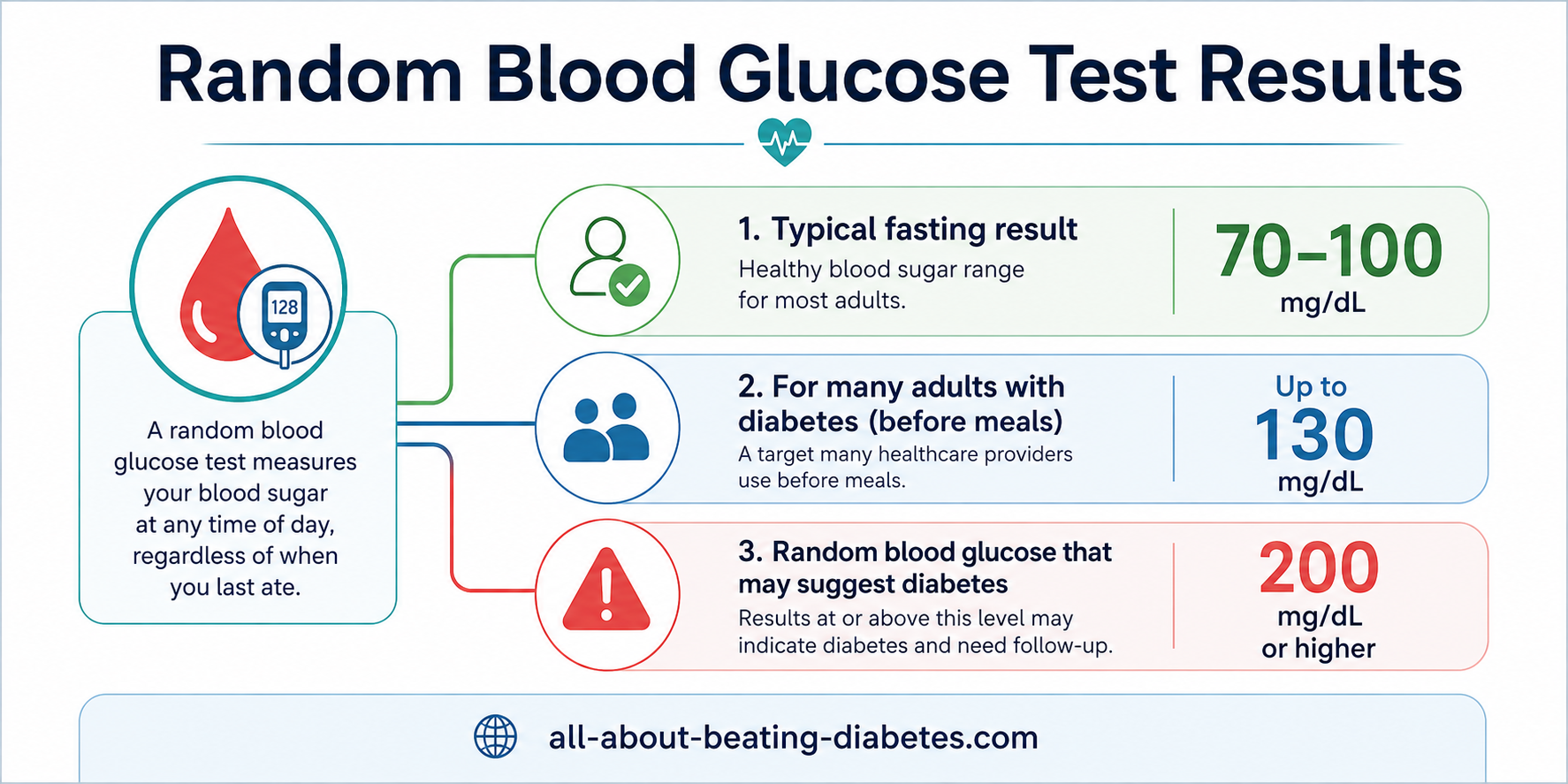
A random plasma glucose test is a laboratory blood test that measures glucose at any time of day, without requiring you to fast.
There is no official normal or prediabetes diagnostic range for random glucose. The result depends greatly on when you ate and your individual circumstances. Prediabetes is diagnosed using fasting plasma glucose, HbA1c or the 2-hour result of a 75-g oral glucose tolerance test.
A random plasma glucose of 200 mg/dL (11.1 mmol/L) or higher together with classic symptoms of hyperglycemia or a hyperglycemic crisis meets a diagnostic criterion for diabetes. A home glucose-meter or CGM reading by itself should not be used to diagnose diabetes.
Random Plasma Glucose vs. Home Meter vs. CGM
Before interpreting a random glucose number, first identify where the result came from. This matters because laboratory glucose testing is used for diagnosis, while home glucose meters and CGMs are primarily tools for monitoring glucose patterns.
A home reading can alert you that glucose is unusually high or low and can tell your doctor that further investigation may be needed. It should not, however, be treated as equivalent to a diagnostic laboratory result.
| Method | Main purpose | Used alone to diagnose diabetes? |
|---|---|---|
| Laboratory random plasma glucose | Clinical testing and, in the appropriate symptomatic setting, diagnosis | Yes, under specific diagnostic conditions |
| Home glucose meter | Monitoring current glucose and patterns | No |
| Continuous glucose monitor (CGM) | Monitoring glucose trends and changes over time | No |
If you are concerned that your readings may indicate diabetes or prediabetes, our guide to blood tests for diabetes explains the diagnostic tests doctors commonly use.
What Is a Random Blood Glucose Test?
A random plasma glucose test measures the amount of glucose in your blood at any time of day without regard to when you last ate. Unlike a fasting blood glucose test, you do not need to avoid food for eight hours beforehand.
This makes random testing convenient when someone has symptoms that may be caused by high glucose and the doctor does not want to wait for a fasting test.
However, food can influence glucose substantially. A reading taken shortly after a meal may naturally be higher than one taken several hours later. That is why a random result must always be interpreted together with its timing and clinical context.
When Is a Random Glucose Reading Useful?
Outside formal diagnosis, checking glucose at an unscheduled time can help answer practical questions about how food, exercise, illness, medication or symptoms are affecting you.
These are monitoring situations rather than diagnostic random plasma glucose tests, but they can still provide valuable information when the timing is recorded.
| When you check | What the result may help show |
|---|---|
| Before a meal | Your glucose before food affects it |
| 1–2 hours after eating | How a meal and portion size influence glucose |
| Before or after exercise | How physical activity affects glucose |
| When symptoms occur | Whether symptoms coincide with unusually high or low glucose |
| During illness or stress | Whether illness, pain, fever or stress is affecting glucose |
Because glucose changes throughout the day, our blood sugar levels by time of day guide can help explain why fasting, before-meal, after-meal and bedtime numbers may look very different.
How Should You Read Random Blood Glucose Results?
This is where random glucose is commonly misunderstood. Unlike fasting plasma glucose or a formal oral glucose tolerance test, there is no standard random-glucose classification of “normal, prediabetes and diabetes.”
For example, the familiar 140–199 mg/dL prediabetes range applies specifically to the 2-hour plasma glucose during a standardized 75-g oral glucose tolerance test. It should not be copied onto an ordinary random glucose reading taken after lunch or at another unscheduled time.
| Random glucose result | How to interpret it |
|---|---|
| Below 70 mg/dL | Low glucose; particularly important in people using insulin or medicines that can cause hypoglycemia |
| 70–199 mg/dL | Cannot be classified as normal, prediabetes or diabetes from a random reading alone; timing and context matter |
| 200 mg/dL or higher without classic symptoms | High and deserves appropriate follow-up; one random home reading alone does not establish diabetes |
| Laboratory random plasma glucose ≥200 mg/dL with classic symptoms or hyperglycemic crisis | Meets a diagnostic criterion for diabetes |
If you are trying to compare ordinary meal-related readings, use our blood sugar levels after eating guide instead of applying fasting or OGTT thresholds to a random result.
Can a Random Blood Glucose Test Diagnose Diabetes?
Yes, but only in a specific clinical situation. A laboratory random plasma glucose can establish diabetes when it is 200 mg/dL (11.1 mmol/L) or higher and the person has classic symptoms of high blood sugar or presents with a hyperglycemic crisis.
The classic symptoms used in this diagnostic criterion include:
- polyuria — urinating much more frequently than usual
- polydipsia — excessive thirst
- unexplained weight loss
A hyperglycemic crisis such as diabetic ketoacidosis (DKA) or HHS can also provide the clinical setting in which a random plasma glucose is diagnostic.
If these classic symptoms or a hyperglycemic crisis are not present, an elevated random glucose should lead to appropriate formal testing rather than self-diagnosis from one reading.
What Does a Random Blood Sugar of 200 mg/dL Mean?
A reading of 200 mg/dL (11.1 mmol/L) naturally worries many patients, but its meaning depends on where the reading came from and whether symptoms are present.
If this is a laboratory random plasma glucose and you also have classic symptoms such as excessive thirst, frequent urination or unexplained weight loss, it meets a diagnostic criterion for diabetes.
If 200 mg/dL is an isolated home-meter reading after a meal and you do not have classic symptoms, it does not automatically diagnose diabetes. However, repeated readings around or above this level deserve medical follow-up with appropriate laboratory testing.
Your doctor may recommend fasting plasma glucose, HbA1c or an oral glucose tolerance test.
Can Random Blood Glucose Diagnose Prediabetes?
No standard random-glucose range is used to diagnose prediabetes. This is an important distinction because patients sometimes see the 140–199 mg/dL range online and assume that every random reading in this range means prediabetes.
Prediabetes is defined using one of the following formal tests:
- HbA1c: 5.7%–6.4%
- fasting plasma glucose: 100–125 mg/dL
- 2-hour plasma glucose during a 75-g OGTT: 140–199 mg/dL
For a fuller explanation of longer-term glucose control, see our guide to HbA1c and average blood sugar.
What If Your Random Blood Sugar Is High?
An unexpectedly high random glucose should first be interpreted in context. A reading soon after a large carbohydrate-containing meal is different from the same result before eating or several hours after a meal.
Before assuming that one number means diabetes or poor control, ask:
- How long ago did I eat?
- What and how much did I eat?
- Am I sick, infected, stressed or in pain?
- Have I been sleeping poorly?
- Did I miss insulin or diabetes medicine?
- Am I taking steroids or another medicine that can raise glucose?
- Did I wash and dry my hands before using my glucose meter?
If a home-meter result is unexpectedly high, washing and drying your hands and repeating the test can sometimes help exclude contamination from food or other substances on the fingers.
If random readings remain high—particularly around or above 200 mg/dL—discuss formal laboratory testing with your healthcare professional. If glucose is extremely high or you have vomiting, dehydration, abdominal pain, rapid/deep breathing, confusion or significant ketones, see our guide to dangerous blood sugar levels and when to seek emergency care.
What If Your Random Blood Sugar Is Low?
A random glucose can also identify hypoglycemia. For many people with diabetes, glucose below 70 mg/dL (3.9 mmol/L) is considered low and deserves prompt attention.
Low glucose is particularly important for people taking insulin or medicines that can cause hypoglycemia. Possible triggers include missed meals, exercise, alcohol, illness and medication or insulin dosing problems.
Symptoms may include shaking, sweating, hunger, weakness, dizziness, fast heartbeat, difficulty concentrating, blurred vision or confusion.
If you have a low reading, follow the treatment plan given by your healthcare professional. Our guide to common causes of low blood glucose explains why repeated lows deserve further review.
How to Make Random Glucose Readings More Useful
A random glucose result becomes much more meaningful when you record what was happening around the time of the test. A number without timing can be difficult for both you and your doctor to interpret.
Whenever possible, record:
- the time of the glucose reading
- when you last ate
- what the meal or snack contained
- medication or insulin timing
- exercise or unusual activity
- stress, illness, fever or poor sleep
- symptoms such as thirst, frequent urination, shakiness or fatigue
A blood sugar log sheet can make these patterns easier to identify and gives your healthcare professional much more useful information than a list of isolated glucose numbers.
When Should You Ask for More Diabetes Testing?
One random reading may raise a question, but formal diabetes testing is usually more useful when abnormal readings repeat or when you have symptoms or important risk factors.
Talk with your healthcare professional about further testing if you have:
- repeatedly high random glucose readings
- excessive thirst or frequent urination
- unexplained weight loss
- a strong family history of diabetes
- overweight or obesity
- high blood pressure or abnormal cholesterol
- a history of gestational diabetes
- other significant diabetes risk factors
Common follow-up tests include fasting plasma glucose, HbA1c and, in selected situations, an oral glucose tolerance test.
Doctor's Note
When patients bring me a random glucose reading, my first question is often not “What was the number?” but “When was it measured, when did you eat, and how were you feeling?” Random glucose can be extremely useful, but one isolated value without context can easily be misunderstood. Patterns, symptoms and properly performed laboratory tests give us a much clearer picture.
Most Asked Questions About Random Blood Glucose
These are some of the questions patients most often ask when they receive an unexpected random glucose result. The answers below are intended to help you understand when a reading is useful and when formal testing is more appropriate.
What is a normal random blood glucose level?
There is no official diagnostic “normal random blood glucose range.” Random glucose varies according to meal timing and other factors. Normal and prediabetes diagnostic categories are established using tests such as fasting plasma glucose, HbA1c and the 2-hour OGTT rather than an ordinary random reading.
Does random blood sugar of 200 mg/dL mean diabetes?
A laboratory random plasma glucose of 200 mg/dL or higher together with classic hyperglycemia symptoms or a hyperglycemic crisis meets a diagnostic criterion for diabetes. An isolated home-meter reading of 200 mg/dL by itself does not diagnose diabetes.
Can random glucose diagnose prediabetes?
No standard random-glucose range is used to diagnose prediabetes. Prediabetes is defined using HbA1c, fasting plasma glucose or the 2-hour result of a 75-g oral glucose tolerance test.
Is random glucose the same as fasting glucose?
No. Fasting plasma glucose is measured after at least eight hours without caloric intake. Random plasma glucose can be measured at any time regardless of when you last ate.
Should I check glucose before or after meals?
Both can provide useful information. A before-meal reading gives a baseline before eating, while a properly timed after-meal reading helps show how the meal affected your glucose. Record the timing so the result can be interpreted correctly.
Why is my random blood sugar different every day?
Food, activity, stress, sleep, illness, hydration, hormones and medications can all influence glucose. Differences are expected when readings are taken at different times or under different conditions.
Can a home glucose meter diagnose diabetes?
No. A home glucose meter is valuable for monitoring glucose, but diabetes diagnosis requires appropriate clinical and laboratory testing.
Related Questions
If you are trying to understand a particular glucose result, these patient questions may help you put the number into context:
- Is My Blood Sugar Normal?
- Is Blood Sugar 107 or 110 mg/dL High?
- What Are Normal and Borderline Blood Sugar Readings?
- Why Isn't My Blood Sugar Going Down?
- Can Blood Sugar Be Normal but Sugar High in Urine?
Related Resources
Random glucose is only one way of looking at blood sugar. These guides explain the other tests and glucose patterns that doctors commonly use when evaluating diabetes:
- Blood Tests for Diabetes
- Normal Fasting Blood Sugar Levels
- Blood Sugar Levels After Eating
- Blood Sugar Levels by Time of Day
- HbA1c and Average Blood Sugar Explained
- HbA1c to Average Glucose Calculator
- Convert mmol/L to mg/dL
Educational Safety Note
This page is for general diabetes education and does not replace personal medical advice, diagnosis or treatment. A home meter or CGM result should not be used alone to diagnose diabetes or prediabetes.
If glucose is extremely high or low, or you develop vomiting, severe dehydration, abdominal pain, rapid/deep breathing, confusion, seizure or loss of consciousness, seek appropriate urgent medical care. Do not start, stop or change diabetes medication or insulin based only on one random glucose result.
References
The diagnostic information on this page is based primarily on current American Diabetes Association guidance and U.S. government diabetes-testing resources.
- American Diabetes Association Professional Practice Committee. Diagnosis and Classification of Diabetes: Standards of Care in Diabetes—2026.
- National Institute of Diabetes and Digestive and Kidney Diseases. Diabetes Tests & Diagnosis.
- National Institute of Diabetes and Digestive and Kidney Diseases. Diabetes & Prediabetes Tests.
- Centers for Disease Control and Prevention. Diabetes Testing.