- Home
- Diabetes Information for Patients Types Symptoms Tests and Treatment
- Does a Low Glycemic Index Diet Help With Weight Loss
Low-GI Diet for Weight Loss: Does Glycemic Index Help?
If you are trying to lose weight while managing diabetes, you may have heard that choosing low-glycemic-index foods will keep you full and make weight loss easier. These foods can be useful, but I want you to see the glycemic index as one meal-planning tool—not as a weight-loss formula.
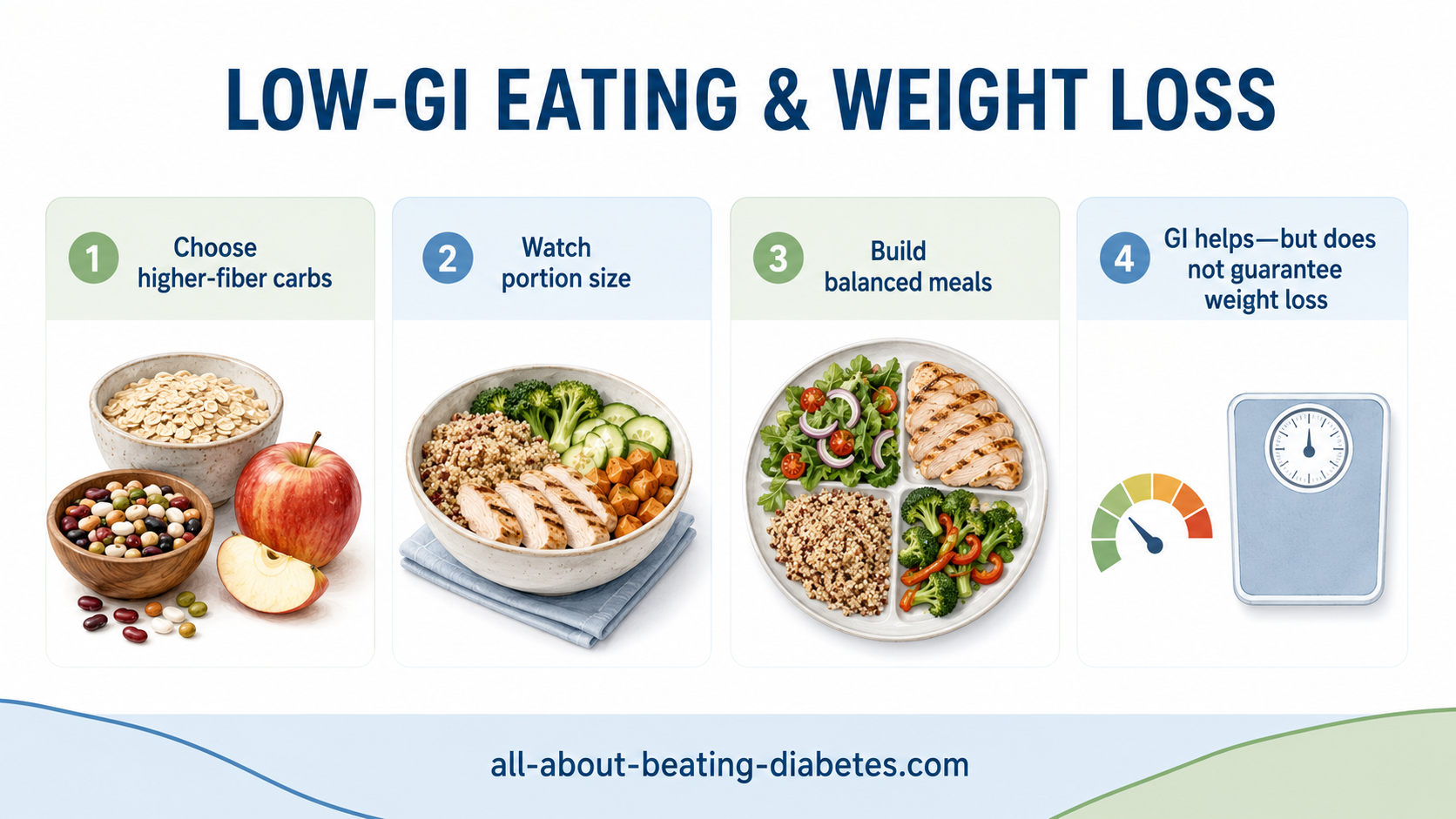
A lower-GI eating pattern may support blood sugar management and may help some people lose a small amount of weight, especially when it replaces refined carbohydrates with beans, lentils, less-processed grains, whole fruit, and other higher-fiber foods. However, low GI does not mean low calorie, and GI alone does not guarantee fullness or weight loss. Portions, total food intake, protein, fiber, fats, drinks, activity, sleep, medicines, and long-term consistency all matter.

What Does Glycemic Index Mean?
The glycemic index, or GI, ranks carbohydrate-containing foods according to their average blood-glucose effect under standardized testing. The food is compared with a reference—usually glucose, which has a GI of 100.
- Low GI: 55 or less
- Medium GI: 56–69
- High GI: 70 or more
GI compares foods after participants eat a fixed amount of available carbohydrate. It does not compare normal serving sizes, show how many calories you eat, or predict your exact glucose reading. Meat, fish, eggs, oils, most cheeses, and many non-starchy vegetables do not contain enough available carbohydrate for a meaningful GI test.
For tested values and their limitations, use our glycemic index chart and GI food chart.
Can a Low-GI Diet Help You Lose Weight?
Research does not support a promise that lowering GI automatically causes substantial weight loss. Systematic reviews have reported small average reductions in body weight or BMI in some groups, including people with overweight, obesity, prediabetes, or diabetes. Other analyses conclude that low-GI diets are not consistently superior to other nutritious eating patterns when calorie intake and support are similar.
This is not a contradiction as much as it may appear. A low-GI plan can be designed in many ways. One person may replace refined cereal, white bread, and large rice portions with oats, lentils, vegetables, and whole fruit. Another may eat large portions of low-GI pasta, high-fat snacks, or calorie-dense desserts. Both plans may be called “low GI,” but their fiber, calories, portions, protein, and nutritional quality can be very different.
Why Might Lower-GI Meals Help?
Possible advantages
- Many useful low-GI foods are rich in fiber and retain more of their natural structure.
- Beans, lentils, intact grains, vegetables, and whole fruit can add volume and nutrients.
- A slower average glucose response may help some people avoid large post-meal swings.
- Replacing refined carbohydrates may improve the overall quality of the diet.
What GI cannot promise
- It cannot guarantee that you will feel full or eat fewer calories.
- It cannot specifically remove abdominal fat.
- It does not measure protein, saturated fat, sodium, vitamins, or processing.
- It cannot replace a personal diabetes or weight-management plan.
Fullness is influenced by more than GI. Protein, fiber, water content, food volume, chewing, fat, meal timing, sleep, stress, and individual appetite signals all contribute. This is why a balanced plate is usually more useful than choosing foods by a GI number alone.
Why GI Alone Can Be Misleading
A food with a lower GI is not automatically better for weight loss. Fat can slow digestion and lower the measured GI of foods such as ice cream, chocolate, or some fried snacks, even though they may be high in calories, saturated fat, or added sugar. Nuts, seeds, avocado, and olive oil are nutritious choices, but their portions still matter because they are energy-dense.
The reverse is also true. A nutritious food does not become “bad” because it has a medium or high GI. A suitable portion of potato, rice, bread, or fruit can fit into a balanced plan. What matters is the portion, the rest of the meal, nutritional quality, and your personal glucose response.
GI values also vary with the food variety, brand, processing, particle size, cooking time, cooling, ripeness, and laboratory methods. Pasta cooked firm often has a different response from very soft pasta; instant oats may differ from steel-cut oats; and rice or potato values can vary widely.
Practical Lower-GI Food Swaps
| Instead of relying mainly on... | Try more often... | Weight-management reminder |
|---|---|---|
| Sweetened cereal or instant cereal | Steel-cut or traditional rolled oats, with suitable protein | Measure the dry portion and limit added sugar. |
| Large portions of white rice | A smaller portion of tested lower-GI rice combined with beans or lentils | Lower GI does not make a large bowl unlimited. |
| White bread or refined crackers | Dense whole-grain, seed, legume-enriched, or authentic sourdough bread | Check ingredients, fiber, calories, and serving size. |
| Fruit juice | Whole fruit | Whole fruit usually provides more fiber and is more filling. |
| Large pasta serving | A modest portion of firm-cooked pasta with vegetables and protein | The amount of pasta still determines much of the carbohydrate load. |
| Sugary drinks | Water, sparkling water, or an unsweetened drink | Drinks can add calories without providing much fullness. |
Use our low-glycemic food list for more examples. Choose foods you enjoy and can afford; you do not need special “diet” products.
GI, Portion Size, and Glycemic Load
GI describes carbohydrate quality under test conditions. Glycemic load (GL) combines the food’s GI with the amount of available carbohydrate in the portion:
GL = GI × grams of available carbohydrate in the serving ÷ 100
GL can make portion comparisons more practical, but it is still an estimate. A large serving of a low-GI food can have a substantial carbohydrate and calorie impact. A small serving of a higher-GI food may have a lower GL than expected. Neither GI nor GL tells you whether the food is high in sodium, saturated fat, or calories.
Explore the difference in our glycemic load chart and calculator. If you use mealtime insulin, do not substitute GL for grams of carbohydrate in your insulin plan.
How to Build a Lower-GI Meal for Weight Loss
- Start with non-starchy vegetables. Fill about half of a 9-inch plate with salad greens, broccoli, peppers, cauliflower, green beans, cabbage, or other suitable vegetables.
- Add a protein source. Use about one-quarter of the plate for fish, chicken, eggs, tofu, low-fat dairy, beans, lentils, or another suitable protein. Beans and lentils also contain carbohydrate.
- Choose a higher-fiber carbohydrate. Use about one-quarter for beans, lentils, barley, firm pasta, oats, whole grains, starchy vegetables, or another portion that fits your plan.
- Add healthy fat thoughtfully. Olive oil, nuts, seeds, or avocado can support a nutritious pattern, but measure portions when weight loss is a goal.
- Choose an unsweetened drink. Water is an easy default. Sweetened drinks add carbohydrate and calories quickly.
A simple one-day example
- Breakfast: traditional oats with plain yogurt, berries, and a small amount of nuts or seeds;
- Lunch: lentil-and-vegetable soup with salad and a suitable slice of dense whole-grain bread;
- Dinner: grilled fish or tofu, a large serving of non-starchy vegetables, and a modest portion of barley or firm-cooked pasta;
- Optional snack, if needed: whole fruit with plain yogurt, or vegetables with a measured portion of hummus.
This is an example, not a calorie prescription. Your energy and carbohydrate needs depend on body size, activity, age, health conditions, pregnancy status, medicines, preferences, and weight goal. Snacks are not required for everyone.
Low GI, Blood Sugar, and Diabetes
Lower-GI or lower-GL dietary patterns may provide a modest improvement in A1C and other cardiometabolic markers for some people with diabetes. They do not replace medication, carbohydrate awareness, activity, or glucose monitoring.
If monitoring is part of your care plan, compare similar meals on more than one occasion. Keep the portion and preparation reasonably consistent, and note your reading before and at the time your clinician recommends after the meal. Sleep, stress, illness, activity, medicine timing, and time of day can all change the result.
Learn more about carbohydrates, GI, and diabetes and blood sugar after eating.
Important Safety Guidance
- Do not stop insulin or diabetes medicine because you begin eating lower-GI foods.
- Do not use GI or GL as the carbohydrate amount for insulin dosing.
- Ask for individual guidance if you are pregnant or breastfeeding, under 18, frail, underweight, living with kidney or liver disease, or have an eating-disorder history.
- Rapid or unexplained weight loss may be a sign of uncontrolled diabetes or another illness and needs medical assessment.
- Persistent glucose readings above or below your target should be reviewed with your diabetes team.
Seek urgent care for severe confusion, fainting, seizure, inability to swallow safely, repeated vomiting, deep or difficult breathing, significant ketones, or symptoms of severe dehydration.
Doctor’s Note
Frequently Asked Questions About GI and Weight Loss
Does a low-GI diet guarantee weight loss?
No. It may support a nutritious plan, but weight loss depends on the complete eating pattern, portions, calorie intake, activity, sleep, medicines, biology, and consistency.
Can low-GI foods specifically reduce belly fat?
No diet can direct fat loss from only the abdomen. Overall weight loss may reduce waist size, but genetics, hormones, age, sleep, activity, and body composition influence where fat is stored and lost.
Are all low-GI foods healthy or low in calories?
No. GI does not measure calories, sodium, saturated fat, added sugar, vitamins, or overall food quality. Some calorie-dense or high-fat products have a lower GI because fat slows digestion.
Do I have to avoid every high-GI food?
No. A suitable portion of a higher-GI food can fit into a balanced meal. Consider the amount, the rest of the meal, nutritional quality, and your glucose response.
Is glycemic load better than glycemic index for weight loss?
GL includes the amount of carbohydrate in a portion, making it more practical for some comparisons. However, it still does not measure calories or overall nutritional quality and is not a personal weight-loss target.
Can I eat rice, pasta, bread, or potatoes on a lower-GI plan?
Yes. Choose varieties and cooking methods that support your glucose goals, keep portions visible, and combine them with vegetables and protein. Personal responses vary.
How quickly should I expect to lose weight?
There is no reliable rate based on GI alone. A safe and realistic goal should consider your starting health, nutrition needs, medicines, and clinician’s advice. Rapid or unexplained loss needs medical evaluation.
Can a low-GI meal still cause low blood sugar?
Yes. Hypoglycemia can occur if insulin or another glucose-lowering medicine is too strong for the carbohydrate eaten, or with delayed meals, activity, alcohol, or illness. Follow your personal low-glucose plan.
Related Questions From Readers
- Which glycemic-index fruits can I eat with diabetes?
- Which foods are better for prediabetes?
- Do people with diabetes need strict food restrictions?
- Is a low-carbohydrate diet safe for type 2 diabetes?
Related Resources
- Low Glycemic Diet: Foods, Plan, and Menu
- Glycemic Index Chart
- Glycemic Load Chart and Calculator
- Low-Glycemic Food List
- Diabetes, Carbohydrates, and GI
- Easy Diabetes-Friendly Cooking
- 1,600-Calorie Diabetes Meal Plan
- Diet for Insulin Resistance
References
- American Diabetes Association Professional Practice Committee. Facilitating Positive Health Behaviors and Well-being: Standards of Care in Diabetes—2026.
- American Diabetes Association. Eating for Diabetes Management.
- National Institute of Diabetes and Digestive and Kidney Diseases. Healthy Living with Diabetes.
- Chiavaroli L, et al. Effect of Low Glycaemic Index or Load Dietary Patterns on Glycaemic Control and Cardiometabolic Risk Factors in Diabetes: Systematic Review and Meta-analysis.
- Zafar MI, et al. Low Glycaemic Index Diets as an Intervention for Obesity: A Systematic Review and Meta-analysis.
- Gaesser GA, Miller Jones J, Angadi SS. Does Glycemic Index Matter for Weight Loss and Obesity Prevention?
- Atkinson FS, et al. International Tables of Glycemic Index and Glycemic Load Values 2021: A Systematic Review.