- Home
- How Glycemic Index and Glycemic Load Affect Blood Sugar
- Low Glycemic Food List for Diabetes
Low Glycemic Food List: Foods, Portions, and Diabetes Tips
A low glycemic food list can make meal planning easier, but I do not want you to treat it as a list of “free” foods. Glycemic index tells us how a carbohydrate food performs under standardized testing. Your portion, total carbohydrate, food preparation, complete meal, medicines, activity, and individual response all matter too.
What Does “Low Glycemic” Mean?
The glycemic index, or GI, ranks foods that contain enough digestible carbohydrate to be tested. During standardized testing, the blood-glucose response to a fixed amount of available carbohydrate from a food is compared with a reference, usually glucose.
| GI category | Value | What it generally means |
|---|---|---|
| Low | 55 or less | Smaller average glucose response than the reference food. |
| Medium | 56–69 | Intermediate average response. |
| High | 70 or more | Larger, usually faster average response under test conditions. |
A GI value is not the number of points your glucose meter will rise. It also does not describe a normal serving. I often explain to my patients that GI is best used to compare similar carbohydrate foods—for example, one grain with another—not to judge an entire diet.
Low Glycemic Food List
The foods below are commonly represented by low-GI tested examples. Exact values are not guaranteed across every brand, variety, recipe, or country. When a product has been formally tested, use the result for that specific product.
Beans and legumes
- Lentils
- Chickpeas
- Kidney, black, navy, and cannellini beans
- Split peas
- Soybeans and edamame
Legumes provide carbohydrate, fiber, and plant protein. Canned products may differ from home-cooked versions, and sauces can add sugar or sodium.
Grains and starches
- Pearl barley
- Bulgur
- Steel-cut or traditional rolled oats
- Firm, al dente pasta
- Some basmati or parboiled rice products
- Dense whole-kernel or traditional pumpernickel breads
“Whole grain” does not automatically mean low GI. Milling, puffing, instant preparation, and long cooking can make starch easier to digest.
Whole fruits
- Apples and pears
- Oranges and grapefruit
- Peaches, plums, and apricots
- Cherries
- Berries
- Less-ripe bananas and some other tropical fruits
Choose whole fruit more often than juice. Ripeness, variety, and portion influence the response, and dried fruit is easy to overeat.
Milk and yogurt
- Plain milk
- Unsweetened natural yogurt
- Unsweetened Greek-style yogurt with carbohydrate on the label
- Some unsweetened soy products
Read the label. Flavored yogurt, sweetened milk, syrups, granola, and large portions can substantially increase total carbohydrate and added sugar.
Foods That Do Not Have a Meaningful GI
GI is a test of carbohydrate quality. Foods with little or no available carbohydrate usually cannot be assigned a meaningful GI value. These include:
- plain meat, poultry, fish, and eggs;
- water, cooking oils, and butter;
- most cheese, nuts, and seeds;
- avocado;
- leafy greens and many non-starchy vegetables, including broccoli, peppers, mushrooms, cucumber, and tomatoes.
I still encourage non-starchy vegetables as the foundation of many meals because they provide fiber, vitamins, minerals, and volume. But “GI not applicable” does not mean a food has no calories, can be eaten without limits, or is automatically heart-healthy.
Why the Same Food Can Have Different GI Values
Published GI numbers are averages, not permanent labels. A food’s result can change with:
- Variety and brand: rice, bread, potatoes, cereal, and fruit can differ considerably.
- Processing: grinding, milling, puffing, juicing, and instant preparation usually reduce food structure.
- Cooking: softer or more thoroughly cooked starch may be digested faster than a firmer version.
- Ripeness: a riper fruit may produce a different response from a less-ripe one.
- Meal composition: fiber, protein, fat, and acidity can change the timing of glucose absorption.
- Your body: medicines, insulin, activity, stress, sleep, illness, digestion, and time of day affect your result.
For representative tested values, use our detailed glycemic index chart or search the University of Sydney’s international GI database.
GI, Total Carbohydrate, and Glycemic Load
These measures answer different questions:
| Measure | Useful question | Main limitation |
|---|---|---|
| Glycemic index | How does this carbohydrate compare with the same amount of carbohydrate from another food? | Does not include your serving size. |
| Total carbohydrate | How much carbohydrate is in my portion? | Does not describe food structure or speed of absorption. |
| Glycemic load | How might GI and the carbohydrate in this serving work together? | Depends on a reliable GI value and an accurate portion. |
| Your glucose pattern | What repeatedly happens after I eat this meal? | Also reflects medicine, activity, sleep, stress, illness, and measurement timing. |
Glycemic load is estimated as: GI × grams of available carbohydrate in the portion ÷ 100. It can add context, but most patients do not need to calculate every meal. The nutrition label, measured portions, and repeated glucose results are often more practical. Learn more in my guide to carbohydrates, GI, and glycemic load.
Practical Lower-GI Swaps
| Instead of choosing most often | Try more often | Why it may help |
|---|---|---|
| Sweetened cereal or instant oats | Steel-cut or traditional rolled oats with nuts or seeds | Less processing and more structure may slow digestion. |
| Large serving of white or jasmine rice | Smaller serving of tested basmati/parboiled rice, barley, bulgur, or lentils | The alternative may have a lower GI and more fiber; portion still matters. |
| Soft white bread | Dense whole-kernel, seeded, or traditional pumpernickel bread | Intact grains and denser structure may produce a gentler response. |
| Fruit juice | Whole fruit in a suitable portion | Whole fruit retains fiber and is less concentrated. |
| Large mashed-potato serving | Smaller potato portion plus beans or lentils and non-starchy vegetables | Reduces the starch load and adds fiber and protein. |
| Sweetened flavored yogurt | Plain yogurt with berries or chopped fruit | Helps limit added sugar while preserving protein and calcium. |
You do not have to ban every medium- or high-GI food. A suitable portion can sometimes fit into a balanced meal, and rapidly absorbed carbohydrate has a specific role in treating low blood sugar according to your hypoglycemia plan.
How to Build a Lower-GI Balanced Plate
- Fill about half your plate with non-starchy vegetables.
- Add a quarter plate of lean protein such as fish, poultry, eggs, tofu, or another suitable choice.
- Use the remaining quarter for a measured high-fiber carbohydrate such as lentils, beans, barley, bulgur, or another lower-GI option.
- Choose water or another unsweetened drink, then count fruit or dairy if they are part of your carbohydrate plan.
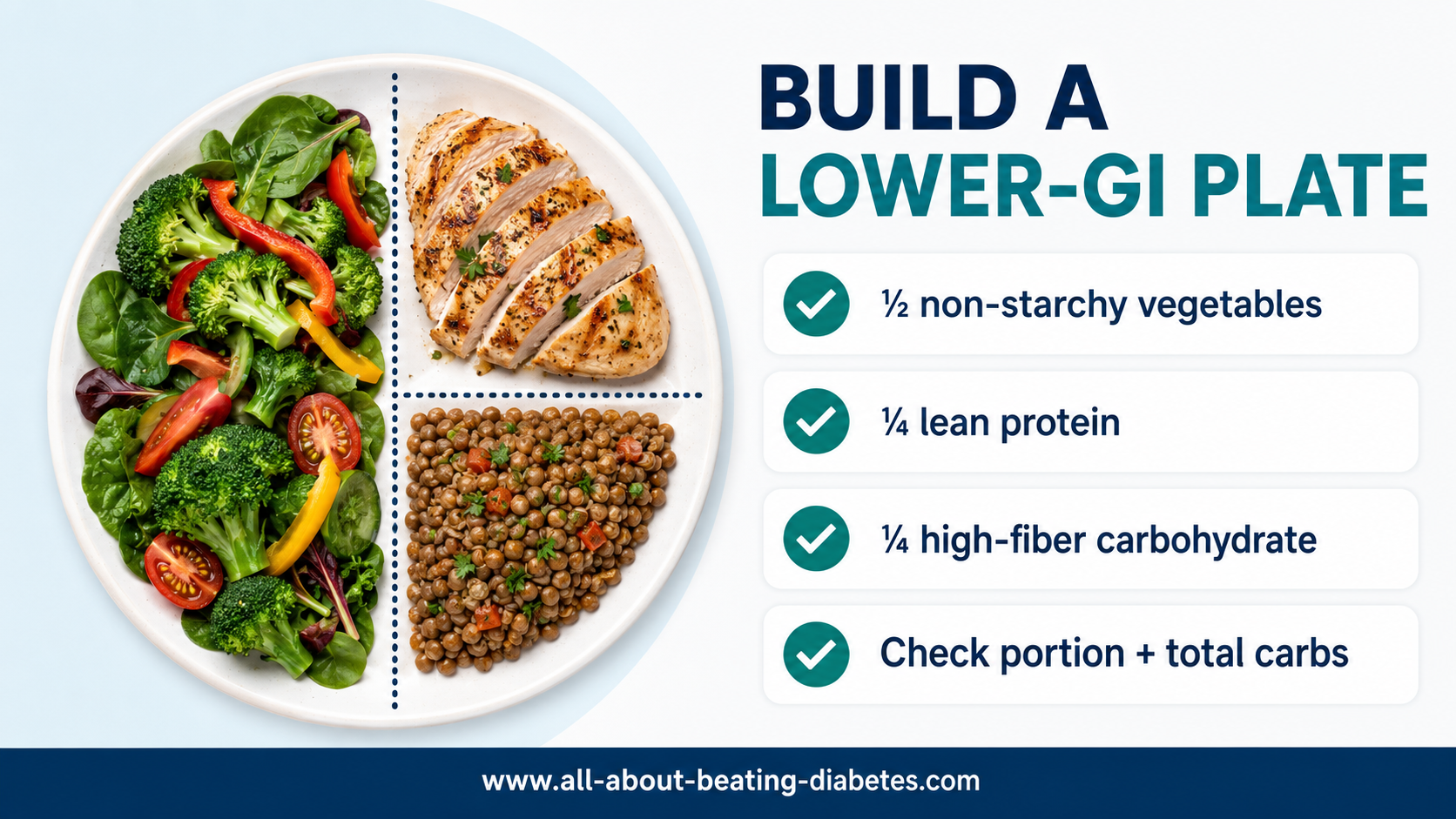

For meal examples, see the diabetes plate method and sample meal plan and the complete low-glycemic diet guide.
How to Check Your Personal Glucose Response
- Choose a realistic, measured portion.
- Record the full meal, not just one ingredient.
- Check glucose before eating if your care plan recommends it.
- Check again at the time recommended for you—often 1–2 hours after the start of the meal.
- Record medicine or insulin timing, activity, stress, illness, and unusual sleep.
- Repeat the comparison before deciding that a food is always safe or unsafe.
A single reading can be misleading. Look for repeated patterns and review them with your healthcare team. My after-meal blood sugar guide explains timing and common targets.
When You Need Individual Guidance
Speak with your doctor or a registered dietitian before making a major dietary change if you:
- use insulin or a sulfonylurea and may develop low blood sugar;
- are pregnant, breastfeeding, or planning pregnancy;
- have chronic kidney disease and need limits on potassium, phosphorus, protein, or fluid;
- have gastroparesis, inflammatory bowel disease, significant constipation, or another digestive condition;
- are a child, teenager, frail older adult, or recovering from illness;
- have an eating disorder or are unintentionally losing weight.
Frequently Asked Questions
Are all vegetables low GI?
Many non-starchy vegetables contain too little available carbohydrate to receive a meaningful GI value. Starchy vegetables such as potatoes, corn, peas, and winter squash contain more carbohydrate and vary by type and preparation. Do not assume that every vegetable has a low GI.
Can I eat unlimited amounts of a low-GI food?
No. GI does not include portion size. A large portion can deliver substantial carbohydrate, calories, sodium, or saturated fat even when the food has a lower GI.
Is whole-wheat bread always low GI?
No. Finely milled whole-wheat bread may be digested quickly. Dense breads containing intact kernels, seeds, or traditional pumpernickel may produce a lower response, but brands and recipes vary.
Are low-GI foods better than carbohydrate counting?
They answer different questions. Carbohydrate counting estimates the amount of carbohydrate, while GI compares its average effect under standardized conditions. Many people benefit from considering both, especially if they use mealtime insulin.
Can a low-GI diet cure diabetes?
No. Lower-GI eating patterns may modestly improve glucose control for some people, but they do not cure diabetes and cannot replace prescribed medication, insulin, monitoring, physical activity, or individualized medical nutrition therapy.
Does adding protein or fat cancel carbohydrate?
No. Protein, fat, and fiber may slow the early rise, but the carbohydrate still counts. High-fat mixed meals can also cause a delayed, prolonged glucose rise, especially in people who use mealtime insulin.
Related Questions
Related Resources
References
- American Diabetes Association: Facilitating Positive Health Behaviors and Well-being—Standards of Care in Diabetes 2026
- National Institute of Diabetes and Digestive and Kidney Diseases: Healthy Living With Diabetes
- American Diabetes Association: How to Read Nutrition Labels
- University of Sydney Glycemic Index Research Service: International GI Database
- Effect of Low-Glycemic Index or Glycemic Load Dietary Patterns on Cardiometabolic Risk Factors in Diabetes: Systematic Review and Meta-analysis
- MedlinePlus: Glycemic Index and Diabetes