Key Medical Takeaways
- Choose from six free tools to understand HbA1c, convert glucose units, estimate meal carbohydrates, and explore weight and diabetes risk factors.
- Calculator results are estimates or conversions. They cannot diagnose diabetes or decide your treatment.
- The insulin tool requires personal settings and safety instructions from your diabetes care team.
Quick Answer
Online diabetes calculators help you make sense of health numbers. Use an HbA1c calculator to estimate average glucose, a converter to change glucose units, or a carb counter to estimate meal carbohydrates. BMI and waist measurements offer additional context, while a risk screener highlights factors to discuss with your doctor. Insulin calculations require your prescribed settings and care plan.
A lab report, food label, or glucose reading can leave you wondering what to do next. I have brought these tools together to help you understand the numbers and prepare useful questions for your diabetes team. Choose the tool that matches your question below.
Choose Your Diabetes Calculator
HbA1c to Average Glucose Calculator
Your question: What does my HbA1c mean in everyday glucose units?
Convert a measured HbA1c percentage into estimated average glucose (eAG). This is an approximate relationship; it does not show daily highs and lows or replace an HbA1c test.
Open the HbA1c to eAG calculatorBlood Sugar Unit Converter
Your question: How do I convert mg/dL to mmol/L, or back again?
Convert a glucose result into the other unit system when comparing a meter reading, lab report, or blood sugar guide. A conversion changes the units, not the meaning of the reading.
Open the blood sugar converterCarb Counter Calculator
Your question: How many grams of carbohydrate are in my meal?
Estimate meal carbohydrates using the foods and portions entered. Actual amounts vary with portion size, recipes, and brands. Check food labels where available, especially when using carbohydrate amounts for insulin dosing.
Open the meal carb counterBMI and Waist-to-Height Calculator
Your question: What can my weight and waist measurements tell me?
Calculate BMI and waist-to-height ratio to discuss weight and central body fat with your clinician. These measurements cannot diagnose insulin resistance or diabetes. BMI also does not distinguish muscle from body fat.
Open the BMI and waist calculatorType 2 Diabetes Risk Screener
Your question: Do I have risk factors worth discussing with my doctor?
For adults without diagnosed diabetes, this custom educational questionnaire reviews common risk factors. It is not a validated clinical score and does not predict your personal probability of developing diabetes.
Open the educational risk screenerInsulin Bolus and Correction Calculator
Your question: How does the calculation in my prescribed mealtime insulin plan work?
For people already prescribed bolus insulin. Use only your care team's carbohydrate ratio, correction factor, glucose target, and active-insulin instructions. Do not guess settings, start insulin, or change your treatment plan using this tool.
Open the insulin calculation guide and tool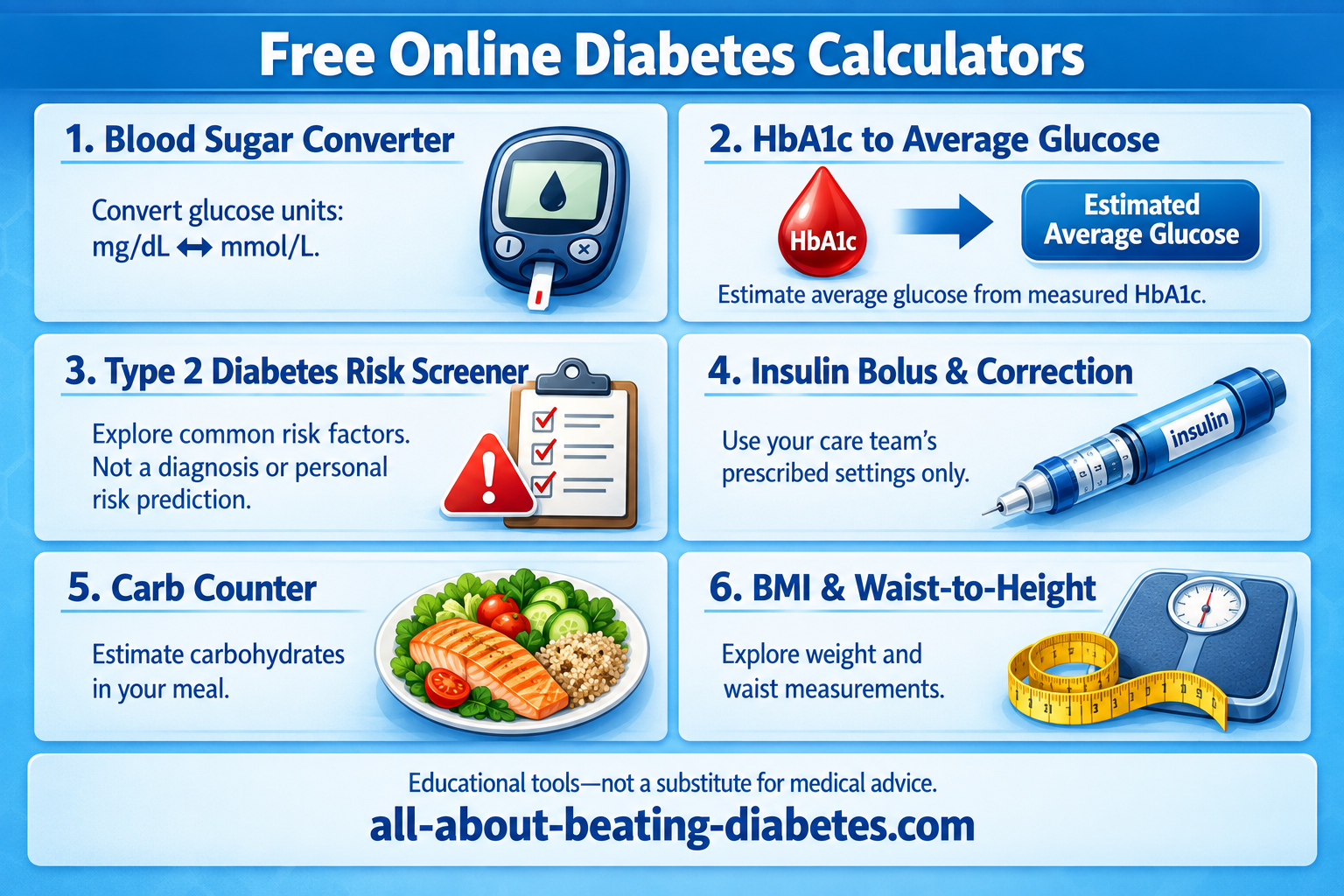

How to Use These Tools
- Read the instructions. Check who the tool is intended for and what information it needs.
- Check every input and unit. Glucose may be in mg/dL or mmol/L; weight and height units also matter.
- Understand the result. A risk category, an estimated average, and a current glucose reading answer different questions.
- Bring questions to your care team. A calculator cannot account for your complete medical history.
If you need help interpreting a blood test rather than converting a number, see our guide to blood glucose test results . If you already have diabetes, your personal treatment targets may differ from diagnostic thresholds.
Frequently Asked Questions
Can an online calculator diagnose diabetes?
No. A questionnaire or calculated value cannot establish a diagnosis. Clinicians use appropriate blood tests and clinical assessment. See our blood tests for diabetes guide and the NIDDK explanation of diabetes testing .
Should I enter mg/dL or mmol/L?
Use the unit shown on your report or glucose meter, and make sure it matches the input label. Check each field separately: a tool may accept more than one unit for current glucose while requiring a specific unit for another setting. Use the glucose converter if needed.
Should I use a lab result or a home glucose reading?
Enter a measured HbA1c result for an HbA1c-to-eAG calculation. For current-glucose calculations, follow the tool's instructions and your care team's monitoring plan. A single finger-stick reading cannot tell you your HbA1c.
Why might estimated average glucose differ from my meter or CGM average?
HbA1c-derived eAG is an estimate, while meter and CGM averages reflect the readings collected over their selected time period. Anemia, altered red-cell lifespan, and some hemoglobin variants can affect HbA1c. Discuss a persistent mismatch with your clinician; the NIDDK A1C guide explains these limitations.
Why do two calculators give different answers?
They may use different equations, inputs, assumptions, or rounding rules. Check those details before comparing results. A difference in an insulin estimate deserves particular attention: do not assume it is harmless or average the doses.
Can I use these calculators every day?
A carb counter or glucose converter can help whenever you need it. Recalculate eAG when you have a new HbA1c result. Insulin calculations must follow your prescribed plan; these tools are not a reason to change your correction factor or carbohydrate ratio each day.
What if a result seems wrong or unexpectedly high?
Check for a typing error, wrong unit, or incorrect portion. If a measured glucose reading remains high, follow your diabetes care plan and seek advice. If an insulin estimate seems wrong, pause and confirm it with your care team before using it.

A Note from Dr. Albana
A number becomes useful when you understand what it measures and what it leaves out. Use these tools to prepare questions and make your next appointment more productive. Your symptoms, medicines, glucose patterns, and personal goals still matter.
Dr. Albana Greca, MD, MMedSc
Family Physician, IDF Fellow
Related Guides
- Diabetes Answers and Tools learning center
- Blood sugar ranges and treatment targets chart
- Understanding insulin resistance
Sources and Further Reading
- NIDDK: The A1C Test & Diabetes — interpretation, eAG, and factors affecting accuracy.
- NIDDK: Diabetes Tests & Diagnosis — why screening tools do not replace diagnostic testing.
- American Diabetes Association: Standards of Care in Diabetes — clinical guidance for individualized diabetes care.
Educational medical notice: These tools and explanations do not replace professional medical advice, diagnosis, treatment, or emergency care. Follow your prescribed plan and consult your healthcare team about medical decisions.