- Home
- Is My Blood Sugar Normal? Blood Sugar Numbers Explained
- Blood Sugar Levels By Time of Day
Blood Sugar Levels by Time of Day
Blood sugar changes throughout the day, so the timing of your test matters. Levels are usually lower before meals and higher after eating. Although general fasting, premeal, and after-meal ranges can help explain your results, your personal targets may differ based on your age, pregnancy, medications, insulin use, risk of low blood sugar, and overall health.
Written by Dr. Albana Greca, MD, MMedSc
Specialist reviewed by Dr. Ruden Cakoni, MD, Endocrinologist
Last reviewed July 2026
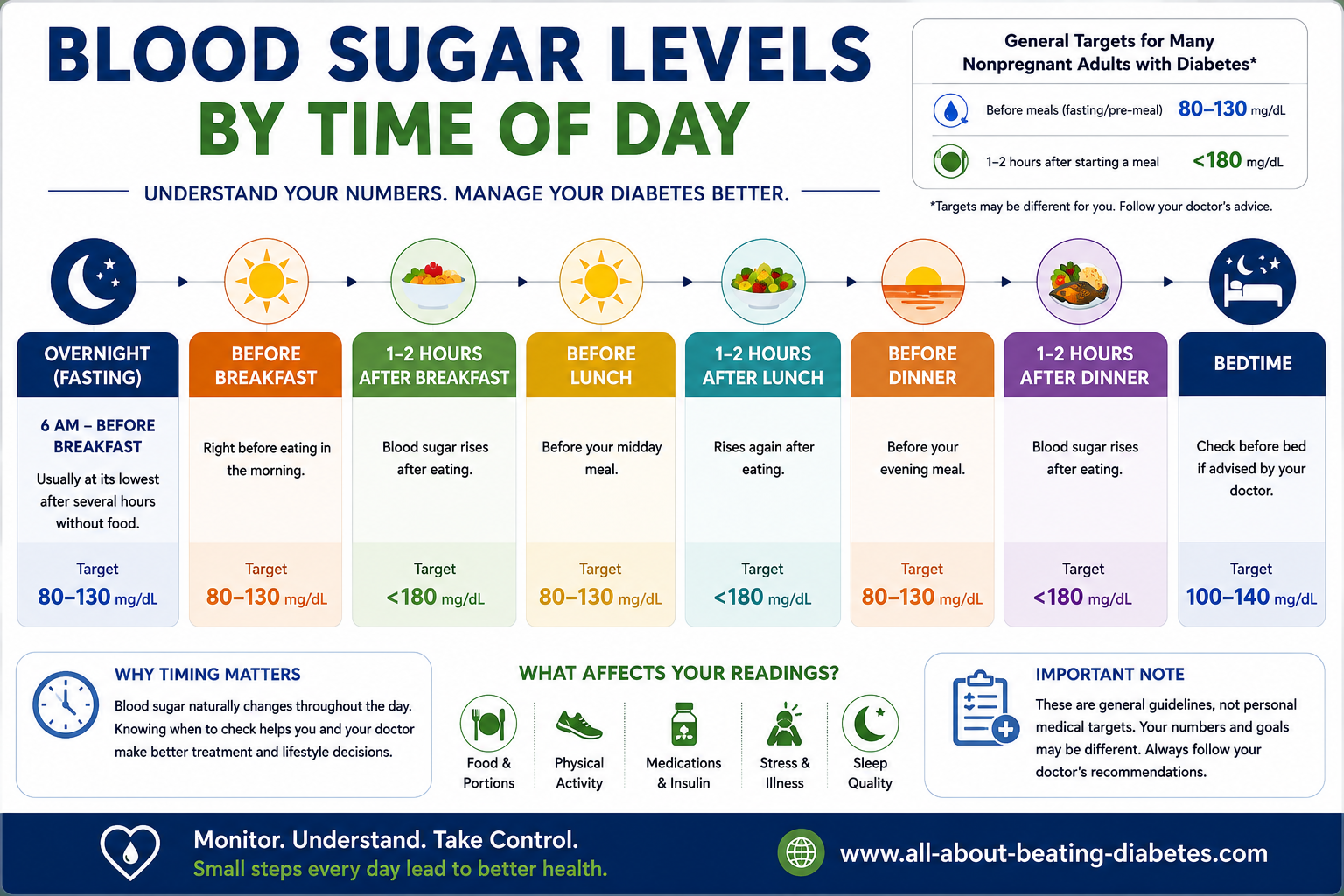

How to Interpret Your Glucose Readings When Fasting, After Meals, and Throughout the Day?
When you check your blood sugar, try not to feel worried or discouraged by one single number. One reading is only a snapshot of what is happening in your body at that moment. What helps us understand your diabetes better is the pattern of your readings over time.
A fasting reading tells us how your blood sugar behaves overnight. A before-meal reading shows your level before food enters the picture. An after-meal reading helps us see how your body responds to the meal, especially carbohydrates, portion size, activity, stress, illness, and medication.
This is why I often encourage patients to write down not only the number, but also the time of the test, what they ate, their medication, symptoms, and physical activity. If your readings are repeatedly above or below your personal target, do not change your treatment by yourself. Share your records with your doctor so your plan can be adjusted safely.
Blood Sugar Levels by Time of Day Chart
Blood sugar levels naturally change during the day. They are often lower before meals and higher after eating, which is why the timing of your test matters. The chart below gives general blood sugar ranges for people without diabetes and common targets for many adults with diabetes, but your personal goal may be different depending on your health, medications, pregnancy status, and risk of low blood sugar.
Blood Sugar Levels by Time of Day Chart
Common blood sugar ranges may vary depending on the time of day, meals, medication, pregnancy, age, and personal medical history.
| Time of Day | People Without Diabetes | Common Target for Many Adults With Diabetes | What It May Mean |
|---|---|---|---|
| Fasting / Before Breakfast |
Usually 70–99 mg/dL 3.9–5.5 mmol/L |
Often 80–130 mg/dL 4.4–7.2 mmol/L |
Shows blood sugar after several hours without food. |
| Before Meals |
Usually under 100 mg/dL Under 5.6 mmol/L |
Often 80–130 mg/dL 4.4–7.2 mmol/L |
Helps understand baseline blood sugar before eating. |
| 1–2 Hours After Meals |
Usually under 140 mg/dL Under 7.8 mmol/L |
Often less than 180 mg/dL Less than 10.0 mmol/L |
Shows how food, portions, and medication affect glucose. |
| Bedtime | May vary by person | Ask your doctor for your personal target | Important for overnight safety, especially if using insulin or medicines that may cause low blood sugar. |
Educational guide from www.all-about-beating-diabetes.com
When Blood Sugar Needs Medical Attention
If your blood sugar readings are sometimes higher or lower than expected, try not to panic from one number alone. What matters most is whether the problem is repeated, whether you have symptoms, and whether you feel unwell. Please call your doctor if your readings are often above or below your personal target, if you are sick, pregnant, using insulin, having medication problems, or unsure what to do next.
Seek urgent medical help if very high blood sugar is accompanied by vomiting, dehydration, confusion, difficulty breathing, severe weakness, fruity-smelling breath, or moderate to high ketones. Also seek urgent care if low blood sugar is severe, does not improve after treatment, or the person becomes confused, very sleepy, has a seizure, or cannot safely swallow. Your safety is more important than trying to manage a serious situation alone at home.
Confused by blood sugar numbers?
Want a simple guide to understand your blood sugar numbers?
Get our free Diabetes Learning Pack and learn blood sugar, HbA1c, food, and daily diabetes care step by step.
Why Timing Matters in Blood Sugar Monitoring
Blood glucose is not a fixed number. It naturally goes up and down during the day depending on many factors, including meals, fasting time, physical activity, stress, hormones, medication, and sleep.
This is why a single reading should not be judged alone. A fasting blood sugar result, a before-meal result, and an after-meal result each give different information.
For example, a blood sugar level of 135 mg/dL may mean different things depending on when it was checked. It may be higher than expected if fasting, but it may be less concerning if checked after a meal.
For people with diabetes, these changes can sometimes be more noticeable. One common example is the dawn phenomenon, where blood sugar rises in the early morning because the body releases hormones that prepare us to wake up and start the day.
These changes do not always mean that something is “wrong.” They are part of how the human body manages glucose.
When we look at a blood sugar reading, we should not judge the number alone. As doctors, we always ask important questions such as:
- When did you last eat?
- How many hours did you fast?
- Did you take diabetes medicine or insulin?
- Were you physically active?
- Are you feeling symptoms such as sweating, shaking, thirst, tiredness, or confusion?
A single glucose number can be misleading if we do not know the timing and the situation around it. That is why blood sugar should always be interpreted together with the person’s symptoms, meals, medication, and daily routine.
Fasting Blood Sugar in the Morning
A fasting blood sugar test is usually taken in the morning or before a meal, after at least 8 hours without food or drinks, except water. Many people check it first thing in the morning before breakfast. This reading helps us understand how well the body is controlling glucose during the night and when no recent food is affecting the result.
In simple terms, fasting blood sugar shows your baseline glucose level.
For most adults without diabetes:
- Less than 100 mg/dL is usually considered normal.
- 100–125 mg/dL may suggest prediabetes, also called impaired fasting glucose.
- 126 mg/dL or higher, when confirmed on two separate tests, is consistent with diabetes.
Fasting blood sugar may be higher in people with prediabetes, diabetes, insulin resistance, poor sleep, stress, illness, or after eating late at night, or because of overnight hormone changes. This is sometimes called the dawn phenomenon.
For people who already have diabetes, fasting targets are different. Many clinicians often aim for a fasting blood sugar range of about 80–130 mg/dL or 4.4–7.2 mmol/L. However, this target should always be personalized. Age, medications, insulin use, other health conditions, and the risk of low blood sugar all matter.
As doctors, we always remind patients not to look at one fasting number in isolation. A single high or low result may be influenced by dinner the night before, stress, poor sleep, illness, missed medication, or the dawn phenomenon.
The most important question is not only, “What is my number?” but also, “Why is this number happening, and is it a pattern?”
Learn more: Normal fasting blood sugar levels and what they may mean.
Blood Sugar Before Meals
Before-meal blood sugar helps show your baseline glucose level before eating again.
For many nonpregnant adults with diabetes, a common before-meal target is often 80–130 mg/dL. However, your personal target may be different.
Before-meal readings can help your healthcare team understand whether your treatment plan, food choices, physical activity, and medications are working well throughout the day.
Blood Sugar After Meals
Blood sugar after eating is called a post-meal or post-prandial glucose reading. This number shows how your body responds to food, especially foods that contain carbohydrates.
After a meal, carbohydrates are broken down into glucose and enter the bloodstream. In a healthy system, insulin helps move this glucose into the cells, keeping the rise under control.
For people living with diabetes, post-meal blood sugar is an important sign of how well meals, medication, insulin timing, and activity are working together.
A common target for many people with diabetes is:
- Less than 180 mg/dL about 1–2 hours after starting a meal
For people without diabetes, typical post-meal values are usually:
- Less than 140 mg/dL about 1–2 hours after eating
Higher readings after meals may happen for several reasons, such as:
- Eating a meal high in carbohydrates
- Not enough insulin or diabetes medication
- Taking medication too late or at the wrong time
- Stress, illness, or infection
- Slow digestion or delayed gastric emptying
As doctors, we always remind patients that one high number after eating does not tell the whole story. It is important to look at the meal, the timing of the test, medication use, symptoms, and whether the same pattern happens often.
The goal is not only to lower a number, but to understand what is causing it and how to manage it safely.
Learn more: Blood sugar levels after eating: what’s normal and what’s high.
Acceptable Blood Glucose Levels by Time of Day
Blood glucose targets are not the same for everyone. There is no single “perfect” number that applies to every person, because blood sugar changes depending on the time of day, meals, medication, activity, and individual health needs.
When we interpret a glucose reading, we first need to ask the following:
- Was this reading taken while fasting?
- Was it taken before a meal?
- Was it taken 1–2 hours after eating?
- Does the person have diabetes, prediabetes, or no diagnosis?
- Has a doctor set a personal target range?
For many people living with diabetes, commonly used blood sugar targets are:
- Fasting or before meals: 80–130 mg/dL
- About 2 hours after meals: less than 180 mg/dL
These ranges are used to help balance three important goals: 1) keeping blood sugar safe, 2) reducing the risk of long-term complications, and 3) maintaining a good quality of life.
As a doctor, I always remind patients that acceptable blood glucose levels should be personalized. Older adults, pregnant women, children, people using insulin, and those at risk for low blood sugar may need different targets.
Explore more ranges on acceptable blood glucose levels by time of day.
Normal Blood Glucose Ranges: Fasting and After Meals
Normal blood glucose levels can vary from person to person. The meaning of a glucose number depends on when it was measured, whether the person has diabetes, and what target range has been recommended by their doctor.
In general, clinical references often use these broad ranges:
Common Blood Sugar Levels and Targets
These ranges are general educational references. Personal blood sugar targets may be different depending on age, pregnancy, medications, diabetes type, risk of low blood sugar, and overall health.
- American Diabetes Association. Diabetes diagnosis and blood glucose targets. diabetes.org
- Mayo Clinic. Diabetes and prediabetes diagnosis: fasting blood sugar levels. mayoclinic.org
Educational guide from www.all-about-beating-diabetes.com
A fasting reading shows how the body manages glucose when no recent food is affecting the result. A post-meal reading shows how the body responds after eating, especially after carbohydrates.
As a doctor, I always remind patients that these numbers are useful guides, but they should not be interpreted alone. Age, medications, insulin use, pregnancy, other medical conditions, and the risk of low blood sugar can change what is considered safe and appropriate.
The best way to understand your glucose control is to look at patterns over time, not just one isolated reading.
See full ranges on Normal blood glucose level ranges when fasting and after meals.
What Do Normal Blood Sugar Levels Look Like for Adults?
“Normal” blood sugar is not exactly the same for every adult. The meaning of a glucose reading depends on when it was checked, whether it was taken before or after eating, and whether the person has diabetes, prediabetes, or another medical condition.
A simple way to understand adult blood sugar levels is to look at two common time points:
- Morning or fasting blood sugar: usually below 100 mg/dL for adults without diabetes; often 80–130 mg/dL as a common target for many adults with diabetes.
- After meals, about 1–2 hours later: usually below 140 mg/dL for adults without diabetes; often less than 180 mg/dL as a common target for many adults with diabetes.
These ranges are commonly used in clinical guidance, but they should not be treated as one fixed rule for everyone. For adults without diabetes, expected values are usually lower. For adults living with diabetes, the target may be slightly higher to reduce the risk of low blood sugar.
As a doctor, I always remind patients that blood sugar goals must be personalized. Age, medications, insulin use, other health conditions, pregnancy, kidney or heart disease, and the risk of hypoglycemia can all affect what is considered safe and appropriate.
The most helpful approach is to look at your numbers as a pattern over time, not as one isolated result.
Learn more: Normal blood sugar levels for adults when fasting and after meals.
How to Interpret a Normal Blood Glucose Reading
A normal blood glucose reading should never be judged as just one number. It must be understood together with when the test was taken, what the person ate, whether medication or insulin was used, and whether any symptoms are present.
For example, a reading may be acceptable 1–2 hours after a meal but may need more attention if it appears after a long fasting period. Stress, illness, poor sleep, physical activity, and the dawn phenomenon can also affect blood sugar results.
As a doctor, I always remind patients to look for patterns, not panic over one isolated reading. If the same type of result happens repeatedly over several days, it gives much more useful information than a single test. Keeping a simple record of fasting readings, post-meal readings, meals, medication timing, and symptoms can help you and your healthcare provider understand what is really happening.
Learn more: Normal blood glucose reading and how to interpret it.
Simple Explanation of “Normal” Blood Sugar
If you are new to checking your blood sugar, it may help to think of glucose as a daily curve, not as one fixed number. Blood sugar is usually lower before eating, rises after meals as food is digested, and should gradually come back toward its usual baseline.
This rise and fall is normal. The body uses insulin to help move glucose from the blood into the cells for energy. What we pay attention to is whether the blood sugar rises too high, stays high for too long, or does not return toward a safer range after eating.
As a doctor, I always remind patients that understanding the pattern is more important than reacting to one number. A single reading gives information, but the curve over the day tells the real story.
Read a simple explanation of normal blood sugar levels.
When Should You Call a Doctor?
Call your doctor if you have repeated high or low readings, symptoms of low blood sugar, symptoms of high blood sugar, illness, medication problems, or uncertainty about your diabetes plan.
Seek urgent medical help if very high blood sugar happens with vomiting, dehydration, confusion, difficulty breathing, severe weakness, or signs of diabetic ketoacidosis.
Key Takeaways for Patients
- Blood sugar targets are different at different times of day.
- A single isolated reading is less useful than a chart of patterns over time.
- Target ranges used by most clinicians balance safety and long-term outcomes.
- Consult your doctor to customize targets for your personal health goals.
Related Blood Sugar Guides
- Normal fasting blood sugar levels
- Blood sugar levels after eating
- Dangerous blood sugar levels
- Is my blood sugar normal?
- HbA1c to average glucose calculator
References
- ADA—Diabetes Diagnosis & Tests
- Checking your Blood Sugar—ADA
- Standards of Care in Diabetes 2026: Glycemic Goals
- Diabetes Diagnosis and Treatment—Mayo
- Diabetes Testing—CDC