- Home
- Insulin Treatment for Type 1 and Type 2 Diabetes
Insulin Treatment for Type 1 and Type 2 Diabetes: Types, Doses, Pumps, and Safety
Insulin is essential for everyone with type 1 diabetes and may also be needed in type 2 diabetes when other treatments are not enough. This guide explains the main insulin types, how doses are individualized, how injections and pumps work, and the safety steps that help prevent low blood sugar and other complications.
Written by Dr. Albana Greca, MD, MMedSc, Family Physician
Medically reviewed by Dr. Ruden Cakoni, MD, Endocrinologist
Last reviewed: July 2026
Quick Answer
Insulin is essential and life-sustaining for everyone with type 1 diabetes. Most people need both background insulin and mealtime insulin, delivered by multiple daily injections or an insulin pump. Continuous glucose monitoring and automated insulin-delivery systems can improve glucose control and reduce treatment burden for suitable users.
People with type 2 diabetes may also need insulin when glucose is very high, symptoms or weight loss are present, during pregnancy or serious illness, or when other medicines are not enough. Insulin is not a sign of failure. The safest plan matches insulin type, dose, meals, activity, glucose patterns, kidney function, and hypoglycemia risk.
Insulin treatment has changed dramatically. Modern human insulin, insulin analogues, pens, pumps, continuous glucose monitors, smart dosing tools, and automated insulin-delivery systems make treatment more precise than it was in the past. However, insulin remains a powerful medicine that requires education, monitoring, correct storage, and a clear plan for low glucose, illness, exercise, and missed doses.
What Does Insulin Do?
Insulin is a hormone made by beta cells in the pancreas. It helps regulate glucose metabolism by allowing glucose to move from the bloodstream into muscle and fat cells and by reducing excess glucose production by the liver. Insulin also influences fat and protein metabolism.
Carbohydrate-containing foods are digested into glucose and other simple sugars. The liver also releases glucose between meals and overnight. Without enough effective insulin, glucose rises in the bloodstream while cells cannot use energy normally.
In type 1 diabetes, autoimmune destruction of pancreatic beta cells causes severe insulin deficiency. Without insulin, the body begins breaking down fat rapidly, producing ketones and creating a risk of diabetic ketoacidosis. Healthy eating, exercise, herbs, or tablets cannot replace insulin in type 1 diabetes.

Who Needs Insulin Treatment?
Type 1 diabetes
Everyone with type 1 diabetes needs insulin to stay alive. Most people use either:
- Multiple daily injections with basal insulin plus mealtime insulin
- An insulin pump delivering rapid-acting insulin continuously
- An automated insulin-delivery system that links a pump with a continuous glucose monitor
Insulin requirements change with meals, activity, stress, illness, hormones, sleep, growth, pregnancy, and many other factors. Treatment therefore requires ongoing adjustment rather than one permanent dose.
Type 2 diabetes
Type 2 diabetes involves insulin resistance and, over time, reduced insulin-producing capacity. Insulin may be used temporarily or long term. It may be appropriate when:
- Glucose is markedly elevated or symptoms are severe
- There is unexplained weight loss, ketosis, or suspected insulin deficiency
- Other medicines do not achieve the individualized goal
- Pregnancy, surgery, hospitalization, infection, steroid treatment, or another illness changes insulin needs
- Kidney or liver disease limits other medication choices
Current treatment does not require every person with type 2 diabetes to “fail” tablets before insulin is considered. At the same time, a GLP-1–based medicine may be preferred before insulin in many adults when severe hyperglycemia or another urgent indication is absent. Review our diabetes medication guide for the roles of metformin, SGLT2 inhibitors, GLP-1 medicines, DPP-4 inhibitors, and insulin.
Pregnancy and other forms of diabetes
Insulin is used for type 1 diabetes during pregnancy and is often the preferred glucose-lowering treatment for type 2 diabetes or gestational diabetes during pregnancy. It may also be needed in pancreatic diabetes, cystic-fibrosis-related diabetes, steroid-induced diabetes, and other insulin-deficient conditions.
A Brief and Accurate History of Insulin
Insulin was discovered in 1921 through work led by Frederick Banting and John Macleod, with major contributions from Charles Best and James Collip. In January 1922, Leonard Thompson became the first person successfully treated with insulin. The 1923 Nobel Prize in Physiology or Medicine was awarded to Banting and Macleod.
Early commercial insulin came from cattle and pigs. The old page incorrectly stated that animal insulin remained the main treatment and was banned by the FDA in 2006. Animal-derived insulin is no longer marketed in the United States, but this was not a general 2006 FDA ban. Modern treatment primarily uses recombinant human insulin and insulin analogues designed to produce different action profiles.
Types of Insulin
Insulins are grouped by how quickly they begin working, when their strongest effect occurs, and how long they last. Exact action varies among people and may change with dose, injection site, temperature, activity, blood flow, and the specific product.
| Category | General Role | Typical Features | Examples |
|---|---|---|---|
| Ultra-rapid or rapid-acting | Meals and corrections | Starts quickly and lasts several hours | Lispro, aspart, glulisine, faster aspart, ultra-rapid lispro |
| Short-acting | Meals and corrections | Slower onset and longer tail than rapid analogues | Regular human insulin |
| Intermediate-acting | Background insulin | Has a noticeable peak and may require once- or twice-daily dosing | NPH insulin |
| Long-acting | Background insulin | Flatter and longer action than NPH | Glargine, detemir |
| Ultra-long-acting | Background insulin | Very long, relatively stable action | Degludec, concentrated glargine |
| Premixed insulin | Combined meal and background coverage | Simplifies injections but offers less flexibility | Human or analogue mixtures |
Do not substitute one insulin for another based only on the category. Concentrations, timing, devices, dose conversions, and meal requirements differ. Follow the prescription and product instructions.
How Insulin Is Delivered
Syringes and insulin pens
Insulin can be injected into subcutaneous fat using a syringe, reusable pen, or disposable pen. Pens may simplify dosing and improve portability. Smart pens and connected caps can record doses and support reminders or dose calculations.
Use the exact insulin concentration and compatible device. U-100, U-200, U-300, and U-500 products are not interchangeable by appearance. Never withdraw concentrated insulin from a pen with a syringe unless the specific product instructions explicitly permit it.
Insulin pumps
A pump delivers rapid-acting insulin continuously through a small cannula or patch. It provides programmable basal delivery and mealtime or correction boluses. Because most pumps do not contain long-acting insulin, interruption can lead to rising glucose and ketones within hours.
Every pump user needs backup insulin, syringes or pen needles, glucose-testing supplies, ketone-testing supplies, and a written plan for pump failure.
Automated insulin-delivery systems
Automated insulin-delivery systems combine a continuous glucose monitor, an insulin pump, and an algorithm that adjusts insulin delivery. They still require user education, infusion-site care, meal announcements in many systems, and action when alerts occur. Current ADA guidance identifies AID as the preferred insulin-delivery approach for people with type 1 diabetes who can use the system safely.
See our guide to home glucose monitoring and CGM for meter accuracy, sensor readings, and pattern review.
Inhaled insulin
Rapid-acting inhaled human insulin is available for selected people. In type 1 diabetes, it must be combined with basal insulin. It is not recommended for treating diabetic ketoacidosis and is contraindicated in chronic lung disease such as asthma or COPD. Lung-function testing is required before use, and it is generally not recommended for people who smoke or recently stopped smoking.
How Insulin Treatment Works in Type 1 Diabetes
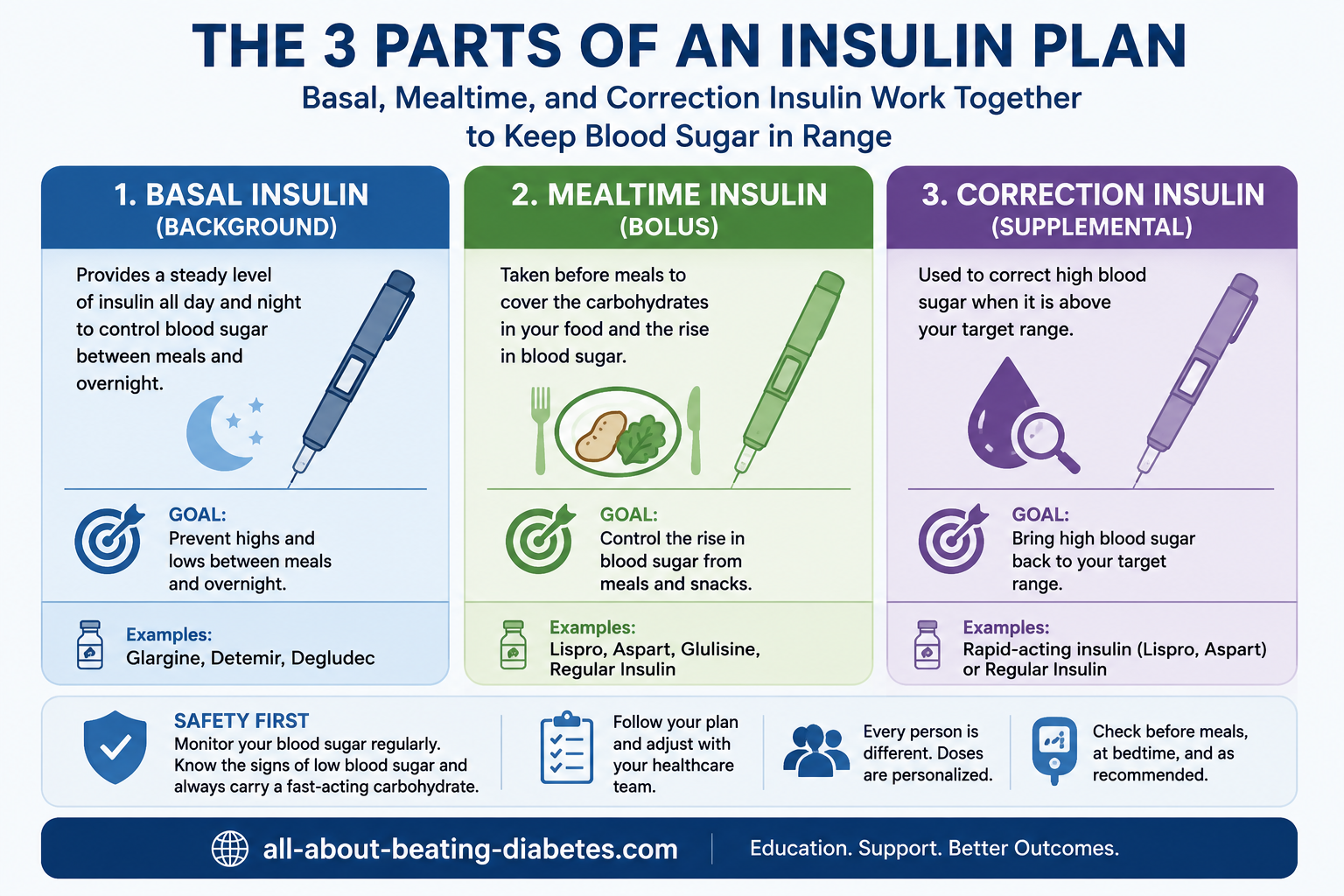
A physiologic type 1 plan attempts to replace the insulin the pancreas would normally provide:
- Basal insulin covers background needs between meals and overnight.
- Mealtime insulin covers carbohydrate and other meal-related glucose effects.
- Correction insulin lowers glucose that is above the individualized target.
People using injections commonly take one or two basal doses plus rapid-acting insulin with meals. Pump and AID users receive continuous rapid-acting insulin with bolus doses for meals and corrections.
Carbohydrate ratio
An insulin-to-carbohydrate ratio estimates how many grams of carbohydrate are covered by one unit of insulin. Ratios may differ by time of day. Protein, fat, meal size, digestion, activity, stress, and illness may also affect the glucose response.
Correction factor
A correction factor estimates how much one unit of insulin is expected to lower glucose. It must be individualized. Repeated correction doses given too close together can create “insulin stacking” and delayed hypoglycemia.
Bolus calculators
A pump, smart pen, or calculator may combine carbohydrate, current glucose, target, correction factor, and active insulin. Use our educational insulin bolus and correction calculator only with ratios and factors prescribed by your diabetes team.
Never guess a first insulin dose from an online calculator. Initial dosing, dose changes, and sick-day corrections require individualized clinical guidance.
How Insulin Is Started in Type 2 Diabetes
When insulin is needed in type 2 diabetes, clinicians often begin with basal insulin while continuing selected noninsulin medicines. The dose is adjusted using fasting-glucose patterns and hypoglycemia risk.
If fasting glucose reaches target but HbA1c remains above goal, the problem may be after-meal glucose rather than insufficient basal insulin. Simply increasing basal insulin can cause overnight or between-meal hypoglycemia. Options may include a GLP-1–based medicine, mealtime insulin, premixed insulin, or another individualized strategy.
Insulin may be started more intensively when glucose is extremely high, catabolic symptoms are present, or insulin deficiency is suspected. Once the acute problem improves, the treatment plan may sometimes be simplified.
People using insulin for type 2 diabetes also benefit from CGM, structured glucose monitoring, injection education, and regular review. Insulin should not be withheld because of stigma or presented as punishment.
Where and How to Inject Insulin
Common injection areas include the abdomen, thighs, buttocks, and back of the upper arms. Insulin should enter subcutaneous fat, not muscle. Absorption may be faster from the abdomen and can increase with heat, massage, or exercise involving the injected limb.
Rotate sites within the same general region rather than injecting repeatedly into one spot. Repeated injections into lumps can cause lipohypertrophy, leading to unpredictable absorption and unexplained highs or lows. Avoid scars, bruises, inflamed skin, wounds, and hardened areas.
Use a new needle when possible, do not share pens or needles, and follow local sharps-disposal rules. A pen must never be shared, even when the needle is changed.
Insulin Safety: Hypoglycemia, High Glucose, and DKA
Low blood glucose
Insulin can cause hypoglycemia, particularly when the dose is too high for the food eaten, activity performed, or current health condition. Symptoms may include shaking, sweating, hunger, palpitations, dizziness, weakness, confusion, visual changes, seizure, or unconsciousness.
If glucose is below 70 mg/dL and the person is awake and able to swallow, take about 15 grams of fast-acting carbohydrate, recheck after 15 minutes, and repeat if still low. Severe hypoglycemia requires ready-to-use glucagon and emergency help. Family, friends, school staff, and coworkers should know where glucagon is kept and how to use it.
Our high- and low-glucose guide explains immediate action thresholds and emergency signs.
High glucose and ketones
High glucose may result from missed insulin, an incorrect dose, illness, spoiled insulin, a blocked pump cannula, leaking tubing, poor absorption, steroids, stress, or underestimated carbohydrate.
People with type 1 diabetes should have a sick-day and ketone-testing plan. Check ketones according to the care plan when glucose is persistently high, during illness, or when symptoms of DKA occur. Never omit basal insulin during illness unless an emergency clinician directs otherwise.
Emergency Warning
Seek urgent medical care for high glucose with moderate or large ketones, repeated vomiting, abdominal pain, deep or rapid breathing, fruity breath, severe dehydration, marked drowsiness, confusion, or inability to keep fluids down.
Call emergency services for unconsciousness, seizure, severe breathing difficulty, chest pain, stroke symptoms, or severe hypoglycemia when the person cannot swallow.
Exercise, Meals, Alcohol, and Insulin
Exercise can lower glucose during activity and for many hours afterward, but intense activity may temporarily raise glucose. Adjustments may involve insulin, carbohydrate, timing, or pump settings. The correct approach depends on glucose, active insulin, type and duration of exercise, and previous responses.
Alcohol can increase delayed hypoglycemia because it reduces the liver’s ability to release glucose. Risk is higher when alcohol is consumed without food or after exercise. Never use alcohol as a glucose-lowering strategy.
Meal timing matters differently for different insulins. Rapid-acting analogues are generally given close to meals, while regular human insulin often requires earlier timing. Follow the exact instructions for the prescribed product.
Insulin During Illness
Illness can raise glucose even when you eat less, while vomiting or diarrhea can also increase hypoglycemia and dehydration risk. A sick-day plan should explain:
- How often to check glucose and ketones
- Which medicines to continue or temporarily hold
- How to maintain fluids and carbohydrate
- When correction insulin is appropriate
- When to contact the diabetes team or seek emergency care
Do not stop basal insulin in type 1 diabetes because you are not eating. Call the care team when you cannot follow the usual plan.
Insulin Storage and Travel
Unopened insulin is generally stored in a refrigerator according to the product label and must not be frozen. In-use insulin may often be kept at controlled room temperature for a product-specific period. Exact limits differ, so read the package instructions.
Discard insulin that has been frozen, overheated, exposed to direct sunlight, or changed in appearance when it should be clear. Do not leave insulin in a parked car. During travel, keep insulin and supplies in carry-on luggage, avoid direct contact with ice packs, carry extra supplies, and bring a prescription or medical letter when appropriate.
Always have backup insulin, needles, meter strips, ketone supplies, glucagon, batteries or chargers, and a written emergency plan. Review our diabetes travel guide before a long trip.
Common Insulin Problems and What They May Mean
| Problem | Possible Explanation | Safe Next Step |
|---|---|---|
| Frequent overnight lows | Basal dose, evening activity, alcohol, delayed digestion, or kidney change | Review CGM or meter patterns promptly with the diabetes team |
| High glucose after meals | Dose timing, carbohydrate estimate, meal composition, or insufficient bolus | Do not repeatedly correct; review meal and active-insulin data |
| Unexpected highs and lows | Injection into lumps, spoiled insulin, pump problem, illness, or dosing error | Inspect sites, insulin, device, and ketones; use the backup plan |
| Weight gain | Reduced glucose loss, excess calories used to treat lows, or overtreatment | Review hypoglycemia, food, activity, and medication options |
| Redness or swelling at the site | Technique, irritation, infection, or rare allergy | Seek care for spreading redness, pus, fever, hives, or breathing symptoms |
Doctor’s Note
Insulin treatment should reproduce normal physiology as safely as possible, not chase every isolated glucose reading. I look for patterns, active insulin, meals, activity, injection sites, kidney function, hypoglycemia, and the person’s daily routine before changing a dose. Technology is valuable, but education and a reliable backup plan remain essential.
Most Asked Questions
Can type 1 diabetes be treated without insulin?
No. People with type 1 diabetes need insulin to survive. Food choices, exercise, and technology support treatment but do not replace insulin.
Does starting insulin mean type 2 diabetes has failed?
No. Type 2 diabetes is progressive for many people, and insulin may be the safest and most effective treatment at different stages. It may also be used temporarily during illness, pregnancy, surgery, or severe hyperglycemia.
Which insulin is best?
There is no single best insulin for everyone. The choice depends on diabetes type, glucose pattern, hypoglycemia risk, schedule, device preference, kidney function, pregnancy, cost, and availability.
Can insulin be taken by mouth?
Standard insulin cannot be swallowed because digestion breaks down the protein. Insulin is mainly injected or delivered by pump. Rapid-acting inhaled insulin is available for selected people but has important lung-related restrictions.
Can insulin cause blindness or kidney failure?
No. Insulin does not cause diabetic eye or kidney disease. Persistently high glucose contributes to these complications. Glucose may change temporarily when treatment improves, so eye symptoms or rapid glucose improvement should be discussed with the clinician.
Can insulin be stopped after glucose improves?
Never stop insulin in type 1 diabetes. Some people with type 2 diabetes may reduce or discontinue insulin after weight loss, recovery from illness, or use of other treatment, but only through supervised adjustment.
Educational safety note: This page does not provide an individual insulin dose. Do not start, stop, substitute, dilute, mix, or adjust insulin without an agreed treatment plan. Product concentrations, devices, and timing instructions differ.
Related Questions
- What Are the Alternatives to Bad Reactions to Insulin?
- Why Is My Blood Sugar Higher After Starting Insulin?
- Why Can’t I Lose Weight While Taking Insulin?
- What Causes Lumps From Insulin Injections?
Related Resources
- Insulin Side Effects and Safety
- Insulin Bolus and Correction Calculator
- Diabetes Home Testing and CGM
- Type 1 Diabetes Information
- Type 2 Diabetes Information
- Diabetes Medical Supplies
References
- American Diabetes Association. Pharmacologic Approaches to Glycemic Treatment: Standards of Care in Diabetes—2026.
- American Diabetes Association. Diabetes Technology: Standards of Care in Diabetes—2026.
- American Diabetes Association. Glycemic Goals, Hypoglycemia, and Hyperglycemic Crises—2026.
- NIDDK. Type 1 Diabetes.
- NIDDK. Insulin, Medicines, and Other Diabetes Treatments.
- U.S. FDA. Inhaled Human Insulin Prescribing Information.
- Nobel Prize. The Discovery and First Clinical Use of Insulin.