- Home
- Diabetes Complications
- Diabetes Back Pain Relief and Symptoms
Diabetes Back Pain Relief & Symptoms
Quick Answer
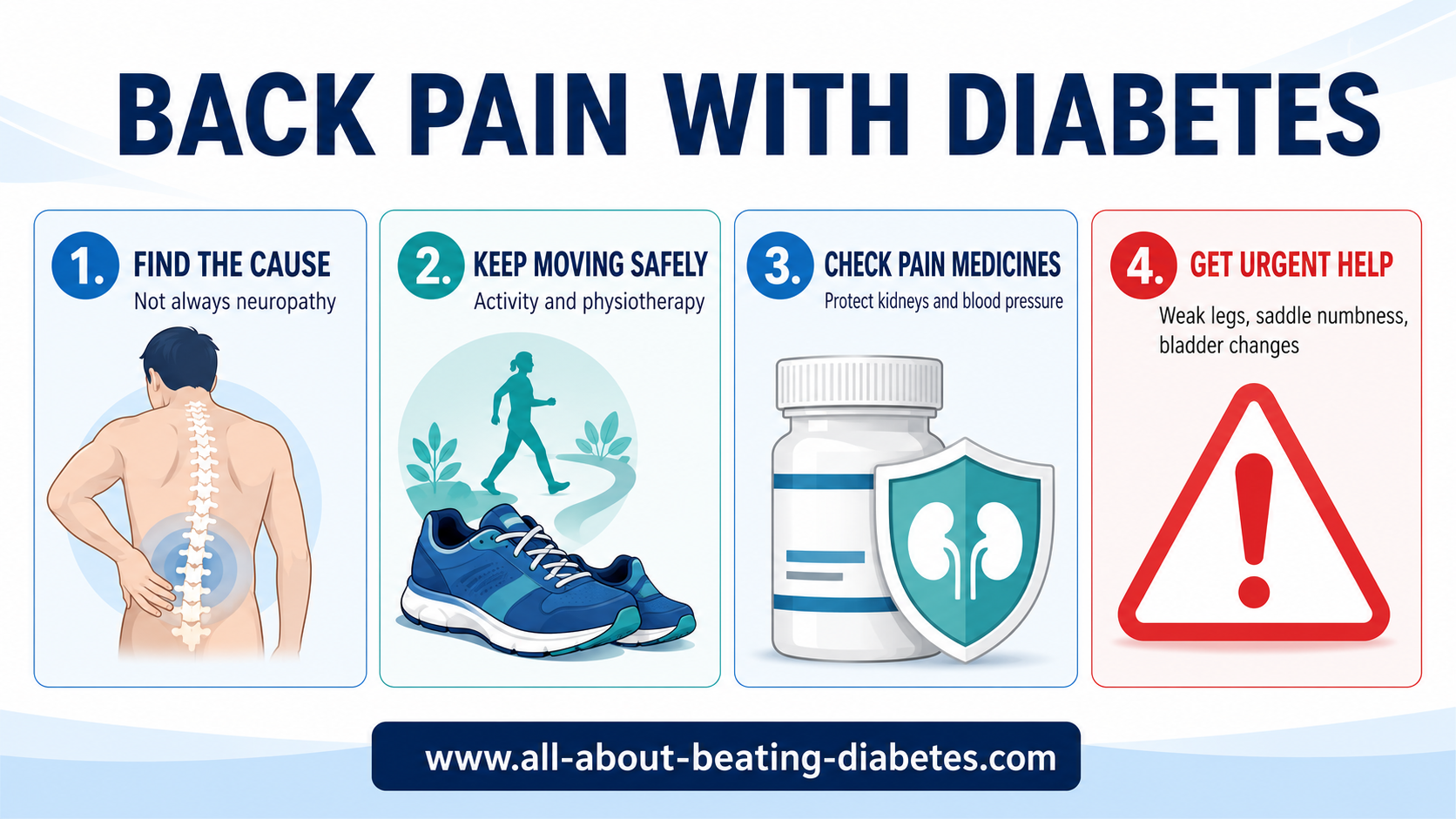
Back pain is common in people with and without diabetes. Diabetes is associated with a modestly higher likelihood of reporting back pain, but research has not proved that diabetes directly causes most cases. Muscle or ligament strain, age-related spinal changes, sciatica, reduced activity, and excess weight are usually more likely explanations than diabetic neuropathy.
For uncomplicated back pain, staying gently active, gradually returning to normal tasks, individualized exercise, and physiotherapy are often more helpful than prolonged bed rest. Pain medicine must be chosen carefully because diabetes often occurs with high blood pressure, heart disease, kidney disease, dehydration risk, or medicines that interact with anti-inflammatory drugs.
Seek emergency care for new weakness or numbness in both legs, numbness around the genitals or anus, loss of bladder or bowel control, or severe back pain with major trauma. Fever, rapidly worsening pain, unexplained weight loss, or feeling seriously unwell also needs prompt assessment.
I want to begin with an important reassurance: having diabetes does not mean every new pain is a diabetes complication. When a patient tells me about back pain, I first identify the pattern, examine strength and sensation, review medicines and kidney health, and look for warning signs. Only then can we choose safe relief.
A Patient With Diabetes, Stiffness, and Back Pain
A 53-year-old man with type 2 diabetes and hypertension for five years developed gradually worsening back pain and stiffness over six months. Bending forward or sideways, sitting cross-legged, stooping, and rising from bed became difficult. Movement eased the stiffness slightly, and he had experienced a similar period of neck stiffness three months earlier.
He reported no significant fall, heavy lifting injury, fever, urinary symptoms, eye inflammation, mouth ulcers, or rash. His BMI was 28.1 kg/m². His fasting glucose was 102 mg/dL, post-meal glucose 159 mg/dL, and A1C 6.5%. His total cholesterol was 230 mg/dL, LDL 157 mg/dL, HDL 41 mg/dL, and triglycerides 154 mg/dL.
His spinal imaging was interpreted in the context of his symptoms as diffuse idiopathic skeletal hyperostosis (DISH). His management included a clinician-guided flexibility and aerobic program, weight and cardiometabolic risk management, lipid-lowering treatment, and a short course of prescribed anti-inflammatory pain relief after individual safety review. At three months, he reported less pain and better mobility, and his LDL had decreased to 98 mg/dL.
What Is the Connection Between Diabetes and Back Pain?
A systematic review found that people with diabetes were more likely to report low back and neck pain than people without diabetes. However, the longitudinal evidence did not establish that diabetes causes future spinal pain. In practical terms, the two conditions often coexist because they share factors such as age, reduced activity, higher body weight, sleep problems, and metabolic disease.
Diabetes may still affect evaluation and treatment in several ways:
- Long-term high glucose can contribute to nerve damage, but typical diabetic peripheral neuropathy begins in both feet and lower legs—not as isolated back pain.
- Diabetes, obesity, hypertension, and metabolic syndrome are associated with DISH.
- Diabetes may increase vulnerability to infection and can complicate healing after injury or surgery.
- Kidney, heart, and vascular complications may limit which pain medicines are safe.
- Pain, poor sleep, stress hormones, and reduced activity can temporarily raise glucose.
My detailed guide to diabetic peripheral neuropathy explains the usual symmetrical foot-and-leg pattern. The ADA emphasizes that diabetic neuropathy is a diagnosis of exclusion, so other treatable causes should still be considered.
Possible Causes and Symptom Patterns
Unexplained weight loss can have many possible causes, and the accompanying symptoms often provide important clues. The table below summarizes common patterns and when further medical evaluation may be needed.
| Possible cause | Typical clues | Why evaluation matters |
|---|---|---|
| Non-specific or mechanical back pain | Ache or stiffness related to movement, posture, lifting, deconditioning, or muscle strain; no major neurologic signs | This is common and often improves with activity, self-management, and an appropriate exercise program. |
| Sciatica or nerve-root irritation | Pain radiating from the back or buttock down one leg, sometimes with tingling, numbness, or weakness | The leg pattern and neurologic examination help distinguish it from peripheral neuropathy. |
| Diabetic peripheral neuropathy | Burning, tingling, electric-shock pain, numbness, or sensitivity that usually starts symmetrically in the toes and feet | Isolated spinal pain is not the usual pattern. Other causes should not be missed. |
| Degenerative spinal changes | Age-related stiffness or pain; possible narrowing, osteoarthritis, or disc changes on imaging | Imaging findings are common even without pain and must match the symptoms and examination. |
| DISH | Spinal stiffness and reduced motion, often involving the thoracic or cervical spine; sometimes found incidentally | Diagnosis requires a characteristic pattern of flowing bony bridges—not an isolated osteophyte alone. |
| Inflammatory spinal disease | Prominent morning or night stiffness, improvement with movement, alternating buttock pain, eye inflammation, psoriasis, or bowel symptoms | A clinician may consider inflammatory markers, imaging, or rheumatology referral. |
| Kidney or urinary problem | Flank pain rather than central spinal pain, fever, painful urination, blood in urine, nausea, or urinary frequency | Early diabetic kidney disease is usually painless. Urinary symptoms need their own assessment. |
| Fracture, infection, or cancer | Major or minor trauma in a high-risk spine, fever, severe night pain, progressive symptoms, unexplained weight loss, cancer history, or immune suppression | These are less common but may need urgent tests and treatment. |

What Is Diffuse Idiopathic Skeletal Hyperostosis?
DISH is a bone-forming condition in which ligaments and tendon attachment sites gradually ossify. In the spine, it usually produces flowing bone along the front and side of several neighboring vertebrae. It is associated with older age, male sex, obesity, diabetes, hypertension, and metabolic syndrome, but its exact cause remains uncertain.
Some people have no symptoms. Others develop back or neck stiffness, reduced spinal movement, or mild-to-moderate pain. Large cervical bone growths can occasionally cause swallowing or breathing difficulty. A spine affected by DISH can also be more vulnerable to unstable fracture, sometimes even after a relatively minor fall.
How is DISH diagnosed?
The classic radiographic criteria include flowing ossification across at least four contiguous vertebrae, relatively preserved disc height, and absence of the sacroiliac erosion and joint ankylosis typical of some inflammatory spinal diseases. Osteophytes alone do not confirm DISH. The imaging pattern must be interpreted with symptoms, examination, and alternative diagnoses.
DISH treatment is individualized. It may include mobility and flexibility work, physiotherapy, management of weight and cardiometabolic risk factors, and carefully selected pain relief. Surgery is not routine but may be necessary for an unstable fracture, spinal-cord compression, or severe swallowing or breathing problems.
Safe Diabetes Back Pain Relief
For most uncomplicated back pain, recovery is supported by a combination of education, movement, and symptom relief rather than one “quick fix.” The World Health Organization recommends person-centered care and usually a combination of approaches for chronic primary low back pain.
- Keep gently active. Continue tolerable walking and normal daily tasks. Prolonged bed rest can increase stiffness and weakness.
- Build activity gradually. Begin below the level that causes a major flare, then increase duration or repetitions slowly.
- Use individualized exercise. A physiotherapist can select mobility, strengthening, balance, aerobic, or mind-body exercises for your symptoms and abilities.
- Adjust aggravating tasks. Break up prolonged sitting, change position regularly, bring loads close to the body, and avoid sudden twisting while lifting.
- Support sleep and recovery. Use a comfortable position and pillow arrangement, maintain a regular sleep schedule, and address stress that amplifies pain.
- Manage glucose and cardiovascular risks. Review blood pressure, cholesterol, weight, smoking, kidney health, and glucose patterns with your care team.
- Choose medicine safely. Ask a clinician or pharmacist to check kidney function, other medicines, and gastrointestinal and cardiovascular risks.
Heat or cold
A wrapped heat or cold pack may provide temporary comfort. If neuropathy has reduced skin sensation, use extra caution: keep the temperature moderate, protect the skin with fabric, limit exposure, check the skin afterward, and never sleep on a heating pad.
Physiotherapy
Physiotherapy can help restore confidence, mobility, strength, and function. The program should match the diagnosis; aggressive manipulation may be unsafe when fracture, osteoporosis, infection, severe neurologic symptoms, or an ankylosed DISH spine is possible.
Pain-medicine safety in diabetes
NSAIDs such as ibuprofen, naproxen, and oral diclofenac can reduce some types of musculoskeletal pain, but they are not appropriate for everyone. NICE recommends the lowest effective dose for the shortest possible time when an NSAID is chosen, after considering gastrointestinal, liver, cardiovascular, and kidney risks.
Ask before using an NSAID if you have kidney disease, albumin in the urine, high blood pressure, heart failure, coronary disease, a previous ulcer or gastrointestinal bleeding, liver disease, dehydration, or if you take a blood thinner, aspirin, diuretic, ACE inhibitor, or ARB. Diabetes itself does not prohibit every NSAID, but it makes the safety review especially important.
Do not copy the medicine doses from the patient story
Naproxen can raise blood pressure, cause stomach bleeding, retain fluid, and reduce kidney blood flow. Atorvastatin treats cholesterol risk; it is not a back-pain medicine. Use only medicines prescribed or approved for your own health conditions, kidney function, and medication list.
Opioids are not recommended for routine chronic low back pain. Gabapentin and pregabalin may be used for selected neuropathic pain conditions, but NICE does not recommend gabapentinoids for ordinary low back pain or sciatica. Steroid tablets and injections may raise glucose and should be used only for a clear indication with a monitoring plan.
Does better glucose control relieve back pain?
Keeping glucose in a safer individualized range supports nerves, healing, energy, and long-term health. It may help prevent progression of diabetic neuropathy, but it is not a direct cure for mechanical back pain, DISH, a herniated disc, or spinal stenosis. Pain treatment and diabetes treatment should work together without promising that one A1C change will remove the pain.
When Are Tests or Imaging Needed?
A clinician will ask about the onset, location, stiffness, leg symptoms, trauma, fever, weight loss, night pain, cancer or infection history, urinary symptoms, medicines, and how pain affects walking and daily activities. The examination may include spinal movement, reflexes, strength, sensation, pulses, hips, abdomen, and feet.
Routine X-rays or MRI are not recommended for every new episode of uncomplicated low back pain because common age-related findings may not explain the pain. Imaging becomes more useful when a serious cause is suspected, neurologic symptoms progress, trauma occurred, DISH or fracture is possible, or the result is likely to change specialist treatment.
Depending on the pattern, tests may include blood count, inflammatory markers, kidney function, urinalysis, calcium or bone evaluation, or other targeted studies. There is no single “back-pain blood test.”
When to Seek Urgent Medical Care
Call emergency services or go to emergency care immediately if back pain occurs with:
- New weakness, numbness, or severe tingling in both legs
- Loss of feeling around the genitals, buttocks, inner thighs, or anus—called saddle numbness
- Difficulty starting urination, inability to urinate, new incontinence, or loss of bowel control
- Sudden inability to walk or rapidly worsening neurologic symptoms
- Major trauma, or even a smaller fall if you have osteoporosis or an ankylosed spine from DISH
Arrange urgent same-day assessment for fever or chills, rapidly worsening severe pain, severe pain with feeling generally unwell, a recent bloodstream infection or spinal procedure, unexplained weight loss, known cancer, immune suppression, or severe pain that is constant and unusual for you. Diabetes is a reported risk factor for rare spinal infection, and fever may be absent—so the full pattern matters.
Doctor’s Note
When a patient with diabetes develops back pain, I do not label it neuropathy without checking the pattern. Neuropathic pain is often burning, tingling, electric-shock-like, or numb and usually starts in the feet. Back stiffness that limits bending may have a musculoskeletal cause, while leg weakness, saddle numbness, or bladder changes need urgent evaluation. I also review kidney function and blood pressure before recommending an anti-inflammatory medicine. The safest plan treats the cause, not only the pain score.
Frequently Asked Questions
Can diabetes directly cause back pain?
Diabetes and back pain commonly coexist, and people with diabetes report back pain somewhat more often. However, research has not established that diabetes directly causes most back pain. The same mechanical, spinal, inflammatory, and medical causes still need consideration.
How can I tell diabetic neuropathy from sciatica?
Typical diabetic peripheral neuropathy usually begins gradually in both feet with burning, tingling, numbness, or electric-shock pain. Sciatica more often starts in the back or buttock and travels down one leg in a nerve-root pattern. An examination is sometimes needed because symptoms can overlap.
Is walking good for back pain with diabetes?
Gentle walking is helpful for many uncomplicated back-pain conditions and supports glucose management. Begin gradually and stop for new weakness, severe radiating pain, dizziness, chest symptoms, or foot injury. Avoid vigorous exercise when you are acutely unwell or have ketones.
Can I take naproxen or ibuprofen?
Possibly, but not without considering kidney function, blood pressure, heart disease, stomach-ulcer or bleeding history, dehydration, and medication interactions. Ask a clinician or pharmacist, use only the approved dose, and avoid prolonged self-treatment.
Does diabetic kidney disease cause back pain?
Early diabetic kidney disease is usually silent and is detected with eGFR and urine albumin testing. Kidney infection or stones may cause flank pain, often with urinary symptoms, nausea, or fever. Do not assume central low back pain is coming from the kidneys.
When does back pain need an MRI?
Most uncomplicated back pain does not need immediate imaging. MRI or other imaging is considered when serious disease is suspected, neurologic deficits progress, symptoms follow significant trauma, an infection or tumor is possible, or imaging is likely to change specialist management.
Related Questions
Related Resources
- Diabetic Peripheral Neuropathy: Early Symptoms and Prevention
- Diabetic Neuropathy Symptoms
- Diabetes Complications and Warning Signs
- Blood Tests for Diabetes
References
- World Health Organization: Guideline for Non-Surgical Management of Chronic Primary Low Back Pain in Adults. 2023.
- NICE: Low Back Pain and Sciatica in Over 16s—Assessment and Management. NG59.
- Pozzobon D, et al. Is There an Association Between Diabetes and Neck and Back Pain? A Systematic Review With Meta-Analyses. PLOS ONE. 2019;14(2):e0212030.
- American Diabetes Association: Retinopathy, Neuropathy, and Foot Care—Standards of Care in Diabetes 2026.
- Kuperus JS, et al. Diffuse Idiopathic Skeletal Hyperostosis: Etiology and Clinical Relevance. Best Practice & Research Clinical Rheumatology. 2020;34(3):101527.
- National Kidney Foundation: Protecting the Kidneys When Using Pain Medicines.
- NHS: Back Pain—Self-Care and Emergency Warning Signs.