Confused by GTT and Insulin Resistance results
by Yolanda
(Klerksdorp, North West, South Africa)
Answer by Dr. Albana Greca, MD, MMedSc
Hello Yolanda,
I want to separate the glucose results from the insulin result because they answer different questions.
Your Oral Glucose Tolerance Test
For a standard nonpregnant 75-gram OGTT:
| Measurement | Your result | Interpretation |
|---|---|---|
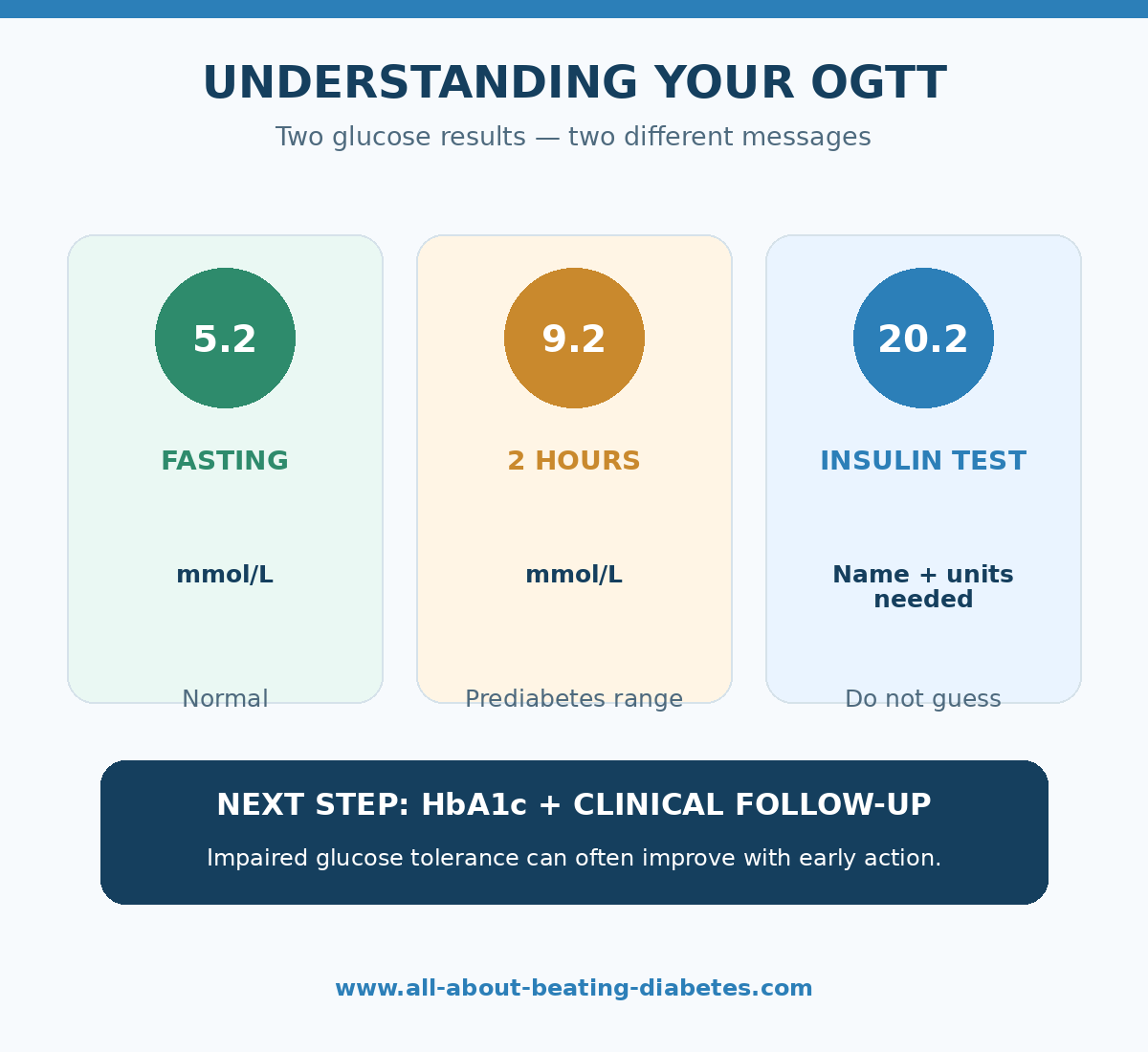
| Fasting plasma glucose | 5.2 mmol/L about 94 mg/dL | Normal fasting range |
| 2-hour glucose after 75 g glucose | 9.2 mmol/L about 166 mg/dL | Impaired glucose tolerance/prediabetes |
The 2-hour categories are:
- Below 7.8 mmol/L (140 mg/dL): normal.
- 7.8–11.0 mmol/L (140–199 mg/dL): impaired glucose tolerance/prediabetes.
- 11.1 mmol/L or higher (200 mg/dL): diabetes range, usually confirmed.
Your fasting result is normal, but the 2-hour result shows reduced glucose tolerance. With normal fasting glucose, this is called isolated impaired glucose tolerance.
This does not diagnose diabetes, but it identifies increased future risk. Read our guide to fasting glucose, HbA1c, and OGTT testing.

What Does “Insulin Resistance 20.2” Mean?
I cannot interpret 20.2 without the laboratory report. There is no single standardized clinical test called simply “insulin resistance.”
The number could represent:
- fasting insulin in µIU/mL or mIU/L;
- HOMA-IR, calculated from fasting glucose and insulin;
- an insulin concentration measured during the OGTT;
- a laboratory-specific score.
If 20.2 is fasting insulin, compare it with the laboratory range and fasting glucose. If it is HOMA-IR, it would usually be unusually high, but cutoffs vary and HOMA-IR is not routinely used alone for diagnosis or treatment. If insulin was measured after the drink, the collection time is essential.
Ask for the full test name, units, collection time, and reference interval. This result does not assess the hypothalamic-pituitary-adrenal axis or prove other endocrine glands are normal.
Could Fasting Too Long Explain the Result?
A standard OGTT requires at least eight hours of fasting and normal eating beforehand. Correct fasting does not make a 2-hour result of 9.2 mmol/L normal. A poorly prepared test may need repeating, but the result should not be dismissed because you fasted.
Tell your clinician about illness, glucose-raising medicines, vomiting, failure to finish the drink, or unusual eating before the test.
What Should You Do Next?
- Obtain a complete copy of the laboratory report, including the insulin test name and units.
- Arrange an HbA1c test, recognizing it may be normal even when the OGTT is abnormal.
- Review weight, blood pressure, lipids, family and pregnancy history, PCOS, sleep apnea, medicines, and activity.
- Ask when testing should be repeated; prediabetes is commonly reassessed at least annually.
- Discuss a structured diabetes-prevention plan rather than waiting for glucose to reach the diabetes range.
See our insulin resistance guide and type 2 diabetes risk calculator.
Reducing the Risk of Type 2 Diabetes
Impaired glucose tolerance may improve with sustained lifestyle changes:
- at least 150 minutes of moderate physical activity weekly;
- resistance exercise two or three times weekly;
- losing about 5%–7% of starting weight when appropriate;
- choosing high-fiber foods and limiting sugary drinks;
- getting adequate sleep and treating sleep apnea;
- not smoking.
Metformin may be considered for selected higher-risk people, but is not automatically required after one abnormal OGTT.
Educational safety note: This is general education and cannot diagnose your condition or interpret an unidentified test. Do not start medication or supplements without your clinician.
Related Questions
- Do Fasting 98 and Two-Hour 142 Mean Prediabetes?
- Is Fasting Glucose 122 mg/dL a Sign of Diabetes?
- Why Can HbA1c and Finger-Prick Readings Disagree?
Related Resources
- Blood Tests for Diabetes and Prediabetes
- What Is Insulin Resistance?
- Normal Blood Sugar Level Chart
- HbA1c Explained
Last reviewed: July 2026
Click here to post comments or follow up
Ask the Doctor now? Simply click here to return to Type 2 diabetes information.